• Wyszukiwanie zaawansowane
  • Kategorie
  • Kategorie BISAC
  • Książki na zamówienie
  • Promocje
  • Granty
  • Książka na prezent
  • Opinie
  • Pomoc
  • Załóż konto
  • Zaloguj się

Statistics for Sensory and Consumer Science » książka


zaloguj się | załóż konto
Logo Krainaksiazek.pl

koszyk

konto

szukaj
topmenu
Księgarnia internetowa
Szukaj
Książki na zamówienie
Promocje
Granty
Książka na prezent
Moje konto
Pomoc
 
 
Wyszukiwanie zaawansowane
Pusty koszyk
Bezpłatna dostawa dla zamówień powyżej 20 złBezpłatna dostawa dla zamówień powyżej 20 zł

Kategorie główne

• Nauka
 [2950560]
• Literatura piękna
 [1849509]

  więcej...
• Turystyka
 [71097]
• Informatyka
 [151150]
• Komiksy
 [35848]
• Encyklopedie
 [23178]
• Dziecięca
 [617388]
• Hobby
 [139064]
• AudioBooki
 [1657]
• Literatura faktu
 [228597]
• Muzyka CD
 [383]
• Słowniki
 [2855]
• Inne
 [445295]
• Kalendarze
 [1464]
• Podręczniki
 [167547]
• Poradniki
 [480102]
• Religia
 [510749]
• Czasopisma
 [516]
• Sport
 [61293]
• Sztuka
 [243352]
• CD, DVD, Video
 [3414]
• Technologie
 [219456]
• Zdrowie
 [101002]
• Książkowe Klimaty
 [124]
• Zabawki
 [2311]
• Puzzle, gry
 [3459]
• Literatura w języku ukraińskim
 [254]
• Art. papiernicze i szkolne
 [8079]
Kategorie szczegółowe BISAC

Statistics for Sensory and Consumer Science

ISBN-13: 9780470518212 / Angielski / Twarda / 2010 / 304 str.
Tormod N's; Per B. Brockhoff; Oliver Tomic
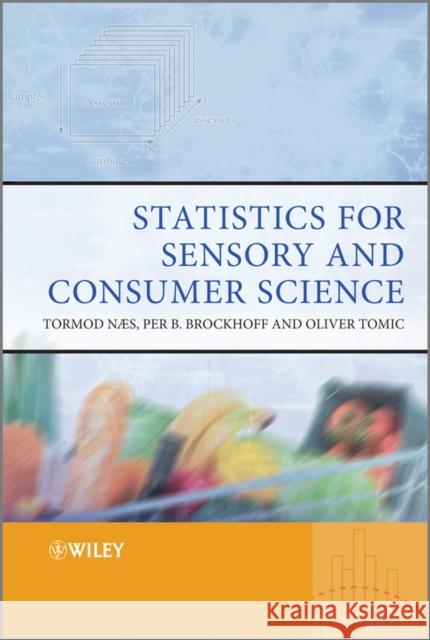
Statistics for Sensory and Consumer Science Tormod N's Per Brockhoff Oliver Tomic 9780470518212 John Wiley & Sons - książkaWidoczna okładka, to zdjęcie poglądowe, a rzeczywista szata graficzna może różnić się od prezentowanej.

Statistics for Sensory and Consumer Science

ISBN-13: 9780470518212 / Angielski / Twarda / 2010 / 304 str.

Tormod N's; Per B. Brockhoff; Oliver Tomic
cena 567,35
(netto: 540,33 VAT:  5%)

Najniższa cena z 30 dni: 563,85
Termin realizacji zamówienia:
ok. 30 dni roboczych
Dostawa w 2026 r.

Darmowa dostawa!

As we move further into the 21st Century, sensory and consumer studies continue to develop, playing an important role in food science and industry. These studies are crucial for understanding the relation between food properties on one side and human liking and buying behaviour on the other. This book by a group of established scientists gives a comprehensive, up-to-date overview of the most common statistical methods for handling data from both trained sensory panels and consumer studies of food. It presents the topic in two distinct sections: problem-orientated (Part I) and method orientated (Part II), making it to appropriate for people at different levels with respect to their statistical skills. This book succesfully:

  • Makes a clear distinction between studies using a trained sensory panel and studies using consumers.
  • Concentrates on experimental studies with focus on how sensory assessors or consumers perceive and assess various product properties.
  • Focuses on relationships between methods and techniques and on considering all of them as special cases of more general statistical methodologies
It is assumed that the reader has a basic knowledge of statistics and the most important data collection methods within sensory and consumer science. This text is aimed at food scientists and food engineers working in research and industry, as well as food science students at master and PhD level. In addition, applied statisticians with special interest in food science will also find relevant information within the book.

Kategorie:
Nauka, Biologia i przyroda
Kategorie BISAC:
Technology & Engineering > Food Science - General
Business & Economics > Marketing - General
Mathematics > Prawdopodobieństwo i statystyka
Wydawca:
John Wiley & Sons
Język:
Angielski
ISBN-13:
9780470518212
Rok wydania:
2010
Ilość stron:
304
Waga:
0.66 kg
Wymiary:
24.92 x 16.81 x 2.21
Oprawa:
Twarda
Wolumenów:
01
Dodatkowe informacje:
Bibliografia
Glosariusz/słownik
Wydanie ilustrowane

"This book provides an up–to–date overview of the most common statistical methods for handling data from both trained sensory panels and consumer studies of food." (Food Science & Technology, 2011)

Preface.

Acknowledgements.

1 Introduction.

1.1 The Distinction between Trained Sensory Panels and Consumer Panels.

1.2 The Need for Statistics in Experimental Planning and Analysis.

1.3 Scales and Data Types.

1.4 Organisation of the Book.

2 Important Data Collection Techniques for Sensory and Consumer Studies.

2.1 Sensory Panel Methodologies.

2.2 Consumer Tests.

PART I PROBLEM DRIVEN.

3 Quality Control of Sensory Profile Data.

3.1 General Introduction.

3.2 Visual Inspection of Raw Data.

3.3 Mixed Model ANOVA for Assessing the Importance of the Sensory Attributes.

3.4 Overall Assessment of Assessor Differences Using All Variables Simultaneously.

3.5 Methods for Detecting Differences in Use of the Scale.

3.6 Comparing the Assessors Ability to Detect Differences between the Products.

3.7 Relations between Individual Assessor Ratings and the Panel Average.

3.8 Individual Line Plots for Detailed Inspection of Assessors.

3.9 Miscellaneous Methods.–

4 Correction Methods and Other Remedies for Improving Sensory Profile Data.

4.1 Introduction.

4.2 Correcting for Different Use of the Scale.

4.3 Computing Improved Panel Averages.

4.4 Pre–processing of Data for Three–Way Analysis.

5 Detecting and Studying Sensory Differences and Similarities between Products.

5.1 Introduction.

5.2 Analysing Sensory Profile Data: Univariate Case.

5.3 Analysing Sensory Profile Data: Multivariate Case.

6 Relating Sensory Data to Other Measurements.

6.1 Introduction.

6.2 Estimating Relations between Consensus Profiles and External Data.

6.3 Estimating Relations between Individual Sensory Profiles and External Data.

7 Discrimination and Similarity Testing.

7.1 Introduction.

7.2 Analysis of Data from Basic Sensory Discrimination Tests.

7.3 Examples of Basic Discrimination Testing.

7.4 Power Calculations in Discrimination Tests.

7.5 Thurstonian Modelling: What Is It Really?

7.6 Similarity versus Difference Testing.

7.7 Replications: What to Do?

7.8 Designed Experiments, Extended Analysis and Other Test Protocols.

8 Investigating Important Factors Influencing Food Acceptance and Choice.

8.1 Introduction.

8.2 Preliminary Analysis of Consumer Data Sets (Raw Data Overview).

8.3 Experimental Designs for Rating Based Consumer Studies.

8.4 Analysis of Categorical Effect Variables.

8.5 Incorporating Additional Information about Consumers.

8.6 Modelling of Factors as Continuous Variables.

8.7 Reliability/Validity Testing for Rating Based Methods.

8.8 Rank Based Methodology.

8.9 Choice Based Conjoint Analysis.

8.10 Market Share Simulation.

9 Preference Mapping for Understanding Relations between Sensory Product Attributes and Consumer Acceptance.

9.1 Introduction.

9.2 External and Internal Preference Mapping.

9.3 Examples of Linear Preference Mapping.

9.4 Ideal Point Preference Mapping.

9.5 Selecting Samples for Preference Mapping.

9.6 Incorporating Additional Consumer Attributes.

9.7 Combining Preference Mapping with Additional Information about the Samples.

10 Segmentation of Consumer Data.

10.1 Introduction.

10.2 Segmentation of Rating Data.

10.3 Relating Segments to Consumer Attributes.

PART II METHOD ORIENTED.

11 Basic Statistics.

11.1 Basic Concepts and Principles.

11.2 Histogram, Frequency and Probability.

11.3 Some Basic Properties of a Distribution (Mean, Variance and Standard Deviation).

11.4 Hypothesis Testing and Confidence Intervals for the Mean .

11.5 Statistical Process Control.

11.6 Relationships between Two or More Variables.

11.7 Simple Linear Regression.

11.8 Binomial Distribution and Tests.

11.9 Contingency Tables and Homogeneity Testing.

12 Design of Experiments for Sensory and Consumer Data.

12.1 Introduction.

12.2 Important Concepts and Distinctions.

12.3 Full Factorial Designs.

12.4 Fractional Factorial Designs: Screening Designs.

12.5 Randomised Blocks and Incomplete Block Designs.

12.6 Split–Plot and Nested Designs.

12.7 Power of Experiments.

13 ANOVA for Sensory and Consumer Data.

13.1 Introduction.

13.2 One–Way ANOVA.

13.3 Single Replicate Two–Way ANOVA.

13.4 Two–Way ANOVA with Randomised Replications.

13.5 Multi–Way ANOVA.

13.6 ANOVA for Fractional Factorial Designs.

13.7 Fixed and Random Effects in ANOVA: Mixed Models.

13.8 Nested and Split–Plot Models.

13.9 Post Hoc Testing.

14 Principal Component Analysis.

14.1 Interpretation of Complex Data Sets by PCA.

14.2 Data Structures for the PCA.

14.3 PCA: Description of the Method.

14.4 Projections and Linear Combinations.

14.5 The Scores and Loadings Plots.

14.6 Correlation Loadings Plot.

14.7 Standardisation.

14.8 Calculations and Missing Values.

14.9 Validation.

14.10 Outlier Diagnostics.

14.11 Tucker–1.

14.12 The Relation between PCA and Factor Analysis (FA).

15 Multiple Regression, Principal Components Regression and Partial Least Squares Regression.

15.1 Introduction.

15.2 Multivariate Linear Regression.

15.3 The Relation between ANOVA and Regression Analysis.

15.4 Linear Regression Used for Estimating Polynomial Models.

15.5 Combining Continuous and Categorical Variables.

15.6 Variable Selection for Multiple Linear Regression.

15.7 Principal Components Regression (PCR).

15.8 Partial Least Squares (PLS) Regression.

15.9 Model Validation: Prediction Performance.

15.10 Model Diagnostics and Outlier Detection.

15.11 Discriminant Analysis.

15.12 Generalised Linear Models, Logistic Regression and Multinomial Regression.

16 Cluster Analysis: Unsupervised Classification.

16.1 Introduction.

16.2 Hierarchical Clustering.

16.3 Partitioning Methods.

16.4 Cluster Analysis for Matrices.

17 Miscellaneous Methodologies.

17.1 Three–Way Analysis of Sensory Data.

17.2 Relating Three–Way Data to Two–Way Data.

17.3 Path Modelling.

17.4 MDS–Multidimensional Scaling.

17.5 Analysing Rank Data.

17.6 The L–PLS Method.

17.7 Missing Value Estimation.

Nomenclature, Symbols and Abbreviations.

Index.

Professor Tormod Naes is a Principal Research Scientist based at Matforsk, a government food research laboratory, in Norway. He received his PhD in statistics from University of Oslo in 1984. He is also currently employed as a Professor at the Institute of Mathematics at the University of Oslo. He serves on the editorial boards of Journal of Chemometrics, Journal of Near Infrared Spectroscopy and Food Quality and Preference.
His main area of research is the development and use of multivariate statistical methods in food science. In particular in applications within the areas of sensory analysis, spectroscopy, process optimisation and bioinformatics. He has published 108 refereed papers and co–authored and co–edited 5 books in multivariate analysis and analysis of variance, including the highly cited "Multivariate Calibration" co–authored with Professor Harald Martens (Wiley 1988). He has received the Tomas Hirschfeld award in NIR analysis. (1997), EAS award for achievements in chemometrics (1997), Kowalski award in Chemometrics (J. Wiley and Sons) (2006) and is an Honorary member of the Chemometric Society of Norway (2006).

As we move further into the 21st Century, sensory and consumer studies continue to develop, playing an important role in food science and industry. These studies are crucial for understanding the relation between food properties on one side and human liking and buying behaviour on the other.

This book by a group of established scientists gives a comprehensive, up–to–date overview of the most common statistical methods for handling data from both trained sensory panels and consumer studies of food.

It presents the topic in two distinct sections: problem–orientated (Part I) and method orientated (Part II), making it to appropriate for people at different levels with respect to their statistical skills.

This book succesfully:

  • Makes a clear distinction between studies using a trained sensory panel and studies using consumers.
  • Concentrates on experimental studies with focus on how sensory assessors or consumers perceive and assess various product properties.
  • Focuses on relationships between methods and techniques and on considering all of them as special cases of more general statistical methodologies


It is assumed that the reader has a basic knowledge of statistics and the most important data collection methods within sensory and consumer science.

This text is aimed at food scientists and food engineers working in research and industry, as well as food science students at master and PhD level. In addition, applied statisticians with special interest in food science will also find relevant information within the book.


Udostępnij

Facebook - konto krainaksiazek.pl


Opinie o Krainaksiazek.pl na Opineo.pl

Partner Mybenefit

Krainaksiazek.pl w programie rzetelna firma Krainaksiaze.pl - płatności przez paypal

Czytaj nas na:

Facebook - krainaksiazek.pl
  • książki na zamówienie
  • granty
  • książka na prezent
  • kontakt
  • pomoc
  • opinie
  • regulamin
  • polityka prywatności

Zobacz:

  • Księgarnia czeska

  • Wydawnictwo Książkowe Klimaty

1997-2025 DolnySlask.com Agencja Internetowa

© 1997-2022 krainaksiazek.pl
     
KONTAKT | REGULAMIN | POLITYKA PRYWATNOŚCI | USTAWIENIA PRYWATNOŚCI
Zobacz: Księgarnia Czeska | Wydawnictwo Książkowe Klimaty | Mapa strony | Lista autorów
KrainaKsiazek.PL - Księgarnia Internetowa

Polityka prywatnosci - link
Krainaksiazek.pl - płatnośc Przelewy24
Przechowalnia Przechowalnia






