Termin realizacji zamówienia: ok. 30 dni roboczych.
Darmowa dostawa!
Unifies existing and emerging concepts concerning multi-objective control and stochastic control with engineering-oriented phenomena
Establishes a unified theoretical framework for control and filtering problems for a class of discrete-time nonlinear stochastic systems with consideration to performance
Includes case studies of several nonlinear stochastic systems
Investigates the phenomena of incomplete information, including missing/degraded measurements, actuator failures and sensor saturations
Considers both time-invariant systems and time-varying systems
Exploits newly developed techniques to handle the emerging mathematical and computational challenges
Widoczna okładka, to zdjęcie poglądowe, a rzeczywista szata graficzna może różnić się od prezentowanej. Nie gwarantujemy zgodności okładki z prezentowanym zdjęciem.
10 Finite–Horizon Filtering with Degraded Measurements 177
10.1 Problem Formulation 178
10.2 Performance Analysis 181
10.2.1 H1 Performance Analysis 181
10.2.2 System Covariance Analysis 186
10.3 Robust Filter Design 187
10.4 Numerical Example 190
10.5 Summary 191
11 Mixed H2=H1 Control with Randomly Occurring Nonlinearities: the Finite–Horizon Case 197
11.1 Problem Formulation 199
11.2 H1 Performance 200
11.3 Mixed H2=H1 Controller Design 204
11.3.1 State–Feedback Controller Design 204
11.3.2 Computational Algorithm 207
11.4 Numerical Example 207
11.5 Summary 211
12 Finite–Horizon H2=H1 Control of MJSs with Sensor Failures 213
12.1 Problem Formulation 214
12.2 H1 Performance 216
12.3 Mixed H2=H1 Controller Design 220
12.3.1 Controller Design 220
12.3.2 Computational Algorithm 224
12.4 Numerical Example 224
12.5 Summary 227
13 Finite–Horizon Control with ROSF 229
13.1 Problem Formulation 230
13.2 H1 And Covariance Performances Analysis 234
13.2.1 H1 Performance 234
13.2.2 Covariance Analysis 238
13.3 Robust Finite–Horizon Controller Design 240
13.3.1 Controller Design 240
13.3.2 Computational Algorithm 243
13.4 Numerical Example 243
13.5 Summary 244
14 Finite–Horizon H2=H1 Control with Actuator Failures 247
14.1 Problem Formulation 248
14.2 H1 Performance 251
14.3 Multi–Objective Controller Design 253
14.3.1 Controller Design 253
14.3.2 Computational Algorithm 256
14.4 Numerical Example 257
14.5 Summary 259
15 Conclusions and Future Topics 261
References 263
Lifeng Ma received the Ph.D. degree in Control Science and Engineering in 2010 from Nanjing University of Science and Technology, Nanjing, China. From August 2008 to February 2009, he was a Visiting Scholar in the Department of Information Systems and Computing, Brunel University, London, UK. From January 2010 to March 2010 and from May 2011 to September 2011, he was a Research Associate in the Department of Mechanical Engineering, the University of Hong Kong. He is now a Lecturer with the School of Automation, Nanjing University of Science and Technology, Nanjing, China. Dr. Ma′s current research interests include nonlinear control and stochastic control. He is a very active reviewer for many international journals.
Zidong Wang is currently Professor of Dynamical Systems and Computing in the Department of Information Systems and Computing, Brunel University, UK. From 1990 to 2002, he held teaching and research appointments in universities in China, Germany and the UK. Prof. Wang′s research interests include dynamical systems, signal processing, bioinformatics, control theory and applications. He has published more than 280 papers in refereed international journals. He is a holder of the Alexander von Humboldt Research Fellowship of Germany, the JSPS Research Fellowship of Japan, William Mong Visiting Research Fellowship of Hong Kong. He serves as the Executive Editor for Systems Science and Control Engineering (Taylor and Francis) and an Associate Editor for 11 international journals including five IEEE Transactions. Prof. Wang is a Fellow of the IEEE, a Fellow of the Royal Statistical Society and a member of the program committee for many international conferences.
Yuming Bo received his BSc degree in Automatic Control in 1984, his MSc degree in Automatic Control in 1987 and PhD degree in Control Theory and Control Engineering in 2005, all from Nanjing University of Science and Technology, Nanjing, China. He is now a Professor of Control Theory and Control Engineering in the School of Automation at Nanjing University of Science and Technology, Nanjing, China. His research interests include stochastic control and estimation, computer communication and programming. He has published more than 20 papers in refereed journals and served as an associate editor for two journals.
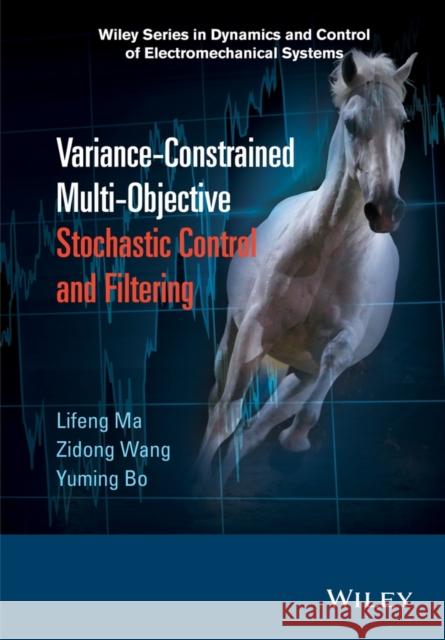
Variance–Constrained Multi–Objective Stochastic Control and Filtering Lifeng Ma – Nanjing University of Science and Technology, China Zidong Wang – Brunel University, UK Yuming Bo – Nanjing University of Science and Technology, China
In engineering practice, it is always desirable to design systems capable of meeting performance requirements such as stability, robustness, and reliability. However nonlinear and stochastic systems are more complex by nature, and with the ever–increasing degree of system complexity, multi–objective design with variance constraints has become a key research area.
Variance–Constrained Multi–Objective Stochastic Control and Filtering covers the latest research results and presents the state–of–the–art of control and filtering problems while taking multiple design objectives into consideration. It examines recent advances in control and filtering in the presence of incomplete information and discusses application potential in engineering practice. The reader will also benefit from the introduction of new concepts, new models and new methodologies with practical significance in control engineering and signal processing.
Key features:
Establishes a unified theoretical framework for control and filtering problems for a class of discrete–time nonlinear stochastic systems with consideration to performance
Includes case studies of several nonlinear stochastic systems
Investigates the phenomena of incomplete information, including missing/degraded measurements, actuator failures and sensor saturations
Considers both time–invariant systems and time–varying systems
Exploits newly developed techniques to handle the emerging mathematical and computational challenges
Variance–Constrained Multi–Objective Stochastic Control and Filtering is a comprehensive reference for engineers dealing with control and filtering problems for nonlinear stochastic systems, and is also suitable as a textbook for senior undergraduate and graduate students in this area.