Termin realizacji zamówienia: ok. 30 dni roboczych.
Darmowa dostawa!
This book addresses an important and current problem with competing solutions.
Widoczna okładka, to zdjęcie poglądowe, a rzeczywista szata graficzna może różnić się od prezentowanej. Nie gwarantujemy zgodności okładki z prezentowanym zdjęciem.
Therefore, I would recommend this book to a broad audience, from advanced undergraduates, to specialists, including probability theoreticians. (Computing Reviews, 16 July 2014)
Preface ix
PART I INTRODUCTION 1
1 Introduction 3
1.1 Risk 4
1.1.1 The concept of risk 4
1.1.2 Describing/measuring risk 6
1.1.3 Examples 6
1.2 Probabilistic risk assessment 8
1.3 Use of risk assessment: The risk management and decision–making context 11
1.4 Treatment of uncertainties in risk assessments 13
1.5 Challenges: Discussion 15
1.5.1 Examples 16
1.5.2 Alternatives to the probability–based approaches to risk and uncertainty assessment 17
1.5.3 The way ahead 19
References Part I 21
PART II METHODS 27
2 Probabilistic approaches for treating uncertainty 29
2.1 Classical probabilities 30
2.2 Frequentist probabilities 31
2.3 Subjective probabilities 35
2.3.1 Betting interpretation 36
2.3.2 Reference to a standard for uncertainty 36
2.4 The Bayesian subjective probability framework 37
2.5 Logical probabilities 39
3 Imprecise probabilities for treating uncertainty 41
4 Possibility theory for treating uncertainty 45
4.1 Basics of possibility theory 45
4.2 Approaches for constructing possibility distributions 49
4.2.1 Building possibility distributions from nested probability intervals 49
4.2.2 Justification for using the triangular possibility distribution 51
4.2.3 Building possibility distributions using Chebyshev s inequality 52
Appendix B Possibility probability transformation 179
Reference 181
Index 183
Terje Aven, University of Stavanger, Norway
Piero Baraldi, Politecnico di Milano, Italy
Roger Flage, University of Stavanger, Norway
Enrico Zio, Politecnico di Milano, Italy
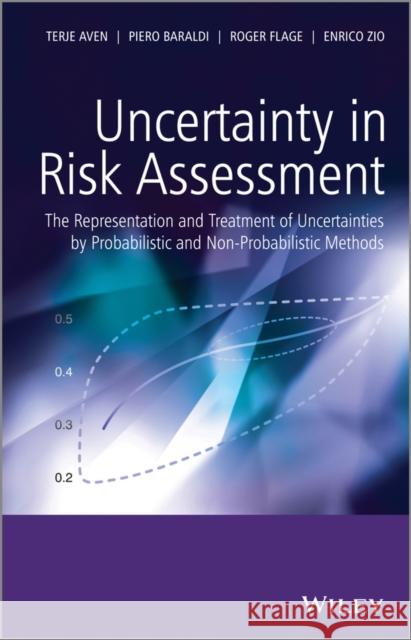
Explores methods for the representation and treatment of uncertainty in risk assessment
In providing guidance for practical decision–making situations concerning high–consequence technologies (e.g., nuclear, oil and gas, transport, etc.), the theories and methods studied in Uncertainty in Risk Assessment have wide–ranging applications from engineering and medicine to environmental impacts and natural disasters, security, and financial risk management. The main focus, however, is on engineering applications.
While requiring some fundamental background in risk assessment, as well as a basic knowledge of probability theory and statistics, Uncertainty in Risk Assessment can be read profitably by a broad audience of professionals in the field, including researchers and graduate students on courses within risk analysis, statistics, engineering, and the physical sciences.
Uncertainty in Risk Assessment:
Illustrates the need for seeing beyond probability to represent uncertainties in risk assessment contexts.
Provides simple explanations (supported by straightforward numerical examples) of the meaning of different types of probabilities, including interval probabilities, and the fundamentals of possibility theory and evidence theory.
Offers guidance on when to use probability and when to use an alternative representation of uncertainty.
Presents and discusses methods for the representation and characterization of uncertainty in risk assessment.
Uses examples to clearly illustrate ideas and concepts.