• Wyszukiwanie zaawansowane
  • Kategorie
  • Kategorie BISAC
  • Książki na zamówienie
  • Promocje
  • Granty
  • Książka na prezent
  • Opinie
  • Pomoc
  • Załóż konto
  • Zaloguj się

symmetry theory in molecular physics with mathematica: a new kind of tutorial book » książka


zaloguj się | załóż konto
Logo Krainaksiazek.pl

koszyk

konto

szukaj
topmenu
Księgarnia internetowa
Szukaj
Książki na zamówienie
Promocje
Granty
Książka na prezent
Moje konto
Pomoc
 
 
Wyszukiwanie zaawansowane
Pusty koszyk
Bezpłatna dostawa dla zamówień powyżej 20 złBezpłatna dostawa dla zamówień powyżej 20 zł

Kategorie główne

• Nauka
 [2946600]
• Literatura piękna
 [1856966]

  więcej...
• Turystyka
 [72221]
• Informatyka
 [151456]
• Komiksy
 [35826]
• Encyklopedie
 [23190]
• Dziecięca
 [619653]
• Hobby
 [140543]
• AudioBooki
 [1577]
• Literatura faktu
 [228355]
• Muzyka CD
 [410]
• Słowniki
 [2874]
• Inne
 [445822]
• Kalendarze
 [1744]
• Podręczniki
 [167141]
• Poradniki
 [482898]
• Religia
 [510455]
• Czasopisma
 [526]
• Sport
 [61590]
• Sztuka
 [243598]
• CD, DVD, Video
 [3423]
• Technologie
 [219201]
• Zdrowie
 [101638]
• Książkowe Klimaty
 [124]
• Zabawki
 [2473]
• Puzzle, gry
 [3898]
• Literatura w języku ukraińskim
 [254]
• Art. papiernicze i szkolne
 [8170]
Kategorie szczegółowe BISAC

symmetry theory in molecular physics with mathematica: a new kind of tutorial book

ISBN-13: 9780387734699 / Angielski / Twarda / 2009 / 689 str.
William Martin McClain
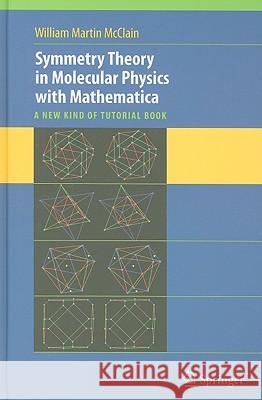
symmetry theory in molecular physics with mathematica: a new kind of tutorial book  McClain, William 9780387734699 Springer - książkaWidoczna okładka, to zdjęcie poglądowe, a rzeczywista szata graficzna może różnić się od prezentowanej.

symmetry theory in molecular physics with mathematica: a new kind of tutorial book

ISBN-13: 9780387734699 / Angielski / Twarda / 2009 / 689 str.

William Martin McClain
cena 363,12 zł
(netto: 345,83 VAT:  5%)

Najniższa cena z 30 dni: 346,96 zł
Termin realizacji zamówienia:
ok. 22 dni roboczych
Bez gwarancji dostawy przed świętami

Darmowa dostawa!
inne wydania

After a few initial chapters on the basics of Mathematica, the logic of the book is controlled by group theory. It continues to teach Mathematica by example as the need arises, so an important use is always at hand for any new operator that is taught. To many science students, this is a greatly preferred way of learning a new computer language.The main part of the book follows a strictly logical development that should be acceptable to the most rigorous minded people, while maintaining an engaging style in the spirit of Numerical Recipes by Press, Flannery, Teukolsky, and Vetterling. The essence of this style is to be just a little opinionated about good and bad ways to calculate things, but to give such advice without provoking offense, and always on an objective basis.After this comes the development of classes and irreducible representations, culminating in a complete proof that for every group the number of classes is equal to the number of representations, so that all character tables must be square. The proof is motivated throughout by numerical constructions that rouse curiosity, and draw the reader into a rediscovery of Schur s Lemmas, which thereby become truly interesting results, rather than the mysterious, dry statements often presented. This section culminates in a method for calculating the entire character table of a group. This is especially important for permutation groups that describe flexible molecules, for which are there very few published character tables. Once the character tables are established, the real meat of physical applications can begin. The author emphasizes that every application has the same structure: (1) The construction of a reducible representation on the basis of some physical property, (2) its separation into irreducible components, and (3) the interpretation in terms of the "symmetry species" so produced. Because Mathematica and the xyz representations are close at hand, the separation into irreducible components can be done quickly."


Kategorie:
Nauka, Fizyka
Kategorie BISAC:
Science > Fizyka atomowa i molekularna
Science > Fizyka matematyczna
Computers > Mathematical & Statistical Software
Wydawca:
Springer
Język:
Angielski
ISBN-13:
9780387734699
Rok wydania:
2009
Wydanie:
2008
Ilość stron:
689
Waga:
1.17 kg
Wymiary:
23.62 x 15.49 x 4.32
Oprawa:
Twarda
Wolumenów:
01
Dodatkowe informacje:
Bibliografia
Wydanie ilustrowane

From the reviews:

"The layout of McClain's book definitely reflects the author's idea of the book, together with multiple examples ... . First of all it is partitioned into three Parts which are further spilt into 48 Chapters and three Appendices. ... Summarizing, it is likely that tutorial book that many students and PhD students of chemistry, atomic and molecular physics are expected to percept the concept of molecular symmetry practically, interactively via Mathematica with molecules and thus to directly apply them in their own research." (Eugene Kryachko, Zentralblatt MATH, Vol. 1187, 2010)

A tutorial on notebooks.- A basic tutorial.- The meaning of symmetry.- Axioms of group theory.- Several kinds of groups.- The fundamental theorem.- The multiplication table.- Molecules.- The point groups.- Euler rotation matrices.- Lie#x2019;s axis-angle rotations.- Recognizing matrices.- to the character table.- The operator MakeGroup.- Product groups.- Naming the point groups.- Tabulated representations of groups.- Visualizing groups.- Subgroups.- Lagrange#x2019;s Theorem.- Classes.- Symmetry and quantum mechanics.- Transformation of functions.- Matrix representations of groups.- Similar representations.- The MakeRep operators.- Reducible representations.- The MakeUnitary operator.- Schur#x2019;s reduction.- Schur#x2019;s First Lemma.- Schur#x2019;s Second Lemma.- The Great Orthogonality.- Character orthogonalities.- Reducible rep analysis.- The regular representation.- Projection operators.- Tabulated bases for representations.- Quantum matrix elements.- Constructing SALCs.- Hybrid orbitals.- Vibration analysis.- Multiple symmetries.- One-photon selection rules.- Two-photon tensor projections.- Three-photon tensor projections.- Class sums and their products.- Make a character table.

W.M. McClain started working with Mathematica as soon as it appeared in 1988, bringing over ten years of nearly daily experience with Mathematica to this book.  He has written many research papers that use Mathematica and has also used group theory throughout his 20-year research career in nonlinear spectroscopy.  He published the first group theoretic analysis of nonlinear tensors in vibronic sprectroscopy, regarded by many as a landmark paper. 

Prof. McClain has indeed produced "a new kind of tutorial book."  It is written using the logic engine Mathematica, which permits concrete exploration and development of every concept involved in Symmetry Theory.  The book may be read in your hand, or on a computer screen with Mathematica running behind it.  It is intended for students of chemistry and molecular physics who need to know mathematical group theory and its applications, either for their own research or for understanding the language and concepts of their field.  The book has three major parts:

Part I begins with the most elementary symmetry concepts, showing how to express them in terms of matrices and permutations.  These are then combined into mathematical groups.  Many chemically important point groups are constructed and kept in a Mathematica package for easy reference.  No other book gives such easy access to the groups themselves.  The automated group construction machinery allows you to tabulate new groups that may be needed in research, such as permutation groups that describe flexible molecules.

In Part II, mathematical group theory is presented with motivating questions and experiments coming first, and theorems that answer those questions coming second.  You learn to make representations of groups based on any set of symmetric objects, and then to make Mathematica operators that carry out rep construction as a single call.  Automated construction of representations is offered by no other book.  Part II follows a reconstructed trail of questions, clues and solid results that led Issai Schur to a complete proof of the Great Orthogonality.

In Part III, the projection operators that flow from the Great Orthogonality are automated and applied to chemical and spectroscopic problems, which are now seen to fall within a unified intellectual framework.  The topics include chemical bonding in symmetric molecules, molecular vibrations and rigorous reasoning about quantum mechanical matrix elements.  As a concrete example of the enormous power of the automated projectors, the tensor operators for two- and three- photon processes are projected under all tabulated groups.  All the machinery presented is general, and will work with new groups that you may construct.  Finally, there is machinery that accepts as input the multiplication table of any group and returns as output its character table.  This will be of great use to spectroscopists who deal with flexible molecules belonging to permutation groups, which are too numerous even for a Mathematica package.

McClain, William Martin W.M. McClain started working with Mathematica as s... więcej >


Udostępnij

Facebook - konto krainaksiazek.pl


Opinie o Krainaksiazek.pl na Opineo.pl

Partner Mybenefit

Krainaksiazek.pl w programie rzetelna firma Krainaksiaze.pl - płatności przez paypal

Czytaj nas na:

Facebook - krainaksiazek.pl
  • książki na zamówienie
  • granty
  • książka na prezent
  • kontakt
  • pomoc
  • opinie
  • regulamin
  • polityka prywatności

Zobacz:

  • Księgarnia czeska

  • Wydawnictwo Książkowe Klimaty

1997-2025 DolnySlask.com Agencja Internetowa

© 1997-2022 krainaksiazek.pl
     
KONTAKT | REGULAMIN | POLITYKA PRYWATNOŚCI | USTAWIENIA PRYWATNOŚCI
Zobacz: Księgarnia Czeska | Wydawnictwo Książkowe Klimaty | Mapa strony | Lista autorów
KrainaKsiazek.PL - Księgarnia Internetowa

Polityka prywatnosci - link
Krainaksiazek.pl - płatnośc Przelewy24
Przechowalnia Przechowalnia





