• Wyszukiwanie zaawansowane
  • Kategorie
  • Kategorie BISAC
  • Książki na zamówienie
  • Promocje
  • Granty
  • Książka na prezent
  • Opinie
  • Pomoc
  • Załóż konto
  • Zaloguj się

quantitative conservation of vertebrates » książka


zaloguj się | załóż konto
Logo Krainaksiazek.pl

koszyk

konto

szukaj
topmenu
Księgarnia internetowa
Szukaj
Książki na zamówienie
Promocje
Granty
Książka na prezent
Moje konto
Pomoc
 
 
Wyszukiwanie zaawansowane
Pusty koszyk
Bezpłatna dostawa dla zamówień powyżej 20 złBezpłatna dostawa dla zamówień powyżej 20 zł

Kategorie główne

• Nauka
 [2946912]
• Literatura piękna
 [1852311]

  więcej...
• Turystyka
 [71421]
• Informatyka
 [150889]
• Komiksy
 [35717]
• Encyklopedie
 [23177]
• Dziecięca
 [617324]
• Hobby
 [138808]
• AudioBooki
 [1671]
• Literatura faktu
 [228371]
• Muzyka CD
 [400]
• Słowniki
 [2841]
• Inne
 [445428]
• Kalendarze
 [1545]
• Podręczniki
 [166819]
• Poradniki
 [480180]
• Religia
 [510412]
• Czasopisma
 [525]
• Sport
 [61271]
• Sztuka
 [242929]
• CD, DVD, Video
 [3371]
• Technologie
 [219258]
• Zdrowie
 [100961]
• Książkowe Klimaty
 [124]
• Zabawki
 [2341]
• Puzzle, gry
 [3766]
• Literatura w języku ukraińskim
 [255]
• Art. papiernicze i szkolne
 [7810]
Kategorie szczegółowe BISAC

quantitative conservation of vertebrates

ISBN-13: 9781405182287 / Angielski / Miękka / 2009 / 352 str.
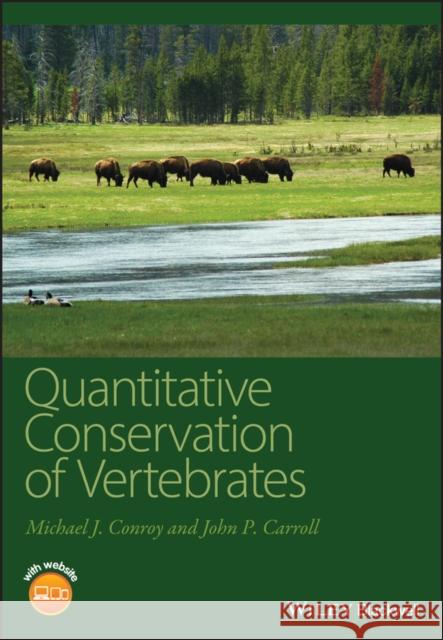
Michael J. Conroy
quantitative conservation of vertebrates  Carroll, John P. 9781405182287 Blackwell Publishers - książkaWidoczna okładka, to zdjęcie poglądowe, a rzeczywista szata graficzna może różnić się od prezentowanej.

quantitative conservation of vertebrates

ISBN-13: 9781405182287 / Angielski / Miękka / 2009 / 352 str.

Michael J. Conroy
cena 336,55
(netto: 320,52 VAT:  5%)

Najniższa cena z 30 dni: 335,16
Termin realizacji zamówienia:
ok. 30 dni roboczych
Bez gwarancji dostawy przed świętami

Darmowa dostawa!

This book provides a hands-on introduction to the construction and application of models to studies of vertebrate distribution, abundance, and habitat. The book is aimed at field biologists, conservation planners, and advanced undergraduate and postgraduate students who are involved with planning and analyzing conservation studies, and applying the results to conservation decisions. The book also acts as a bridge to more advanced and mathematically challenging coverage in the wider literature.
Part I provides a basic background in population and community modeling. It introduces statistical models, and familiarizes the reader with important concepts in the design of monitoring and research programs. These programs provide the essential data that guide conservation decision making. Part II covers the principal methods used to estimate abundance, occupancy, demographic parameters, and community parameters, including occupancy sampling, sample counts, distance sampling, and capture-mark-recapture (for both closed and open populations). Emphasis is placed on practical aspects of designing and implementing field studies, and the proper analysis of data. Part III introduces structured decision making and adaptive management, in which predictive models are used to inform conservation decision makers on appropriate decisions in the face of uncertainty--with the goal of reducing uncertainty through monitoring and research. A detailed case study is used to illustrate each of these themes. Numerous worked examples and accompanying electronic material (on a website - http: //www.blackwellpublishing.com/conroy - and accompanying CD) provide the details of model construction and application, and data analysis.


Kategorie:
Nauka, Biologia i przyroda
Kategorie BISAC:
Science > Life Sciences - Ecology
Science > Life Sciences - Biological Diversity
Science > Zoologia i nauki o zwierzętach
Wydawca:
Blackwell Publishers
Język:
Angielski
ISBN-13:
9781405182287
Rok wydania:
2009
Ilość stron:
352
Waga:
0.77 kg
Wymiary:
24.38 x 16.76 x 2.03
Oprawa:
Miękka
Wolumenów:
01
Dodatkowe informacje:
Bibliografia
Glosariusz/słownik

"Overall, this would be a plausible book for an upper–division course in which students would learn, rather painlessly, the necessary combination of observation and mathematics necessary to make important conservation decisions." ( CHOICE, December 2009)

Preface vii

Acknowledgements ix

Companion website and CD–ROM x

1 Introduction: the role of science in conservation 1

Part I Basic concepts in scientific investigations for conservation 7

2 Using models in conservation biology 9

3 Models of population dynamics 15

4 Applying population models to conservation 32

5 Basics of study design and analysis 47

Part II Conservation studies and monitoring programs 71

6 General principles of estimation 73

7 Occupancy (presence absence) analysis 81

8 Sample counts for abundance estimation 101

9 Distance sampling for estimating density and abundance 115

10 Capture mark recapture studies for estimating abundance and density 135

11 Estimation of survival from radiotelemetry, nesting success studies, and age distributions 160

12 Mark recapture for estimating survival, recruitment, abundance, and movement rates 189

13 Analysis of habitat 219

14 Estimation of species richness and other community parameters 230

Part III Integrating modeling and monitoring for conservation 251

15 Elements of conservation decision making 253

16 Accounting for uncertainty in conservation decisions 265

17 Learning and adaptive management 274

18 Case study: decision modeling and adaptive management for declining grassland birds in the southeastern USA 289

19 Summary and recommendations 303

Literature cited 307

Glossary 314

Appendix A: Statistical and modeling programs available on the worldwide web 324

Appendix B: Other internet resources 326

Appendix C: Modeling and statistical notation 328

Appendix D: Key to abundance and parameter estimation 331

Index 337

Dr Michael J. Conroy has nearly 30 years of experience in developing sampling approaches, statistical estimation methods, and modeling for a wide variety of natural resource management problems. He is the author of numerous publications in applied quantitative approaches, and is coauthor on the widely acclaimed volume by Williams et al. (2002). He is currently Adjunct Professor of Wildlife Ecology and Management at the University of Georgia, and Assistant Unit Leader of the Georgia Cooperative Fish and Wildlife Research Unit. He is literate in Spanish and has taught short courses on quantitative methods in the US, Spain, India, Ecuador, Costa Rica, and Argentina.

Dr John P. Carroll has been researching conservation issues relative to the Galliformes for more than 20 years. He is Chair of the World Pheasant Association/BirdLife/IUCN Species Survival Commission Partridge, Quail, and Francolin Specialist Group. He is author of numerous publications on the biology and conservation of Galliformes and the effects of agricultural practices on wildlife. He is currently Professor of Wildlife Ecology and Management in the Warnell School of Forestry and Natural Resources at the University of Georgia. He has taught short courses on field research methods and techniques in Malaysia, Nepal, and India.

This book provides a hands–on introduction to the construction and application of models to studies of vertebrate distribution, abundance, and habitat. The book is aimed at field biologists, conservation planners, and advanced undergraduate and postgraduate students who are involved with planning and analyzing conservation studies, and applying the results to conservation decisions. The book also acts as a bridge to more advanced and mathematically challenging coverage in the wider literature.

Part I provides a basic background in population and community modeling. It introduces statistical models, and familiarizes the reader with important concepts in the design of monitoring and research programs. These programs provide the essential data that guide conservation decision making. Part II covers the principal methods used to estimate abundance, occupancy, demographic parameters, and community parameters, including occupancy sampling, sample counts, distance sampling, and capture–mark–recapture (for both closed and open populations). Emphasis is placed on practical aspects of designing and implementing field studies, and the proper analysis of data. Part III introduces structured decision making and adaptive management, in which predictive models are used to inform conservation decision makers on appropriate decisions in the face of uncertainty with the goal of reducing uncertainty through monitoring and research. A detailed case study is used to illustrate each of these themes.

Numerous worked examples and accompanying electronic material (on a website and accompanying CD) provide the details of model construction and application, and data analysis.




Udostępnij

Facebook - konto krainaksiazek.pl


Opinie o Krainaksiazek.pl na Opineo.pl

Partner Mybenefit

Krainaksiazek.pl w programie rzetelna firma Krainaksiaze.pl - płatności przez paypal

Czytaj nas na:

Facebook - krainaksiazek.pl
  • książki na zamówienie
  • granty
  • książka na prezent
  • kontakt
  • pomoc
  • opinie
  • regulamin
  • polityka prywatności

Zobacz:

  • Księgarnia czeska

  • Wydawnictwo Książkowe Klimaty

1997-2025 DolnySlask.com Agencja Internetowa

© 1997-2022 krainaksiazek.pl
     
KONTAKT | REGULAMIN | POLITYKA PRYWATNOŚCI | USTAWIENIA PRYWATNOŚCI
Zobacz: Księgarnia Czeska | Wydawnictwo Książkowe Klimaty | Mapa strony | Lista autorów
KrainaKsiazek.PL - Księgarnia Internetowa

Polityka prywatnosci - link
Krainaksiazek.pl - płatnośc Przelewy24
Przechowalnia Przechowalnia



