• Wyszukiwanie zaawansowane
  • Kategorie
  • Kategorie BISAC
  • Książki na zamówienie
  • Promocje
  • Granty
  • Książka na prezent
  • Opinie
  • Pomoc
  • Załóż konto
  • Zaloguj się

Practical Software Reuse » książka


zaloguj się | załóż konto
Logo Krainaksiazek.pl

koszyk

konto

szukaj
topmenu
Księgarnia internetowa
Szukaj
Książki na zamówienie
Promocje
Granty
Książka na prezent
Moje konto
Pomoc
 
 
Wyszukiwanie zaawansowane
Pusty koszyk
Bezpłatna dostawa dla zamówień powyżej 40 złBezpłatna dostawa dla zamówień powyżej 40 zł

Kategorie główne

• Nauka
 [3096608]
• Literatura piękna
 [1811851]

  więcej...
• Turystyka
 [52420]
• Informatyka
 [156381]
• Komiksy
 [36668]
• Encyklopedie
 [23065]
• Dziecięca
 [611771]
• Hobby
 [103434]
• AudioBooki
 [1747]
• Literatura faktu
 [194995]
• Muzyka CD
 [406]
• Słowniki
 [3005]
• Inne
 [447054]
• Kalendarze
 [243]
• Podręczniki
 [166293]
• Poradniki
 [420077]
• Religia
 [508460]
• Czasopisma
 [551]
• Sport
 [61144]
• Sztuka
 [249742]
• CD, DVD, Video
 [3441]
• Technologie
 [231132]
• Zdrowie
 [98236]
• Książkowe Klimaty
 [126]
• Zabawki
 [2530]
• Puzzle, gry
 [3999]
• Literatura w języku ukraińskim
 [273]
• Art. papiernicze i szkolne
 [8463]
Kategorie szczegółowe BISAC

Practical Software Reuse

ISBN-13: 9781852335021 / Angielski / Miękka / 2002 / 222 str.
Michel Ezran; M. Ezran; M. Morisio
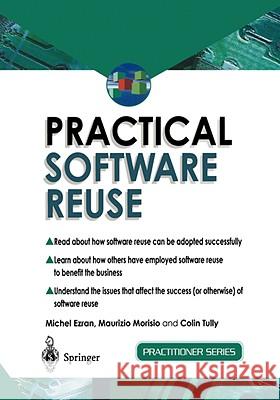
Practical Software Reuse Michel Ezran M. Ezran M. Morisio 9781852335021 Springer - książkaWidoczna okładka, to zdjęcie poglądowe, a rzeczywista szata graficzna może różnić się od prezentowanej.

Practical Software Reuse

ISBN-13: 9781852335021 / Angielski / Miękka / 2002 / 222 str.

Michel Ezran; M. Ezran; M. Morisio
cena 202,19
(netto: 192,56 VAT:  5%)

Najniższa cena z 30 dni: 192,74
Termin realizacji zamówienia:
ok. 16-18 dni roboczych.

Darmowa dostawa!

Right context, software reuse promises high value to businesses that develop software, opening the door to radical improvements in their software capability (productivity, cost, time to market). Attempts to adopt reuse without a sound understanding of the range of issues involved, however, can lead to expensive failure. This book is for those who are wondering whether they should adopt reuse and how, and also to those who have already started to adopt it but are wondering where they may be going wrong and how they could do better. It consistently emphasizes the practical issues that influence success or failure in reuse; and it offers a concise and balanced coverage of the essentials of the subject, rather than going into undue depth or detail on some topics at the expense of others. It occupies the central ground between being on the one hand an academic textbook and on the other hand a cookbook with ready-made recipes for exactly "how to do it." The authors have drawn on their extensive experience of reuse and of software process improvement to provide a readable and balanced coverage of the subject. This book is suitable for business executives, software managers and software developers, regardless of whatever kind of software or applications are developed by their organisations, and whatever the size of those organisations. A special feature of the book is the frequent use of experience notes, drawn from the real-life experience of organisations that have embarked on the reuse adventure.


Kategorie:
Informatyka, Bazy danych
Kategorie BISAC:
Computers > Software Development & Engineering - General
Computers > Languages - General
Computers > Computer Science
Wydawca:
Springer
Język:
Angielski
ISBN-13:
9781852335021
Rok wydania:
2002
Wydanie:
Softcover Repri
Numer serii:
000308047
Ilość stron:
222
Waga:
0.55 kg
Wymiary:
24.79 x 19.56 x 1.57
Oprawa:
Miękka
Wolumenów:
01
Dodatkowe informacje:
Bibliografia
Wydanie ilustrowane

From the reviews:

"This book explains how reuse is a systematic software development practice which goes beyond code to include all stages, from requirements capture right through to maintenance. ... In a very readable 218 pages and 10 chapters the authors present a well structured and well presented view of the essentials. The balanced and broad coverage leaves a clear picture of the issues. ... It is suitable for developers or managers in any size of organization, and good value for money." (Hilary Green, Computer Bulletin, November, 2002)

1. Introducing Software Reuse.- 1.1 First of All.- 1.2 Definition and Basic Essentials.- 1.2.1 Reuse Is a Systematic Software Development Practice.- 1.2.2 Reuse Employs a Stock of Building Blocks.- 1.2.3 Reuse Expoits Similarities in Requirements and/or Architecture Between Applications.- 1.2.4 Reuse Offers Substantial Benefits in Productivity, Quality and Business Performance.- 1.3 Some Further Introductory Essentials.- 1.3.1 There Are Various Routes by Which Assets Achieve Reuse.- 1.3.2 There Is an Important Relationship Between Reuse and Software Process Maturity.- 1.3.3 Reuse Is an Investment, Whether or Not You Call It That.- 1.3.4 Reuse May Be Pursued Within the Wider Business Context of Product Line Practice.- 1.4 Systematic Reuse — Crossing Frontiers.- 1.4.1 Systematic Reuse as a Critical Transition.- 1.4.2 Why So Long?.- 1.5 A Note on the Experience Base Used in This Book.- 2. Reusable Software Assets.- 2.1 What Is a Software Asset?.- 2.1.1 A Software Asset Is a Software Product.- 2.1.2 What Kind of Asset?.- 2.1.3 Asset Granularity.- 2.1.4 What Is an Asset Made of? The Asset Model.- 2.1.5 Technical Strategies.- 2.2 What Are the Characteristics of Reusable Assets?.- 2.2.1 General Criteria: Quality and Reusability.- 2.2.2 Functional Criteria.- 2.2.3 Technical Criteria.- 2.3 Managing Software Assets.- 2.3.1 Asset Life Circle.- 2.3.2 Organizing Asset Acquisition.- 2.3.3 Make or Buy?.- 2.4 Assets vs Objects.- 2.4.1 OO Is Neither Necessary Nor Sufficient.- 2.4.2 OO Is an ‘Enabling’ Factor.- 2.4.3 What About Business Objects?.- 3. Reuse Repository.- 3.1 Who Needs a Repository?.- 3.2 Requirements for a Reuse Repository.- 3.2.1 What Is Stored Inside a Repository?.- 3.2.2 Functions of a Repository.- 3.2.3 Non-Functional Requirements.- 3.3 Repositories on the Internet.- 3.4 Tool Categories on the Market.- 3.4.1 Reuse-Specific.- 3.4.2 Repositories.- 3.4.3 Intranet and Groupware Tools.- 3.5 Key Points in the Choice of an Asset Repository.- 4. Reuse Processes.- 4.1 What Processes Do We Need?.- 4.1.1 What Is a Process?.- 4.1.2 Why Are Reuse Processes Necessary?.- 4.1.3 Extending Reuse Boundaries.- 4.1.4 The Producer-Consumer Paradigm.- 4.1.5 Different Ways of Practising Reuse.- 4.1.6 An Overview of Reuse Processes.- 4.1.7 Who Does What?.- 4.2 Starting a Corporate Reuse Programme: The Reuse Introduction Process.- 4.2.1 Should I Go for Reuse?.- 4.2.2 The Software Productivity Consortium Reuse Adoption Process.- 4.3 Practising Reuse: Asset Production and Application Production Processes.- 4.3.1 The REBOOT Process Model.- 4.3.2 Jacobson, Griss and Jonsson Process Model.- 4.3.3 Should I Practise Domain Engineering?.- 4.3.4 Processes in the Field.- 4.3.5 Qualifying and Evaluating Assets.- 4.3.6 Managing Risks When Reusing.- 4.3.7 Advertising Assets.- 4.3.8 Communicating About Reuse.- 4.3.9 Maintaining Assets.- 4.3.10 Managing and Improving Reuse Efficiency.- 4.4 A Summarized Vision on Processes: How Does Reuse Affect Traditional Software Processes?.- 5. Managing Reuse.- 5.1 The Management Issues.- 5.2 To Reuse or Not To Reuse? ­ the Big Question.- 5.3 Reuse for All, and All for Reuse.- 5.4 Adapting the Work Structure.- 5.4.1 Conditioning Factors.- 5.4.2 Key Decisions.- 5.4.3 Final Comments on Work Structure.- 6. Reuse Metrics.- 6.1 General Aspects of a Metrics Programme.- 6.2 A Typical Reuse Metrics Programme.- 6.2.1 Gl.- 6.2.2 G2.- 6.2.3 G3.- 6.2.4 G4.- 6.2.5 G5.- 6.2.6 G6.- 6.2.7 What To Count as Reused?.- 7. Reuse Techniques and Technologies.- 7.1 Rationale.- 7.2 Reuse-Enabling Architectures.- 7.2.1 Three-Tier Architecture.- 7.2.2 Multi-Layered, Web-Enabled Architecture.- 7.2.3 Internet Systems Architectures.- 7.3 Object-Oriented Techniques.- 7.4 Design Patterns.- 7.5 Object-Oriented Frameworks.- 7.6 Component-Based Development.- 7.6.1 Client-Side Components.- 7.6.2 Server-Side Components.- 7.6.3 Internet Components.- 7.6.4 From Component Reuse to Information Reuse.- 7.7. Agent-Based Systems.- 7.8 Comparison of Techniques.- 7.8.1 Developing With Reuse: Which Types of Artefacts Are Reused?.- 7.8.2 Developing for Reuse: Which Phase of the Software Life Cycle Does the Technique Involve?.- 8. Two Major Case Histories.- 9. Two Smaller Case Histories.- 10. Experience Review and Success Factors.- 10.1 The Experience Base.- 10.2 Analysis of Experience.- 10.2.1 Successes and Failures in General.- 10.2.2 Successes in More Detail.- 10.2.3 Failures in More Detail.- 10.3 A Reuse Introduction Decision Sequence.- 10.4 Conclusion.- Acronyms.- Selected Bibliography.- Index 219.


Udostępnij

Facebook - konto krainaksiazek.pl


Opinie o Krainaksiazek.pl na Opineo.pl

Partner Mybenefit

Krainaksiazek.pl w programie rzetelna firma Krainaksiaze.pl - płatności przez paypal

Czytaj nas na:

Facebook - krainaksiazek.pl
  • książki na zamówienie
  • granty
  • książka na prezent
  • kontakt
  • pomoc
  • opinie
  • regulamin
  • polityka prywatności

Zobacz:

  • Księgarnia czeska

  • Wydawnictwo Książkowe Klimaty

1997-2026 DolnySlask.com Agencja Internetowa

© 1997-2022 krainaksiazek.pl
     
KONTAKT | REGULAMIN | POLITYKA PRYWATNOŚCI | USTAWIENIA PRYWATNOŚCI
Zobacz: Księgarnia Czeska | Wydawnictwo Książkowe Klimaty | Mapa strony | Lista autorów
KrainaKsiazek.PL - Księgarnia Internetowa

Polityka prywatnosci - link
Krainaksiazek.pl - płatnośc Przelewy24
Przechowalnia Przechowalnia





