• Wyszukiwanie zaawansowane
  • Kategorie
  • Kategorie BISAC
  • Książki na zamówienie
  • Promocje
  • Granty
  • Książka na prezent
  • Opinie
  • Pomoc
  • Załóż konto
  • Zaloguj się

mathematical and computational methods in biomechanics of human skeletal systems: an introduction » książka

zaloguj się | załóż konto
Logo Krainaksiazek.pl

koszyk

konto

szukaj
topmenu
Księgarnia internetowa
Szukaj
Książki na zamówienie
Promocje
Granty
Książka na prezent
Moje konto
Pomoc
 
 
Wyszukiwanie zaawansowane
Pusty koszyk
Bezpłatna dostawa dla zamówień powyżej 20 złBezpłatna dostawa dla zamówień powyżej 20 zł

Kategorie główne

• Nauka
 [2946350]
• Literatura piękna
 [1816154]

  więcej...
• Turystyka
 [70666]
• Informatyka
 [151172]
• Komiksy
 [35576]
• Encyklopedie
 [23172]
• Dziecięca
 [611458]
• Hobby
 [135995]
• AudioBooki
 [1726]
• Literatura faktu
 [225763]
• Muzyka CD
 [378]
• Słowniki
 [2917]
• Inne
 [444280]
• Kalendarze
 [1179]
• Podręczniki
 [166508]
• Poradniki
 [469467]
• Religia
 [507199]
• Czasopisma
 [496]
• Sport
 [61352]
• Sztuka
 [242330]
• CD, DVD, Video
 [3348]
• Technologie
 [219391]
• Zdrowie
 [98638]
• Książkowe Klimaty
 [124]
• Zabawki
 [2382]
• Puzzle, gry
 [3525]
• Literatura w języku ukraińskim
 [259]
• Art. papiernicze i szkolne
 [7107]
Kategorie szczegółowe BISAC

mathematical and computational methods in biomechanics of human skeletal systems: an introduction

ISBN-13: 9780470408247 / Angielski / Twarda / 2011 / 592 str.
Jira- Nedoma; Jiri Stehlik
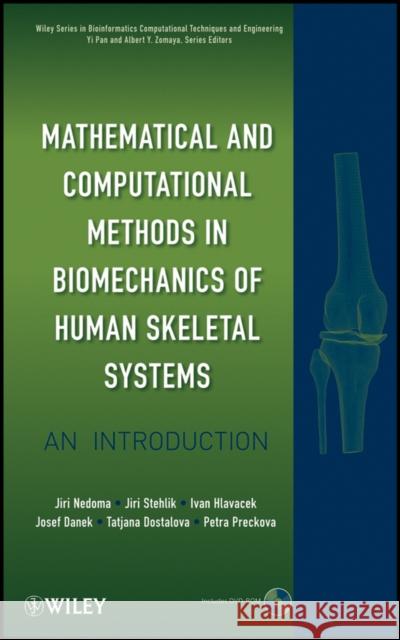
mathematical and computational methods in biomechanics of human skeletal systems: an introduction  Nedoma, Jirí 9780470408247 Wiley-Interscience - książkaWidoczna okładka, to zdjęcie poglądowe, a rzeczywista szata graficzna może różnić się od prezentowanej.

mathematical and computational methods in biomechanics of human skeletal systems: an introduction

ISBN-13: 9780470408247 / Angielski / Twarda / 2011 / 592 str.

Jira- Nedoma; Jiri Stehlik
cena 587,46
(netto: 559,49 VAT:  5%)

Najniższa cena z 30 dni: 580,29
Termin realizacji zamówienia:
ok. 30 dni roboczych.

Darmowa dostawa!

Cutting-edge solutions to current problems in orthopedics, supported by modeling and numerical analysis

Despite the current successful methods and achievements of good joint implantations, it is essential to further optimize the shape of implants so they may better resist extreme long-term mechanical demands. This book provides the orthopedic, biomechanical, and mathematical basis for the simulation of surgical techniques in orthopedics. It focuses on the numerical modeling of total human joint replacements and simulation of their functions, along with the rigorous biomechanics of human joints and other skeletal parts. The book includes:

  • An introduction to the anatomy and biomechanics of the human skeleton, biomaterials, and problems of alloarthroplasty

  • The definition of selected simulated orthopedic problems

  • Constructions of mathematical model problems of the biomechanics of the human skeleton and its parts

  • Replacement parts of the human skeleton and corresponding mathematical model problems

  • Detailed mathematical analyses of mathematical models based on functional analysis and finite element methods

  • Biomechanical analyses of particular parts of the human skeleton, joints, and corresponding replacements

  • A discussion of the problems of data processing from nuclear magnetic resonance imaging and computer tomography


This timely book offers a wealth of information on the current research in this field. The theories presented are applied to specific problems of orthopedics. Numerical results are presented and discussed from both biomechanical and orthopedic points of view and treatment methods are also briefly addressed. Emphasis is placed on the variational approach to the investigated model problems while preserving the orthopedic nature of the investigated problems. The book also presents a study of algorithmic procedures based on these simulation models. This is a highly useful tool for designers, researchers, and manufacturers of joint implants who require the results of suggested experiments to improve existing shapes or to design new shapes. It also benefits graduate students in orthopedics, biomechanics, and applied mathematics.

Kategorie:
Nauka, Biologia i przyroda
Kategorie BISAC:
Science > Biotechnology
Wydawca:
Wiley-Interscience
Seria wydawnicza:
Wiley Series in Bioinformatics: Computational Techniques and
Język:
Angielski
ISBN-13:
9780470408247
Rok wydania:
2011
Numer serii:
000343789
Ilość stron:
592
Waga:
1.03 kg
Wymiary:
23.62 x 16.0 x 3.56
Oprawa:
Twarda
Wolumenów:
01
Dodatkowe informacje:
Bibliografia
Wydanie ilustrowane

PREFACE.

ACKNOWLEDGMENTS.

PART I ANATOMY, BIOMECHANICS, AND ALLOARTHROPLASTY OF HUMAN JOINTS.

1 BIOMECHANICS OF THE HUMAN SKELETON ANDTHE PROBLEM OF ALLOARTHROPLASTY.

1.1 Introduction to History of Biomechanics and Alloarthroplasty.

1.2 Biomechanics of Human Joints and Tissues.

2 INTRODUCTION TOTHE ANATOMY OF THE SKELETAL SYSTEM.

2.1 Anatomy of the Skeletal System.

2.2 Human Joints and Their Functions.

2.3 Tribology of Human Joints.

2.4 Biomechanics of the Skeletal System.

3 TOTAL REPLACEMENT OF HUMAN JOINTS.

3.1 View of Arthroplasty Developments.

3.2 Static and Dynamic Loading of Human Joint Replacements.

3.3 Mechanical Destruction of Implants and Demands on Human Joint Arthroplasty.

3.4 Biomaterials in Ostheosynthesis and Alloarthroplasty.

3.5 Artificial Joint Replacements.

PART II MATHEMATICAL MODELS OF BIOMECHANICS.

4 BACKGROUND OF BIOMECHANICS.

4.1 Introduction.

4.2 Fundamentals of Continuum Mechanics.

4.3 Background of the Static and Dynamic Continuum Mechanics in Different Rheologies.

4.4 Background of the Quasi–Static and Dynamic Continuum Mechanics in Thermo(visco)elastic Rheology.

5 MATHEMATICAL MODELS OF PARTICULAR PARTS OF THE HUMAN SKELETON AND JOINTS ANDTHEIR REPLACEMENTS BASED ON BOUNDARY VALUE PROBLEM ANALYSES.

5.1 Introduction.

5.2 Mathematical Models of Human Joints and of Their Total Replacements asWell as of Parts of the Human Body.

5.3 Mathematical Models of Human Body Parts and Human Joints and Their Total Replacements Based on the Boundary Value Problems in (Thermo)elasticity.

5.4 Biomechanical Model of a Long Bone.

5.5 Mathematical Model of a Loaded Long Bone Based on Composite Biomaterials.

5.6 Stochastic Approach.

5.7 Mathematical Model of Heat Generation and Heat Propagation in the Neighborhood of the Bone Cement. Problems of Bone Necrosis.

6 MATHEMATICAL ANALYSES AND NUMERICAL SOLUTIONS OF FUNDAMENTAL BIOMECHANICAL PROBLEMS.

6.1 Background of Functional Analysis, Function Spaces, and Variational Inequalities.

6.2 Variational Equations and Inequalities and Their Numerical Approximations.

6.3 Biomechanical Models of Human Joints and Their Total Replacements.

6.4 Stress Strain Analysis of Total Human Joint Replacements in Linear, Nonlinear, Elasticity, and Thermoelasticity: Static Cases, Finite Element Approximations, Homogenization and Domain Decomposition Methods, and Algorithms.

6.5 Stress Strain Analyses of Human Joints and Their Replacements Based on Quasi–Static and Dynamic Multibody Contact Problems in Viscoelastic Rheologies.

6.6 Algorithms.

6.7 Viscoplastic Model of Total Human Joint Replacements.

6.8 Optimal Shape Design in Biomechanics of Human Joint Replacements.

6.9 Worst–Scenario Method in Biomechanics of Human Joint Replacements.

6.10 Biomechanical Models of Human Joint Replacements Coupling Bi– and Unilateral Contacts, Friction, Adhesion, and Wear.

PART III BIOMECHANICAL ANALYSES OF PARTICULAR PARTS OF THE HUMAN SKELETON, JOINTS, AND THEIR REPLACEMENTS.

7 BIOMECHANICAL MODELS BASED ON CONTACT PROBLEMS AND BIOMECHANICAL ANALYSES OF SOME HUMAN JOINTS,THEIR TOTAL REPLACEMENTS, AND SOME OTHER PARTS OF THE HUMAN SKELETON.

7.1 Introduction to the Biomechanics of Statically Loaded and of Moving Loaded Human Body.

7.2 Bone Remodeling and the Corresponding Mathematical Model.

7.3 Biomechanical Studies of Cysts, Osteophytes, and of Inter– and Subtrochanteric Osteotomy of the Femur and the Knee Joint.

7.4 Biomechanical Analysis of the Loosened Total Hip Arthroplasty (THA).

7.5 Biomechanical Analysis of the Hip Joint after THA Implanting and Subtrochanteric Osteotomy Healing.

7.6 Analysis of Loaded Tubular Long Bone Filled with Marrow Tissue.

7.7 Numerical Analysis of theWeight–Bearing Total Knee Replacement; Analysis of Effect of Axial Angle Changes onWeight–bearing Total Knee Arthroplasty.

7.8 Total Knee Replacement with Rotational Polyethylene Insert.

7.9 Computer–Assisted Surgery in Orthopedics: A Perspective.

7.10 Biomechanical and Mathematical Models of the Thoracolumbal Spine.

7.11 Biomechanical and Mathematical Models of Joints of the Upper Limbs.

7.12 Mathematical and Biomechanical Analyses of the Temporomandibular Joint.

APPENDIX.

A.1 List of Notations.

A.2 Cartesian Tensors.

A.3 Some Fundamental Theorems.

A.4 Elementary Inequalities.

A.5 Finite Element Method.

REFERENCES.

INDEX.

Jiri Nedoma, PhD, is a senior researcher at the Institute of Computer Science of the Academy of Sciences of the Czech Republic, Prague ,where he also received his PhD. He is also an associate professor at the University of West Bohemia, Czech Republic.

Jiri Stehlik, PhD, is the Chief of the Orthopedic Department of the Hospital of Ceske Budejovice, and an associate professor of the Charles University, Prague, where he also received his PhD.

Ivan Hlavacek, PhD, DSc, is a senior researcher at the Mathematical Institute of the Academy of Sciences of the Czech Republic. He graduated from the Czech Technical University, where he received his PhD in Applied Mathematics.

Josef Danek, PhD, received his PhD in applied mathematics from the University of West Bohemia, Czech Republic, where he is currently an associate professor. He is also a research fellow at the Academy of Sciences of the Czech Republic

Tatjana Dostálová, MD, PhD, DSc, is affiliated with Charles University, second Medical Faculty and the Faculty Hospital Motol, where she is the Chief of the Department of Pediatric Stomatology.

Petra Preckova MSc, is a research fellow in the Medical Informatics Department at the Institute of Computer Science, Academy of Sciences of the Czech Republic.

Cutting–edge solutions to current problems in orthopedics, supported by modeling and numerical analysis

Despite the current successful methods and achievements of good joint implantations, it is essential to further optimize the shape of implants so they may better resist extreme long–term mechanical demands. This book provides the orthopedic, biomechanical, and mathematical basis for the simulation of surgical techniques in orthopedics. It focuses on the numerical modeling of total human joint replacements and simulation of their functions, along with the rigorous biomechanics of human joints and other skeletal parts. The book includes:
  • An introduction to the anatomy and biomechanics of the human skeleton, biomaterials, and problems of alloarthroplasty
  • The definition of selected simulated orthopedic problems
  • Constructions of mathematical model problems of the biomechanics of the human skeleton and its parts
  • Replacement parts of the human skeleton and corresponding mathematical model problems
  • Detailed mathematical analyses of mathematical models based on functional analysis and finite element methods
  • Biomechanical analyses of particular parts of the human skeleton, joints, and corresponding replacements
  • A discussion of the problems of data processing from nuclear magnetic resonance imaging and computer tomography

This timely book offers a wealth of information on the current research in this field. The theories presented are applied to specific problems of orthopedics. Numerical results are presented and discussed from both biomechanical and orthopedic points of view and treatment methods are also briefly addressed. Emphasis is placed on the variational approach to the investigated model problems while preserving the orthopedic nature of the investigated problems. The book also presents a study of algorithmic procedures based on these simulation models.

This is a highly useful tool for designers, researchers, and manufacturers of joint implants who require the results of suggested experiments to improve existing shapes or to design new shapes. It also benefits graduate students in orthopedics, biomechanics, and applied mathematics.


Udostępnij

Facebook - konto krainaksiazek.pl


Opinie o Krainaksiazek.pl na Opineo.pl

Partner Mybenefit

Krainaksiazek.pl w programie rzetelna firma Krainaksiaze.pl - płatności przez paypal

Czytaj nas na:

Facebook - krainaksiazek.pl
  • książki na zamówienie
  • granty
  • książka na prezent
  • kontakt
  • pomoc
  • opinie
  • regulamin
  • polityka prywatności

Zobacz:

  • Księgarnia czeska

  • Wydawnictwo Książkowe Klimaty

1997-2026 DolnySlask.com Agencja Internetowa

© 1997-2022 krainaksiazek.pl
     
KONTAKT | REGULAMIN | POLITYKA PRYWATNOŚCI | USTAWIENIA PRYWATNOŚCI
Zobacz: Księgarnia Czeska | Wydawnictwo Książkowe Klimaty | Mapa strony | Lista autorów
KrainaKsiazek.PL - Księgarnia Internetowa

Polityka prywatnosci - link
Krainaksiazek.pl - płatnośc Przelewy24
Przechowalnia Przechowalnia





