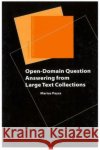
Many books have indexes, but most textual media have none. Newspapers, legal transcripts, conference proceedings, correspondence, video subtitles, and web pages are increasingly accessible with computers, yet are still without indexes or other sophisticated means of finding the excerpts most relevant to a reader's question. Better than an index, and much better than a keyword search, are the high-precision computerized question-answering systems explored in this book. Marius Pasca presents novel and robust methods for capturing the semantics of natural language questions and for finding...
Many books have indexes, but most textual media have none. Newspapers, legal transcripts, conference proceedings, correspondence, video subtitles, and...
The finite-state paradigm of computer science has provided a basis for natural-language applications that are efficient, elegant, and robust. This volume is a practical guide to finite-state theory and the affiliated programming languages lexc and xfst. Readers will learn how to write tokenizers, spelling checkers, and especially morphological analyzer/generators for words in English, French, Finnish, Hungarian, and other languages. Included are graded introductions, examples, and exercises suitable for individual study as well as formal courses. These take advantage of widely-tested lexc...
The finite-state paradigm of computer science has provided a basis for natural-language applications that are efficient, elegant, and robust. This vol...
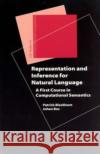
How can computers distinguish the coherent from the unintelligible, recognize new information in a sentence, or draw inferences from a natural language passage? Computational semantics is an exciting new field that seeks answers to these questions, and this volume is the first textbook wholly devoted to this growing subdiscipline. The book explains the underlying theoretical issues and fundamental techniques for computing semantic representations for fragments of natural language. This volume will be an essential text for computer scientists, linguists, and anyone interested in the...
How can computers distinguish the coherent from the unintelligible, recognize new information in a sentence, or draw inferences from a natural languag...