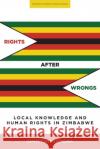
The international legal framework of human rights presents itself as universal. But rights do not exist as a mere framework; they are enacted, practiced, and debated in local contexts. Rights After Wrongs ethnographically explores the chasm between the ideals and the practice of human rights. Specifically, it shows where the sweeping colonial logics of Western law meets the lived experiences, accumulated histories, and humanitarian debts present in post-colonial Zimbabwe.
Through a comprehensive survey of human rights scholarship, Shannon Morreira explores the ways in which...
The international legal framework of human rights presents itself as universal. But rights do not exist as a mere framework; they are enacted, prac...
Police who engage in torture are condemned by human rights activists, the media, and people across the world who shudder at their brutality. Stark revelations about torture by American forces at places like Guantanamo Bay have stoked a fascination with torture and debates about human rights. Yet despite this interest, the public knows little about the officers who actually commit such violence. How do the police understand what they do? How do their beliefs inform their responses to education and activism against torture?
Just Violence reveals the moral perspective of...
Police who engage in torture are condemned by human rights activists, the media, and people across the world who shudder at their brutality. Stark ...
Bodies of Truth offers an intimate account of how apartheid victims deal with the long-term effects of violence, focusing on the intertwined themes of embodiment, injury, victimhood, and memory. In 2002, victims of apartheid-era violence filed suit against multinational corporations, accusing them of aiding and abetting the security forces of the apartheid regime. While the litigation made its way through the U.S. courts, thousands of victims of gross human rights violations have had to cope with painful memories of violence. They have also confronted an official discourse claiming...
Bodies of Truth offers an intimate account of how apartheid victims deal with the long-term effects of violence, focusing on the intertwined th...
Bodies of Truth offers an intimate account of how apartheid victims deal with the long-term effects of violence, focusing on the intertwined themes of embodiment, injury, victimhood, and memory. In 2002, victims of apartheid-era violence filed suit against multinational corporations, accusing them of aiding and abetting the security forces of the apartheid regime. While the litigation made its way through the U.S. courts, thousands of victims of gross human rights violations have had to cope with painful memories of violence. They have also confronted an official discourse claiming...
Bodies of Truth offers an intimate account of how apartheid victims deal with the long-term effects of violence, focusing on the intertwined th...
Police who engage in torture are condemned by human rights activists, the media, and people across the world who shudder at their brutality. Stark revelations about torture by American forces at places like Guantanamo Bay have stoked a fascination with torture and debates about human rights. Yet despite this interest, the public knows little about the officers who actually commit such violence. How do the police understand what they do? How do their beliefs inform their responses to education and activism against torture? Just Violence reveals the moral perspective of perpetrators and...
Police who engage in torture are condemned by human rights activists, the media, and people across the world who shudder at their brutality. Stark rev...
Since its adoption in 1948, the Universal Declaration of Human Rights (UDHR) has served as the foundation for the protection of human rights around the world. Historians and human rights scholars have claimed that the UDHR was based in part on UNESCO's global survey of intellectuals, theologians, and cultural and political leaders to generate truly universal assessment of human rights. This book provides a critical analysis of the use and misuse of the UNESCO process within contemporary debates over the origins, legitimacy, and universality of human rights.
Based on meticulous...
Since its adoption in 1948, the Universal Declaration of Human Rights (UDHR) has served as the foundation for the protection of human rights around...
Since its adoption in 1948, the Universal Declaration of Human Rights (UDHR) has served as the foundation for the protection of human rights around the world. Historians and human rights scholars have claimed that the UDHR was based in part on UNESCO's global survey of intellectuals, theologians, and cultural and political leaders to generate truly universal assessment of human rights. This book provides a critical analysis of the use and misuse of the UNESCO process within contemporary debates over the origins, legitimacy, and universality of human rights.
Based on meticulous...
Since its adoption in 1948, the Universal Declaration of Human Rights (UDHR) has served as the foundation for the protection of human rights around...