Archival Afterlives explores the posthumous fortunes of scientific and medical archives in early modern Britain. If early modern natural philosophers claimed all knowledge as their province, theirs was a paper empire. But how and why did naturalists engage with archives, and in particular, with the papers of their dead predecessors? This volume makes a firm case for expanding what counts as scientific labour, integrating scribes, archivist, library keepers, editors, and friends and family of deceased naturalists into the history of science. It shows how early modern natural philosophers...
Archival Afterlives explores the posthumous fortunes of scientific and medical archives in early modern Britain. If early modern natural philosophers ...
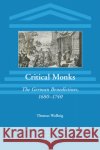
Benedictine scholars around 1700, most prominently proponents of historical criticism, have long been regarded as the spearhead of ecclesiastical learning on the brink of Enlightenment, first in France, then in Germany and other parts of Europe. Based on unpublished sources, this book is the first to contextualize this narrative in its highly complex pre-modern setting, and thus at some distance from modernist ascriptions ex posteriori. Challenged by Protestant and Catholic anti-monasticism, Benedictine scholars strove to maintain control of their intellectual tradition. They failed...
Benedictine scholars around 1700, most prominently proponents of historical criticism, have long been regarded as the spearhead of ecclesiastical lear...
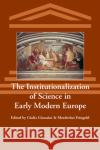
This volume aims to furnish a broader framework for analyzing the scientific and institutional context that gave rise to scientific academies in Europe—including the Accademia del Cimento in Florence; the Royal Society in London; the Académie Royale des Sciences in Paris; and the Academia naturae curiosorum in Schweinfurt. The essays detail the multiple backgrounds that prompted seventeenth-century savants—from Italy to England, and from Poland to Portugal—to establish new forms of scientific organizations, in which to institutionalize collaborative research as well as modes of...
This volume aims to furnish a broader framework for analyzing the scientific and institutional context that gave rise to scientific academies in Europ...
Teyler’s Foundation in Haarlem and its ‘Book and Art Room’ of 1779, edited by Ellinoor Bergvelt and Debora Meijers, examines for the first time this institution in the context of scientific, museological, political, artistic, religious and philosophical developments. The key moment was the decision in 1779 to give a free interpretation to the testament of its founder, the Mennonite entrepreneur Pieter Teyler van der Hulst (1702–1778): stimulated by the naturalist Martinus van Marum, the Foundation’s board decided to build an impressive museum room and to establish a natural science...
Teyler’s Foundation in Haarlem and its ‘Book and Art Room’ of 1779, edited by Ellinoor Bergvelt and Debora Meijers, examines for the first time ...
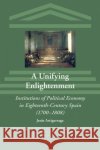
This book contains a systematic study of economic institutions during the Spanish Enlightenment in the areas of print culture (the press, merchants’ handbooks, teaching materials), education (university chairs in political economy and commerce) and the organisation of financial matters at state level (economic societies, trade consulates and the official statistics agency). A Unifying Enlightenment is a fresh interpretation of political economy’s contribution to the development of the European Enlightenment. Jesús Astigarraga shows that, far from being a straightforward intellectual...
This book contains a systematic study of economic institutions during the Spanish Enlightenment in the areas of print culture (the press, merchants’...
In this erudite book, Ian Adamson provides a comprehensive history of Gresham College in the seventeenth century, particularly its contribution to the intellectual, educational, and administrative life of London and England. He analyses its relationship with the Tudor and Stuart courts, the Corporation of London, the universities, and the Royal Society, and assesses the quality and effectiveness of all the professors elected during this period. Finally, he explains the presence in the College of Ben Jonson and Sir Kenelm Digby, why it is likely that Shakespeare was often in attendance, and...
In this erudite book, Ian Adamson provides a comprehensive history of Gresham College in the seventeenth century, particularly its contribution to the...