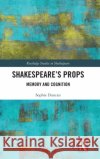
This book recovers a sense of the high stakes of Shakespearean comedy, arguing that the comedies, no less than the tragedies, serve to dramatize responses to the condition of being human, responses that invite scholarly investigation and explanation. Taking its cue from Stanley Cavell's influential readings of Othello and Lear, the book argues that exposure or vulnerability to others is the source of both human happiness and human misery; while the tragedies showcase attempts at the evasion of such vulnerability through the self-defeating pursuit of epistemological certainty,...
This book recovers a sense of the high stakes of Shakespearean comedy, arguing that the comedies, no less than the tragedies, serve to dramatize re...
This book is the first to explore the rich archive of Shakespeare in Indian cinemas, including less familiar, Indian language cinemas to contribute to the assessment of the expanding repertoire of Shakespeare films worldwide. Essays cover mainstream and regional Indian cinemas such as the better known Tamil and Kannada, as well as the less familiar regions of the North Eastern states. The volume visits diverse filmic genres, starting from the earliest silent cinema, to diasporic films made for global audiences, television films, independent films, and documentaries, thus expanding the very...
This book is the first to explore the rich archive of Shakespeare in Indian cinemas, including less familiar, Indian language cinemas to contribute...
This study contends that folly is of fundamental importance to the implicit philosophical vision of Shakespeare s drama. The discourse of folly s wordplay, jubilant ironies, and vertiginous paradoxes furnish Shakespeare with a way of understanding that lays bare the hypocrisies and absurdities of the serious world. Like Erasmus, More, and Montaigne before him, Shakespeare employs folly as a mode of understanding that does not arrogantly insist upon the veracity of its own claims a fool s truth, after all, is spoken by a fool. Yet, as this study demonstrates, Shakespearean folly is not the...
This study contends that folly is of fundamental importance to the implicit philosophical vision of Shakespeare s drama. The discourse of folly s w...
This book asks new questions about how and why Shakespeare engages with source material, and about what should be counted as sources in Shakespeare studies. The essays demonstrate that source study remains an indispensable mode of inquiry for understanding Shakespeare, his authorship and audiences, and early modern gender, racial, and class relations, as well as for considering how new technologies have and will continue to redefine our understanding of the materials Shakespeare used to compose his plays. Although source study has been used in the past to construct a conservative view of...
This book asks new questions about how and why Shakespeare engages with source material, and about what should be counted as sources in Shakespeare...
This interdisciplinary, transhistorical collection brings together international scholars from English literature, Italian studies, performance history, and comparative literature to offer new perspectives on the vibrant engagements between Shakespeare and Italian theatre, literary culture, and politics, from the sixteenth to the twenty-first century. Chapters address the intricate, two-way exchange between Shakespeare and Italy: how the artistic and intellectual culture of Renaissance Italy shaped Shakespeare's drama in his own time, and how the afterlife of Shakespeare's work and...
This interdisciplinary, transhistorical collection brings together international scholars from English literature, Italian studies, performance his...
This volume gives Asia s Shakespeares the critical, theoretical, and political space they demand, offering rich, alternative ways of thinking about Asia, Shakespeare, and Asian Shakespeare based on Asian experiences and histories. Challenging and supplementing the dominant critical and theoretical structures that determine Shakespeare studies today, close analysis of Shakespeare s Asian journeys, critical encounters, cultural geographies, and the political complexions of these negotiations reveal perspectives different to the European. Exploring what Shakespeare has done to Asia along with...
This volume gives Asia s Shakespeares the critical, theoretical, and political space they demand, offering rich, alternative ways of thinking about...
In this new monograph, Claire Hansen demonstrates how Shakespeare can be understood as a complex system, and how complexity theory can provide compelling and original readings of Shakespeare's plays. The book utilises complexity theory to illuminate early modern theatrical practice, Shakespeare pedagogy, and the phenomenon of the Shakespeare 'myth'. The monograph re-evaluates Shakespeare, his plays, early modern theatre, and modern classrooms as complex systems, illustrating how the lens of complexity offers an enlightening new perspective on diverse areas of Shakespeare scholarship. The...
In this new monograph, Claire Hansen demonstrates how Shakespeare can be understood as a complex system, and how complexity theory can provide comp...
The work of Shakespeare and his contemporaries has often been the testing-ground for innovations in literary studies, but this has not been true of ecocriticism. This is partly because, until recently, most ecologically minded writers have located the origins of ecological crisis in the Enlightenment, with the legacies of the Cartesian cogito singled out as a particular cause of our current woes. Traditionally, Renaissance writers were tacitly (or, occasionally, overtly) presumed to be oblivious of environmental degradation and unaware that the episteme--the conceptual edifice of their...
The work of Shakespeare and his contemporaries has often been the testing-ground for innovations in literary studies, but this has not been true of ec...
Long before the economist Amartya Sen proposed that more than 100 million women were missing--lost to disease or neglect, kidnapping or forced marriage, denied the economic and political security of wages or membership in a larger social order--Shakespeare was interested in such women's plight, how they were lost, and where they might have gone. Characters like Shakespeare's Cordelia and Perdita, Rosalind and Celia constitute a collection of figures related to the mythical Persephone who famously returns to her mother and the earth each spring, only to withdraw from the world each winter...
Long before the economist Amartya Sen proposed that more than 100 million women were missing--lost to disease or neglect, kidnapping or forced marr...