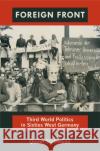
It is often asserted that West German New Leftists "discovered the Third World" in the pivotal decade of the 1960s. Quinn Slobodian upsets that storyline by beginning with individuals from the Third World themselves: students from Africa, Asia, and Latin America who arrived on West German campuses in large numbers in the early 1960s. They were the first to mobilize German youth in protest against acts of state violence and injustice perpetrated beyond Europe and North America. The activism of the foreign students served as a model for West German students, catalyzing social movements and...
It is often asserted that West German New Leftists "discovered the Third World" in the pivotal decade of the 1960s. Quinn Slobodian upsets that storyl...
It is often asserted that West German New Leftists "discovered the Third World" in the pivotal decade of the 1960s. Quinn Slobodian upsets that storyline by beginning with individuals from the Third World themselves: students from Africa, Asia, and Latin America who arrived on West German campuses in large numbers in the early 1960s. They were the first to mobilize German youth in protest against acts of state violence and injustice perpetrated beyond Europe and North America. The activism of the foreign students served as a model for West German students, catalyzing social movements and...
It is often asserted that West German New Leftists "discovered the Third World" in the pivotal decade of the 1960s. Quinn Slobodian upsets that storyl...
In A New Deal for All? Andor Skotnes examines the interrelationships between the Black freedom movement and the workers' movement in Baltimore and Maryland during the Great Depression and the early years of the Second World War. Adding to the growing body of scholarship on the long civil rights struggle, he argues that such "border state" movements helped resuscitate and transform the national freedom and labor struggles. In the wake of the Great Crash of 1929, the freedom and workers' movements had to rebuild themselves, often in new forms. In the early 1930s, deepening commitments to...
In A New Deal for All? Andor Skotnes examines the interrelationships between the Black freedom movement and the workers' movement in Baltimore ...
In A New Deal for All? Andor Skotnes examines the interrelationships between the Black freedom movement and the workers' movement in Baltimore and Maryland during the Great Depression and the early years of the Second World War. Adding to the growing body of scholarship on the long civil rights struggle, he argues that such "border state" movements helped resuscitate and transform the national freedom and labor struggles. In the wake of the Great Crash of 1929, the freedom and workers' movements had to rebuild themselves, often in new forms. In the early 1930s, deepening commitments to...
In A New Deal for All? Andor Skotnes examines the interrelationships between the Black freedom movement and the workers' movement in Baltimore ...
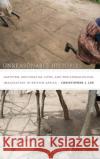
In Unreasonable Histories, Christopher J. Lee unsettles the parameters and content of African studies as currently understood. At the book's core are the experiences of multiracial Africans in British Central Africa--contemporary Malawi, Zimbabwe, and Zambia--from the 1910s to the 1960s. Drawing on a spectrum of evidence--including organizational documents, court records, personal letters, commission reports, popular periodicals, photographs, and oral testimony--Lee traces the emergence of Anglo-African, Euro-African, and Eurafrican subjectivities which constituted a grassroots...
In Unreasonable Histories, Christopher J. Lee unsettles the parameters and content of African studies as currently understood. At the book's co...
In Unreasonable Histories, Christopher J. Lee unsettles the parameters and content of African studies as currently understood. At the book's core are the experiences of multiracial Africans in British Central Africa--contemporary Malawi, Zimbabwe, and Zambia--from the 1910s to the 1960s. Drawing on a spectrum of evidence--including organizational documents, court records, personal letters, commission reports, popular periodicals, photographs, and oral testimony--Lee traces the emergence of Anglo-African, Euro-African, and Eurafrican subjectivities which constituted a grassroots...
In Unreasonable Histories, Christopher J. Lee unsettles the parameters and content of African studies as currently understood. At the book's co...
In The Color of Modernity, Barbara Weinstein focuses on race, gender, and regionalism in the formation of national identities in Brazil; this focus allows her to explore how uneven patterns of economic development are consolidated and understood. Organized around two principal episodes the 1932 Constitutionalist Revolution and 1954 s IV Centenario, the quadricentennial of Sao Paulo s founding this book shows how both elites and popular sectors in Sao Paulo embraced a regional identity that emphasized their European origins and aptitude for modernity and progress, attributes that became...
In The Color of Modernity, Barbara Weinstein focuses on race, gender, and regionalism in the formation of national identities in Brazil; this f...
In The Color of Modernity, Barbara Weinstein focuses on race, gender, and regionalism in the formation of national identities in Brazil; this focus allows her to explore how uneven patterns of economic development are consolidated and understood. Organized around two principal episodes the 1932 Constitutionalist Revolution and 1954 s IV Centenario, the quadricentennial of Sao Paulo s founding this book shows how both elites and popular sectors in Sao Paulo embraced a regional identity that emphasized their European origins and aptitude for modernity and progress, attributes that became...
In The Color of Modernity, Barbara Weinstein focuses on race, gender, and regionalism in the formation of national identities in Brazil; this f...
During the Second World War, the FDR administration placed the FBI in charge of political surveillance in Latin America. Through a program called the Special Intelligence Service (SIS), 700 agents were assigned to combat Nazi influence in Mexico, Brazil, Chile, and Argentina. The SIS s mission, however, extended beyond countries with significant German populations or Nazi spy rings. As evidence of the SIS s overreach, forty-five agents were dispatched to Ecuador, a country without any German espionage networks. Furthermore, by 1943, FBI director J. Edgar Hoover shifted the SIS s focus from...
During the Second World War, the FDR administration placed the FBI in charge of political surveillance in Latin America. Through a program called the ...
The largely unknown story of the FBI's surveillance operations in Latin America during the 1940s provides new insights into leftist organizations and the nature of the U.S.'s imperial ambitions in the western hemisphere.
The largely unknown story of the FBI's surveillance operations in Latin America during the 1940s provides new insights into leftist organizations and ...