Most narratives depict Soviet Cold War cultural activities and youth groups as drab and dreary, militant and politicized. In this study Gleb Tsipursky challenges these stereotypes in a revealing portrayal of Soviet youth and state-sponsored popular culture. The primary local venues for Soviet culture were the tens of thousands of klubs where young people found entertainment, leisure, social life, and romance. Here sports, dance, film, theater, music, lectures, and political meetings became vehicles to disseminate a socialist version of modernity. The Soviet way of life was...
Most narratives depict Soviet Cold War cultural activities and youth groups as drab and dreary, militant and politicized. In this study Gleb Tsipursky...
FINALIST, 2016 National Jewish Book Award (Holocaust category) Published in association with the United States Holocaust Memorial Museum. The Holocaust in Croatia recounts the history of the Croatian Jewish community during the Second World War, with a focus on the city of Zagreb. Ivo and Slavko Goldstein have grounded their study on extensive research in recently opened archives, additionally aided by the memories of survivors to supplement and enrich the interpretation of documents. The authors' accessible narrative, here available in English for the first time, has...
FINALIST, 2016 National Jewish Book Award (Holocaust category) Published in association with the United States Holocaust Memorial Museum. ...
This book traces transformations in German views of Russia in the first half of the twentieth century, leading up to the disastrous German invasion of the Soviet Union in 1941. Casteel shows how Russia figured in the imperial visions and utopian desires of a variety of Germans, including scholars, journalists, travel writers, government and military officials, as well as nationalist activists. He illuminates the ambiguous position that Russia occupied in Germans' global imaginary as both an imperial rival and an object of German power. During the interwar years in particular, Russia, now...
This book traces transformations in German views of Russia in the first half of the twentieth century, leading up to the disastrous German invasion of...
In 1937, the Soviet Union mounted a national celebration commemorating the centenary of poet Alexander Pushkin's death. Though already a beloved national literary figure, the scale and feverish pitch of the Pushkin festival was unprecedented. Greetings, Pushkin presents the first in-depth study of this historic event and follows its manifestations in art, literature, popular culture, education, and politics, while also examining its philosophical underpinnings. Jonathan Brooks Platt looks deeply into the motivations behind the Soviet glorification of a long-dead poet--seemingly at...
In 1937, the Soviet Union mounted a national celebration commemorating the centenary of poet Alexander Pushkin's death. Though already a beloved natio...
Vasily Sleptsov was a Russian social activist and writer during the politically charged 1860s, known as the era of great reforms, and marked by Alexander II s emancipation of the serfs and the relaxation lifting of censorship. Popular in his day, Sleptsov s contemporaries Leo Tolstoy and Anton Chekhov praised his writing:, with Chekhov once remarkeding, Sleptsov taught me, better than most, to understand the Russian intelligent, and my own self as well. The novella Hard Times is considered Sleptsov s most important work. It focused popular attention on the radical...
Vasily Sleptsov was a Russian social activist and writer during the politically charged 1860s, known as the era of great reforms, and marked by Alexan...
Following the 1992 breakup of Yugoslavia, the region descended into a series of bloody conflicts marked by intense ethnic and religious hatreds. Kosovo emerged at the epicenter of these disputes and the site of innumerable human rights violations, as Serbia, united with Montenegro at the time, sought to remove the Albanian presence. Kosovo (roughly ninety percent Albanian) declared independence in 2008, and although it is recognized by over one hundred UN member states, it is still not recognized by Serbia. This volume brings together scholars of Serbian, Albanian, Christian, and Muslim...
Following the 1992 breakup of Yugoslavia, the region descended into a series of bloody conflicts marked by intense ethnic and religious hatreds. Kosov...
In this innovative study of the aftermath of ethnic cleansing, Eagle Glassheim examines the transformation of Czechoslovakia's Sudetenland from the end of the Second World War, through the Cold War, and into the twenty-first century. Prior to their expulsion in 1945, ethnic Germans had inhabited the Sudeten borderlands for hundreds of years, with deeply rooted local cultures and close, if sometimes tense, ties with Bohemia's Czech majority. Cynically, if largely willingly, harnessed by Hitler in 1938 to his pursuit of a Greater Germany, the Sudetenland's three million Germans became the...
In this innovative study of the aftermath of ethnic cleansing, Eagle Glassheim examines the transformation of Czechoslovakia's Sudetenland from the en...
In eighteenth-century Russia, as elsewhere in Europe, bread was a dietary staple--truly grain was the staff of economic, social, and political life. Early on Tsar Peter the Great founded St. Petersburg to export goods from Russia's vast but remote interior and by doing so to drive Russia's growth and prosperity. But the new city also had to be fed with grain brought over great distances from those same interior provinces. In this compelling account, Robert E. Jones chronicles how the unparalleled effort put into the building of a wide infrastructure to support the provisioning of the newly...
In eighteenth-century Russia, as elsewhere in Europe, bread was a dietary staple--truly grain was the staff of economic, social, and political life. E...
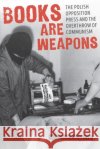
Much attention has been given to the role of intellectual dissidents, labor, and religion in the historic overthrow of communism in Poland during the 1980s. Books Are Weapons presents the first English-language study of that which connected them--the press. Siobhan Doucette provides a comprehensive examination of the Polish opposition's independent, often underground, press and its crucial role in the events leading to the historic Round Table and popular elections of 1989. While other studies have emphasized the role that the Solidarity movement played in bringing about civil society...
Much attention has been given to the role of intellectual dissidents, labor, and religion in the historic overthrow of communism in Poland during the ...
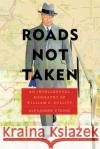
A journalist, diplomat, and writer, William Christian Bullitt (1891-1967) negotiated with Lenin and Stalin, Churchill and de Gaulle, Chiang Kai-shek and Goering. He took part in the talks that ended World War I and those that failed to prevent World War II. While his former disciples led American diplomacy into the Cold War, Bullitt became an early enthusiast of the European Union. From his early (1919) proposal of disassembling the former Russian Empire into dozens of independent states, to his much later (1944) advice to land the American troops in the Balkans rather than in Normandy,...
A journalist, diplomat, and writer, William Christian Bullitt (1891-1967) negotiated with Lenin and Stalin, Churchill and de Gaulle, Chiang Kai-shek a...