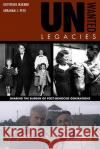
How does a society reconcile itself in a post-genocide era? How can generations of those whose families were victims and victimizers break the cycle of hate, mistrust, shame, and guilt that characterizes their relationship? What family reactions do they face as they seek to begin the act of sitting across from each other and facing their legacies? For more than two decades, Gottfried Wagner, great-grandson of composer Richard Wagner, whose music inspired Adolf Hitler and whose family helped the Nazis rise to power, and Abraham J. Peck, the son of two survivors whose entire families were...
How does a society reconcile itself in a post-genocide era? How can generations of those whose families were victims and victimizers break the cycle o...
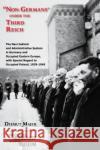
Under the legal and administrative system of Nazi Germany, people categorized as Fremdvolkische (literally, foreign people ) were subject to special laws that restricted their rights, limited their protection under the law, and exposed them to extraordinary legal sanctions and brutal, extralegal police actions. These special laws, one of the central constitutional principles of the Third Reich, applied to anyone perceived as different or racially inferior, whether German citizens or not. " Non-Germans under the Third Reich" traces the establishment and evolution of these laws from the...
Under the legal and administrative system of Nazi Germany, people categorized as Fremdvolkische (literally, foreign people ) were subject to special l...
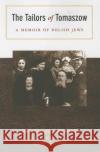
"Preserving the collective memory of a community that is no more" Seven decades after the Nazis annihilated the Jewish community of Tomaszow-Mazowiecki, Poland, comes a gripping eyewitness narrative told by one of the youngest survivors of the Holocaust, as well as through first-hand accounts of other Tomaszow survivors. This unique communal memoir presents a rare view of Eastern European Jewry, before, during, and after World War II. It is both the memoir of a child and of a lost Jewish community, an unvarnished story in which disputes, controversy, and scandal all play a role in...
"Preserving the collective memory of a community that is no more" Seven decades after the Nazis annihilated the Jewish community of Tomaszow-Mazo...
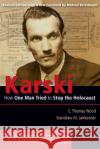
"Revised and updated, with previously unpublished material, and a new Introduction and Afterword" A young Polish diplomat turned cavalry officer, Jan Karski joined the Polish Underground movement in 1939. He became a courier for the Underground, crossing enemy lines to serve as a liaison between occupied Poland and the free world. In 1942, Jewish leaders asked him to carry a desperate message to Allied leaders: the news of Hitler's effort to exterminate the Jews of Europe. To be able to deliver an authentic report, Karski twice toured the Warsaw Ghetto in disguise and later...
"Revised and updated, with previously unpublished material, and a new Introduction and Afterword" A young Polish diplomat turned cavalry officer,...
During his long career, Rabbi Stephen Samuel Wise received letters with only two words written on the envelope: Rabbi USA. But the United States Postal Service was never in doubt about the intended recipient: there was only one Rabbi USA. No other rabbi before or since Wise has dominated the American and the international scene with such passion and power. Both his admirers and opponents there was no shortage of either group acknowledged him as the premier leader of the American Jewish community and a major political figure. " Pillar of Fire" goes behind the headlines and the...
During his long career, Rabbi Stephen Samuel Wise received letters with only two words written on the envelope: Rabbi USA. But the United States ...
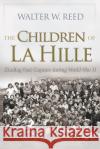
Following the horrors of Kristallnacht in November of 1938, frightened parents were forced to find refuge for their children, far from the escalating anti-Jewish violence. To that end, a courageous group of Belgian women organized a desperate and highly dangerous rescue mission to usher nearly 1,000 children out of Germany and Austria. Of these children, ninety-three were placed on a freight train, traveling through the night away from their families and into the relative safety of Vichy France. Ranging in age from five to sixteen years, the children along with their protectors spent a...
Following the horrors of Kristallnacht in November of 1938, frightened parents were forced to find refuge for their children, far from the escalati...
Following the horrors of Kristallnacht in November of 1938, frightened parents were forced to find refuge for their children, far from the escalating anti-Jewish violence. To that end, a courageous group of Belgian women organized a desperate and highly dangerous rescue mission to usher nearly 1,000 children out of Germany and Austria. Of these children, ninety-three were placed on a freight train, traveling through the night away from their families and into the relative safety of Vichy France. Ranging in age from five to sixteen years, the children along with their protectors spent a harsh...
Following the horrors of Kristallnacht in November of 1938, frightened parents were forced to find refuge for their children, far from the escalating ...
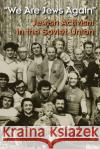
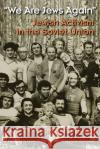
Kosharovsky's authoritative four-volume history of the Jewish movement in the Soviet Union is now available in a condensed and edited volume that makes this compelling insider's account of Soviet Jewish activism after Stalin available to a wider audience. Originally published in Russian from 2008 to 2012, "We Are Jews Again" chronicles the struggles of Jews who wanted nothing more than the freedom to learn Hebrew, the ability to provide a Jewish education for their children, and the right to immigrate to Israel. Through dozens of interviews with former refuseniks and famous activists,...
Kosharovsky's authoritative four-volume history of the Jewish movement in the Soviet Union is now available in a condensed and edited volume that make...
Kosharovsky s authoritative four-volume history of the Jewish movement in the Soviet Union is now available in a condensed and edited volume that makes this compelling insider s account of Soviet Jewish activism after Stalin available to a wider audience. Originally published in Russian from 2008 to 2012, "We Are Jews Again" chronicles the struggles of Jews who wanted nothing more than the freedom to learn Hebrew, the ability to provide a Jewish education for their children, and the right to immigrate to Israel. Through dozens of interviews with former refuseniks and famous activists,...
Kosharovsky s authoritative four-volume history of the Jewish movement in the Soviet Union is now available in a condensed and edited volume that make...