Major General Don Carlos Buell stood among the senior Northern commanders early in the Civil War, led the Army of the Ohio in the critical Kentucky theater in 1861-62, and helped shape the direction of the conflict during its first years. Only a handful of Northern generals loomed as large on the military landscape during this period, and Buell is the only one of them who has not been the subject of a full-scale biography.
A conservative Democrat, Buell viewed the Civil War as a contest to restore the antebellum Union rather than a struggle to bring significant social change to the...
Major General Don Carlos Buell stood among the senior Northern commanders early in the Civil War, led the Army of the Ohio in the critical Kentucky th...
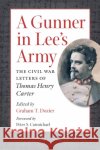
In May 1861, Virginian Thomas Henry Carter (1831-1908) raised an artillery battery and joined the Confederate army. Over the next four years, he rose steadily in rank from captain to colonel, placing him among the senior artillerists in Robert E. Lee's Army of Northern Virginia. During the war, Carter wrote more than 100 revealing letters to his wife, Susan, about his service. His interactions with prominent officers--including Lee, Jubal A. Early, John B. Gordon, Robert E. Rodes, and others--come to life in Carter's astute comments about their conduct and personalities. Combining insightful...
In May 1861, Virginian Thomas Henry Carter (1831-1908) raised an artillery battery and joined the Confederate army. Over the next four years, he rose ...
Reconstruction policy after the Civil War, observes Mark Wahlgren Summers, was shaped not simply by politics, principles, and prejudices. Also at work were fears--often unreasonable fears of renewed civil war and a widespread sense that four years of war had thrown the normal constitutional process so dangerously out of kilter that the republic itself remained in peril.
To understand Reconstruction, Summers contends, one must understand that the purpose of the North's war was--first and foremost--to save the Union with its republican institutions intact. During Reconstruction there...
Reconstruction policy after the Civil War, observes Mark Wahlgren Summers, was shaped not simply by politics, principles, and prejudices. Also at work...
Joseph Holt, the stern, brilliant, and deeply committed Unionist from Kentucky, spent the first several months of the American Civil War successfully laboring to maintain Kentucky's loyalty to the Union and then went on to serve as President Lincoln's judge advocate general. In Lincoln's Forgotten Ally, Elizabeth Leonard offers the first full-scale biography of Holt, who has long been overlooked and misunderstood by historians and students of the war.
In his capacity as the administration's chief arbiter and enforcer of military law, Holt strove tenaciously, often against...
Joseph Holt, the stern, brilliant, and deeply committed Unionist from Kentucky, spent the first several months of the American Civil War successfully ...
Most Civil War generals were graduates of West Point, and many of them helped transform the U.S. Army from what was little better than an armed mob that performed poorly during the War of 1812 into the competent fighting force that won the Mexican War. Wayne Wei-siang Hsieh demonstrates how the "old army" transformed itself into a professional military force after 1814, and, more important, how "old army" methods profoundly shaped the conduct of the Civil War.
Most Civil War generals were graduates of West Point, and many of them helped transform the U.S. Army from what was little better than an armed mob th...
In this sophisticated quantitative study, Joseph T. Glatthaar provides a comprehensive narrative and statistical analysis of many key aspects of General Robert E. Lee's Army of Northern Virginia. Serving as a companion to Glatthaar's General Lee's Army: From Victory to Collapse, this book presents Glatthaar's supporting data and major conclusions in extensive and extraordinary detail.
While gathering research materials for General Lee's Army, Glatthaar compiled quantitative data on the background and service of 600 randomly selected soldiers--150 artillerists, 150...
In this sophisticated quantitative study, Joseph T. Glatthaar provides a comprehensive narrative and statistical analysis of many key aspects of Gener...
In the years after the Civil War, black and white Union soldiers who survived the horrific struggle joined the Grand Army of the Republic (GAR)--the Union army's largest veterans' organization. In this thoroughly researched and groundbreaking study, Barbara Gannon chronicles black and white veterans' efforts to create and sustain the nation's first interracial organization.
According to the conventional view, the freedoms and interests of African American veterans were not defended by white Union veterans after the war, despite the shared tradition of sacrifice among both black and...
In the years after the Civil War, black and white Union soldiers who survived the horrific struggle joined the Grand Army of the Republic (GAR)--the U...
After the Civil War, white Confederate and Union army veterans reentered--or struggled to reenter--the lives and communities they had left behind. In Sing Not War, James Marten explores how the nineteenth century's "Greatest Generation" attempted to blend back into society and how their experiences were treated by nonveterans.
Many soldiers, Marten reveals, had a much harder time reintegrating into their communities and returning to their civilian lives than has been previously understood. Although Civil War veterans were generally well taken care of during the Gilded Age,...
After the Civil War, white Confederate and Union army veterans reentered--or struggled to reenter--the lives and communities they had left behind. In ...
Comprised of essays from twelve leading scholars, this volume extends the discussion of Civil War controversies far past the death of the Confederacy in the spring of 1865. Contributors address, among other topics, Walt Whitman's poetry, the handling of the Union and Confederate dead, the treatment of disabled and destitute northern veterans, Ulysses S. Grant's imposing tomb, and Hollywood's long relationship with the Lost Cause narrative. The contributors are William Blair, Stephen Cushman, Drew Gilpin Faust, Gary W. Gallagher, J. Matthew Gallman, Joseph T. Glatthaar, Harold Holzer, James...
Comprised of essays from twelve leading scholars, this volume extends the discussion of Civil War controversies far past the death of the Confederacy ...
Exploring the history of Civil War commemorations from both sides of the color line, William Blair places the development of memorial holidays, Emancipation Day celebrations, and other remembrances in the context of Reconstruction politics and race relations in the South. His grassroots examination of these civic rituals demonstrates that the politics of commemoration remained far more contentious than has been previously acknowledged.
Commemorations by ex-Confederates were intended at first to maintain a separate identity from the U.S. government, Blair argues, not as a vehicle for...
Exploring the history of Civil War commemorations from both sides of the color line, William Blair places the development of memorial holidays, Emanci...