The author of this life of Erasmus Darwin, published in 1879, is given as Ernst Krause (1839 1903) a German biologist, but in fact more than half the book is a 'preliminary notice' by Charles Darwin, who explains in the preface that he has written it because of his access to family papers which add 'to the knowledge of Erasmus Darwin's character'. Krause wrote his original article in a German periodical because, in turn, he was intrigued by a reference made by Charles Darwin in the later editions of On the Origin of Species to his grandfather's anticipation in his Zoonomia (also reissued in...
The author of this life of Erasmus Darwin, published in 1879, is given as Ernst Krause (1839 1903) a German biologist, but in fact more than half the ...
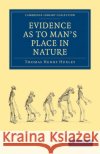
In 1863, the biologist and educator Thomas Henry Huxley published Evidence as to Man's Place in Nature, a compilation of his public lectures on Darwin's theory of evolution specifically the controversial idea of the ape ancestry of humans. An energetic supporter of Darwin, Huxley's argues that in order to understand the universe, everyone must know their place in the natural world. The book is divided into three parts, each written with the aim of persuading lay audiences. The first covers earlier human beliefs about exotic animals, especially 'man-like' apes. In Part 2, Huxley suggests that...
In 1863, the biologist and educator Thomas Henry Huxley published Evidence as to Man's Place in Nature, a compilation of his public lectures on Darwin...
Sir Charles Lyell (1797 1875) was one of the most renowned geologists of the nineteenth century. He was awarded the Copley Medal by the Royal Society in 1858 and the Wollaston Medal by the Geological Society of London in 1866 for his contributions to geology. Lyell's most important contribution to modern geology was his refining and popularising the geological concept of uniformitarianism, the idea that the earth has been formed through slow-acting geological forces. This biography, first published in 1881 and edited by his sister-in-law K. M. Lyell, provides an intimate view of Lyell's...
Sir Charles Lyell (1797 1875) was one of the most renowned geologists of the nineteenth century. He was awarded the Copley Medal by the Royal Society ...
Sir Charles Lyell (1797 1875) was one of the most renowned geologists of the nineteenth century. He was awarded the Copley Medal by the Royal Society in 1858 and the Wollaston Medal by the Geological Society of London in 1866 for his contributions to geology. Lyell's most important contribution to modern geology was his refining and popularising the geological concept of uniformitarianism, the idea that the earth has been formed through slow-acting geological forces. This biography, first published in 1881 and edited by his sister-in-law K. M. Lyell, provides an intimate view of Lyell's...
Sir Charles Lyell (1797 1875) was one of the most renowned geologists of the nineteenth century. He was awarded the Copley Medal by the Royal Society ...
Frederick Orpen Bower (1855 1948) was a renowned botanist best known for his research on the origins and evolution of ferns. Appointed Regius Professor of Botany at the University of Glasgow in 1885, he became a leading figure in the development of modern botany and the emerging field of paleobotany, devising the interpolation theory of the life cycle in land plants. First published between 1923 and 1928 as part of the Cambridge Botanical Handbook series, The Ferns was the first systematic classification of ferns according to anatomical, morphological and developmental features. In this...
Frederick Orpen Bower (1855 1948) was a renowned botanist best known for his research on the origins and evolution of ferns. Appointed Regius Professo...
First published in 1913, this volume reproduces a series of lectures on influential botanists delivered in 1911 in the Botanical Department of University College, London. The subjects of these biographies include Sir William Hooker (1785 1865), the first Director of Kew, and John Ray (1627 1705), considered the founder of scientific botany in Britain. The biographies are written by distinguished botanists of the period, over half of them holding a university professorship and membership of the Royal Society. Edited by F. W. Oliver (1864 1951), Professor of Botany at University College,...
First published in 1913, this volume reproduces a series of lectures on influential botanists delivered in 1911 in the Botanical Department of Univers...
Agnes Arber (1879 1960) was a prominent British botanist specialising in plant morphology and the history of botany. In 1946 she became the first female botanist to be elected a Fellow of the Royal Society. First published in 1912 and issued in an expanded second edition in 1938, this volume traces the history and development of printed herbals between 1470 and 1670. This two-hundred-year period was the most prolific for the publication of herbals, and significantly saw the emergence of botany as a scientific discipline within the study of natural history. Although Arber mentions the medical...
Agnes Arber (1879 1960) was a prominent British botanist specialising in plant morphology and the history of botany. In 1946 she became the first fema...
Sir William Jackson Hooker (1785 1865) was an eminent British botanist who is best known for expanding and developing the Royal Botanic Gardens at Kew into a leading centre of botanic research and conservation. After undertaking botanical expeditions to Iceland and across Europe, he was appointed Regius Professor of Botany at Glasgow University in 1820, where he proved to be a popular lecturer and established the Royal Botanical Institution of Glasgow. In 1841 Hooker was appointed the first Director of the Royal Gardens at Kew, a position he held until his death. This volume, written by his...
Sir William Jackson Hooker (1785 1865) was an eminent British botanist who is best known for expanding and developing the Royal Botanic Gardens at Kew...