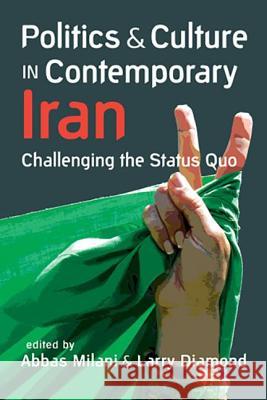
Despite the relative calm apparent in Iran today, there is unmistakable evidence of political, social, and cultural ferment stirring beneath the surface. The authors of Politics and Culture in Contemporary Iran ua unique group of scholars, activists, and artistsuexplore that unrest and its challenge to the legitimacy and stability of the present authoritarian regime. Ranging from political theory to music, from human rights law to social media, their contributions reveal the tenacious and continually evolving forces that are at work resisting the status quo.
Despite the relative calm apparent in Iran today, there is unmistakable evidence of political, social, and cultural ferment stirring beneath the surfa...
When Chen Shui-bian, Taiwan's first non-Kuomintang president, left office in 2008, his tenure was widely considered a disappointment. More recent events, however, suggest the need for a reassessment of this crucial period in Taiwan's political development. Taiwan's Democracy Challenged provides that assessment, considering key facets of both the progress toward and the obstacles to democratic consolidation during the Chen Shui-bian era.
When Chen Shui-bian, Taiwan's first non-Kuomintang president, left office in 2008, his tenure was widely considered a disappointment. More recent even...
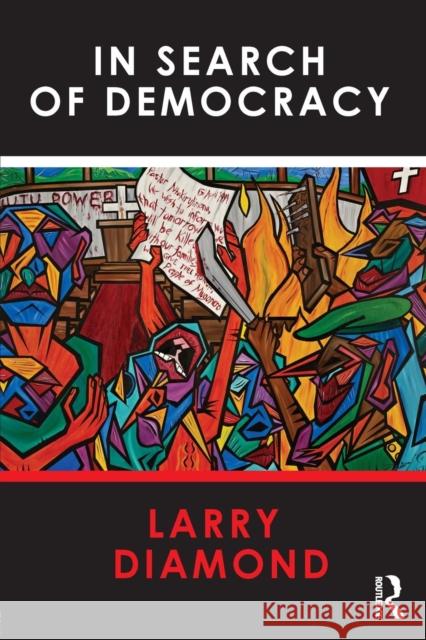
This book evaluates the global status and prospects of democracy, with an emphasis on the quality of democratic institutions and the effectiveness of governance as key conditions for stable democracy. Bringing together a wide range of the author's work over the past three decades, it advances a framework for assessing the quality of democracy and it analyzes alternative measures of democracy. Drawing on the most recent data from Freedom House, it assesses the global state of democracy and freedom, as of the beginning of 2015, and it explains why the world has been experiencing a mild but...
This book evaluates the global status and prospects of democracy, with an emphasis on the quality of democratic institutions and the effectiveness ...
Despite the relative calm apparent in Iran today there is unmistakable evidence of political social and cultural ferment stirring beneath the surface. The authors of Politics and Culture in Contemporary Irana"a unique group of scholars activists and artistsa"explore that unrest and its challenge to the legitimacy and stability of the present authoritarian regime. Ranging from political theory to music from human rights law to social media their contributions reveal the tenacious and continually evolving forces that are at work resisting the status quo.
Despite the relative calm apparent in Iran today there is unmistakable evidence of political social and cultural ferment stirring beneath the surface....
When Chen Shui-bian, Taiwan's first non-Kuomintang president, left office in 2008, his tenure was widely considered a disappointment. More recent events, however, suggest the need for a reassessment of this crucial period in Taiwan's political development. Taiwan's Democracy Challenged provides that assessment, considering key facets of both the progress toward and the obstacles to democratic consolidation during the Chen Shui-bian era.
When Chen Shui-bian, Taiwan's first non-Kuomintang president, left office in 2008, his tenure was widely considered a disappointment. More recent even...
Andreas Schedler Larry Diamond Marc F. Plattner (Counsellor, National E
This text states that democratic governments must be accountable to the electorate; but they must also be subject to restraint and oversight by other public agencies. The state must control itself. This text explores how new democracies can achieve this goal.
This text states that democratic governments must be accountable to the electorate; but they must also be subject to restraint and oversight by other ...
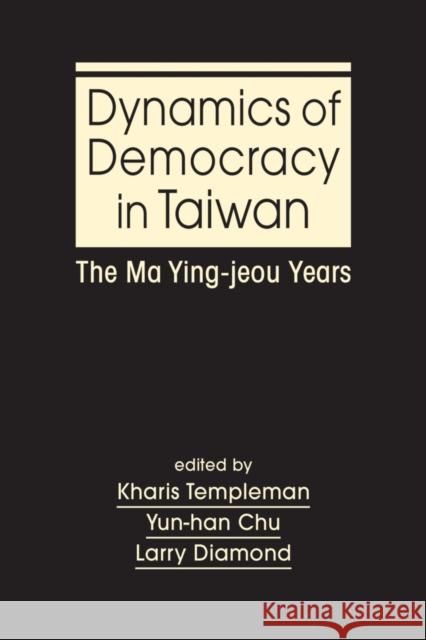
During the Ma Ying-jeou presidency in Taiwan (2008-2016), confrontations over relations with mainland China stressed the country's institutions, leading to a political crisis. Nevertheless, its democracy proved to be resilient. The authors of Dynamics of Democracy in Taiwan explore key aspects of the complicated Ma era, including party politics and elections, the sources of Ma's governance challenges, changing public opinion, protest movements, and shifts in the regional balance of power.
During the Ma Ying-jeou presidency in Taiwan (2008-2016), confrontations over relations with mainland China stressed the country's institutions, leadi...
This book evaluates the global status and prospects of democracy, with an emphasis on the quality of democratic institutions and the effectiveness of governance as key conditions for stable democracy. Bringing together a wide range of the author's work over the past three decades, it advances a framework for assessing the quality of democracy and it analyzes alternative measures of democracy. Drawing on the most recent data from Freedom House, it assesses the global state of democracy and freedom, as of the beginning of 2015, and it explains why the world has been experiencing a mild but...
This book evaluates the global status and prospects of democracy, with an emphasis on the quality of democratic institutions and the effectiveness ...