The widespread adoption of college- and career-readiness standards, including the Common Core State Standards for Mathematics, presents a historic opportunity to improve mathematics education. What will it take to turn this opportunity into reality in every classroom, school, and district? Continuing its tradition of mathematics education leadership, NCTM has defined and described the principles and actions, including specific teaching practices, that are essential for a high-quality mathematics education for all students. Principles to Actions: Ensuring Mathematical Success for...
The widespread adoption of college- and career-readiness standards, including the Common Core State Standards for Mathematics, presents a historic opp...
Could there be a better or more delicious way to prove the case that math is a basic fact of our everyday lives than with a cookbook? The success or failure of our efforts in the kitchen often comes down to the alchemy of not just the selection of ingredients but how much of any one ingredient. Judging by the dishes in The Mathematics Education Trust cookbook, Recipes You Can Count On , National Council of Teachers of Mathematics members know their way around the kitchen as well as the classroom. Throughout, there are tips for getting the best results for each recipe and Measure for Measure...
Could there be a better or more delicious way to prove the case that math is a basic fact of our everyday lives than with a cookbook? The success or f...
The enduring challenge for every teacher is providing individual and responsive learning experiences for every student. Factor in other parts of the educator's mission--aligning teaching with content and practice standards, providing worthwhile tasks for class participation and discussion, assessing mathematical understanding and progress--and the challenge is even greater. Transforming the Task with Number Choice presents a uniquely powerful tool to accomplish these goals and more. By choosing and sequencing productive arrays of numbers for problems, you can-- meet the needs and strengths of...
The enduring challenge for every teacher is providing individual and responsive learning experiences for every student. Factor in other parts of the e...
Do your students think they can model ratios with sets of discrete objects and combine them to show the addition of ratios? Do they believe that equivalent ratios are based on additive relationships rather than multiplicative ones? What tasks can you offer what questions can you ask to determine what your students know or don't know and move them forward in their thinking? This book focuses on the specialized pedagogical content knowledge that you need to teach ratios and proportions effectively in grades 6-8. The authors demonstrate how to use this multifaceted knowledge to address the big...
Do your students think they can model ratios with sets of discrete objects and combine them to show the addition of ratios? Do they believe that equiv...
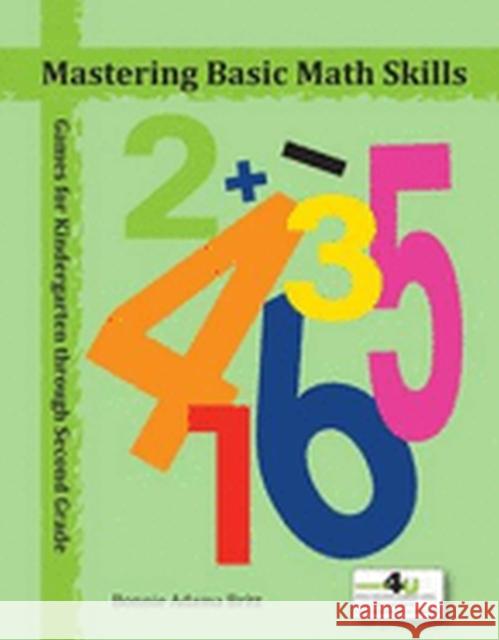
Fractions, decimals, integers ...can children gain a deeper understanding of mathematical concepts, develop better math skills, and have fun? Absolutely! This collection of games for children in third through fifth grade proves it. Games are organized in each chapter from simplest to more advanced, and many have variations that change the rules of play or make it more challenging once the basic game is mastered. Math games keep children engaged while providing the enormous amounts of practice they need to learn new concepts and math facts. Designed for use in the classroom and at home, the...
Fractions, decimals, integers ...can children gain a deeper understanding of mathematical concepts, develop better math skills, and have fun? Absolute...
Do your students think that a sample, regardless of size, always has the same characteristics as the population from which it is drawn? Do they know the difference between the distribution of a sample and the sampling distribution of a statistic? What tasks can you offer, and what questions can you ask, to determine what your students know or don't know--and move them forward in their thinking? This book focuses on the specialized pedagogical content knowledge that you need to teach statistics effectively in grades 9-12. The authors demonstrate how to use this multifaceted knowledge to...
Do your students think that a sample, regardless of size, always has the same characteristics as the population from which it is drawn? Do they know t...
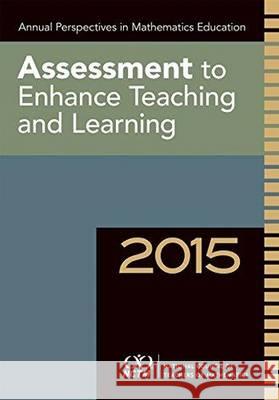
Assessment is one of the most discussed topics in mathematics education today. Issues drawing particular attention include the proper role of formative assessment, the need to show accountability through large-scale assessment, and the use of assessment to measure student learning of the content and practices in evolving new standards. The 2015 issue of Annual Perspectives in Mathematics Education (APME) approaches assessment from a wide variety of perspectives. Its 21 chapters, written by leading mathematics educators and researchers, are grouped into four sections: Assessment in Action...
Assessment is one of the most discussed topics in mathematics education today. Issues drawing particular attention include the proper role of formativ...
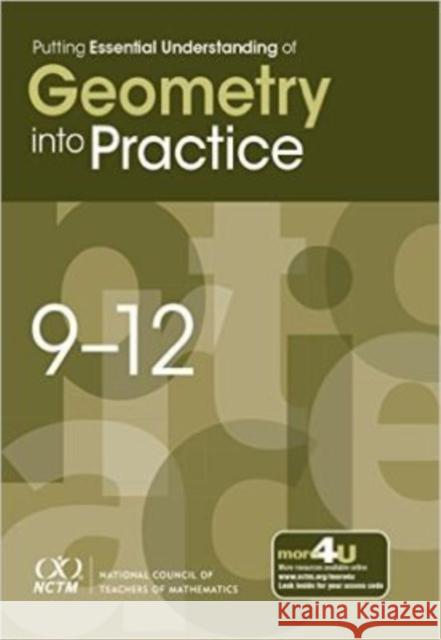
Do your students think a triangle can be constructed from any three given line segments? Do they believe that a transformation affects only the pre-image-not the whole plane? Do they understand that examples-no matter how many they find-cannot prove a conjecture but one counterexample is sufficient to disprove it? What tasks can you offer-what questions can you ask-to determine what they know or don't know-and move them forward in their thinking This book focuses on the specialized pedagogical content knowledge that you need to teach geometry effectively in grades 9-12. The authors...
Do your students think a triangle can be constructed from any three given line segments? Do they believe that a transformation affects only the pre-im...
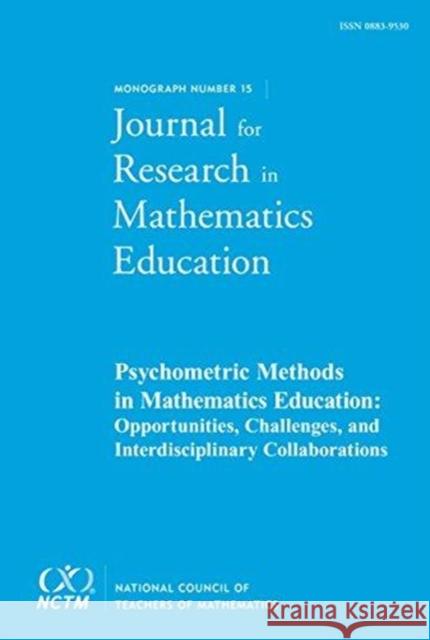
The fifteenth Journal for Research in Mathematics Education monograph had its origins in a conference titled An Interdisciplinary Conference on Assessment in K--12 Mathematics: Collaborations Between Mathematics Education and Psychometrics, which was held in 2011 in Atlanta, Georgia. The basis for the conference was the renaissance in the field of psychometrics in which an increasing variety of psychometric models are becoming available through advances in computer hardware and software. This is opening new avenues for studying the mathematical knowledge of teachers and students. The...
The fifteenth Journal for Research in Mathematics Education monograph had its origins in a conference titled An Interdisciplinary Conference on Assess...