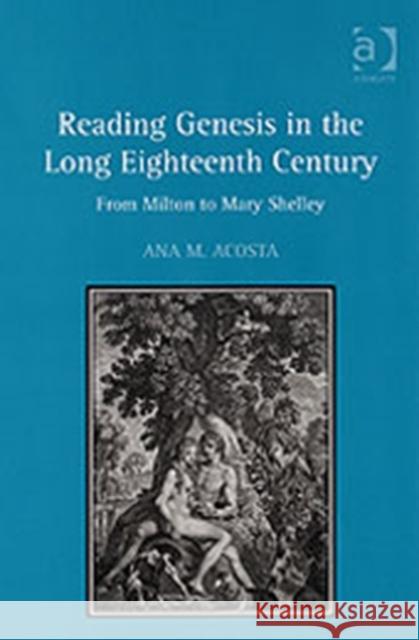
In a reassessment of the long-accepted division between religion and enlightenment, Ana Acosta here traces a tissue of readings and adaptations of Genesis and Scriptural language from Milton through Rousseau to Wollstonecraft and Mary Shelley. Acosta's interdisciplinary approach places these writers in the broader context of eighteenth-century political theory, biblical criticism, religious studies and utopianism. Acosta's argument is twofold: she establishes the importance of Genesis within utopian thinking, in particular the influential models of Milton and Rousseau; and she demonstrates...
In a reassessment of the long-accepted division between religion and enlightenment, Ana Acosta here traces a tissue of readings and adaptations of Gen...
In a reassessment of the long-accepted division between religion and enlightenment, Ana Acosta here traces a tissue of readings and adaptations of Genesis and Scriptural language from Milton through Rousseau to Wollstonecraft and Mary Shelley. Acosta's interdisciplinary approach places these writers in the broader context of eighteenth-century political theory, biblical criticism, religious studies and utopianism. Acosta's argument is twofold: she establishes the importance of Genesis within utopian thinking, in particular the influential models of Milton and Rousseau; and she demonstrates...
In a reassessment of the long-accepted division between religion and enlightenment, Ana Acosta here traces a tissue of readings and adaptations of Gen...