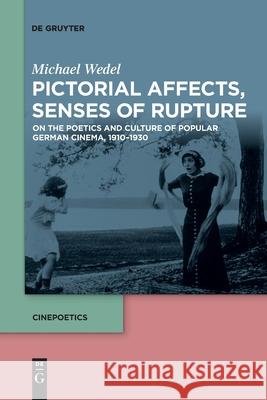
German film in the Wilhelmine and Weimar periods is regarded as marked by a strong sense of cultural conservatism and the aspiration to be recognized as an art form. This book takes an alternative approach to the history of German cinema from the emergence of the early feature film to the transition to sound by focusing on the poetics of popular genres such as the disaster film, melodrama, the musical and the war film, exploring their cultural reverberations and modes of audience address. Based on the assumption that popular cinema contributed immensely to the breakthrough of a modern...
German film in the Wilhelmine and Weimar periods is regarded as marked by a strong sense of cultural conservatism and the aspiration to be recognized ...
Too often, film and the cinema have been treated primarily as a visual medium, with the consequence that spectatorship has come to be regarded as a matter of the eye alone. In Film History: An Introduction through the Senses, Thomas Elsaesser and Michael Wedel put the other senses at the centre of the cinematic experience, charting the dynamics along which the cinema has configured, positioned, and rearticulated itself over time within the larger cultural force field of media technologies, the body, and the senses.
Much like Film Theory: An Introduction through the Senses, each chapter...
Too often, film and the cinema have been treated primarily as a visual medium, with the consequence that spectatorship has come to be regarded as a...
German film in the Wilhelmine and Weimar periods is regarded as marked by a strong sense of cultural conservatism and the aspiration to be recognized as an art form. This book takes an alternative approach to the history of German cinema from the emergence of the early feature film to the transition to sound by focusing on the poetics of popular genres such as the disaster film, melodrama, the musical and the war film, exploring their cultural reverberations and modes of audience address. Based on the assumption that popular cinema contributed immensely to the breakthrough of a modern...
German film in the Wilhelmine and Weimar periods is regarded as marked by a strong sense of cultural conservatism and the aspiration to be recognized ...
Too often, film and the cinema have been treated primarily as a visual medium, with the consequence that spectatorship has come to be regarded as a matter of the eye alone. In Film History: An Introduction through the Senses, Thomas Elsaesser and Michael Wedel put the other senses at the centre of the cinematic experience, charting the dynamics along which the cinema has configured, positioned, and rearticulated itself over time within the larger cultural force field of media technologies, the body, and the senses.
Much like Film Theory: An Introduction through the Senses, each chapter...
Too often, film and the cinema have been treated primarily as a visual medium, with the consequence that spectatorship has come to be regarded as a...