Studien, die Dürreereignisse identifizieren, tragen zur Entscheidungsfindung bei und etablieren eine angemessene landwirtschaftliche Planung und Bewirtschaftung, beispielsweise den Zeitpunkt der Aussaat, Notwendigkeiten der Bewässerung und Sortenwahl (PATHMESWARAN et al. 2018; WIRÉHN, 2018; SANTI et al., 2018; DE SOUSA; DE OLIVEIRA, 2018; DE SOUZA et al., 2018; TAYT'SOHN et al., 2018; AGOVINO] et al., 2019).Der Anbau von Sojabohnen erfolgt im Frühling und Sommer zwischen September und März und ist die wichtigste landwirtschaftliche Tätigkeit in Brasilien und im Bundesstaat Paraná....
Studien, die Dürreereignisse identifizieren, tragen zur Entscheidungsfindung bei und etablieren eine angemessene landwirtschaftliche Planung und Bewi...
Les études qui identifient les occurrences de sécheresse contribuent à la prise de décision et établissent une planification et une gestion agricole appropriées, par exemple le moment des semis, les nécessités de l'irrigation et le choix du cultivar (PATHMESWARAN et al. 2018; WIRÉHN, 2018; SANTI et al., 2018; DE SOUSA; DE OLIVEIRA, 2018; DE SOUZA et al., 2018; TAYT'SOHN et al., 2018 ; AGOVINO] et al., 2019).Cultivée au printemps et en été, entre septembre et mars, la culture du soja constitue la principale activité agricole du Brésil et de l'État du Paraná. Plusieurs études...
Les études qui identifient les occurrences de sécheresse contribuent à la prise de décision et établissent une planification et une gestion agric...
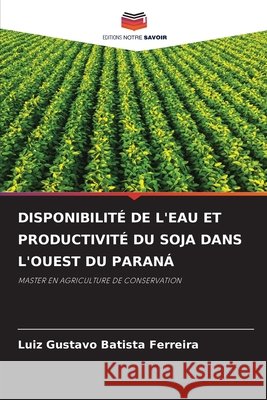
Soja (Glycine max L.) ist die wichtigste landwirtschaftliche Nutzpflanze in Paraná, dem zweitgrößten Erzeuger des Landes. Unter den Sojaanbaugebieten Paranás ragt der Westen mit 21 % der Produktion des Bundesstaates heraus. Mehrere Studien haben gezeigt, dass die El Niño Southern Oscillation (ENOS) und die Pacific Decadal Oscillation (PDO) die Niederschläge in Brasilien und Paraná beeinflussen. Ziel dieser Dissertation war es, den Einfluss von Klimaschwankungen und Wasserverfügbarkeit auf die Sojaproduktivität im westlichen Paraná zu untersuchen.
Soja (Glycine max L.) ist die wichtigste landwirtschaftliche Nutzpflanze in Paraná, dem zweitgrößten Erzeuger des Landes. Unter den Sojaanbaugebiet...
Soybeans (Glycine max L.) are the main agricultural crop in Paraná, the second largest producer in the country. Among Paraná's soybean-producing regions, the West stands out, accounting for 21% of the state's production. Several studies have shown that the El Niño Southern Oscillation (ENOS) and the Pacific Decadal Oscillation (PDO) influence rainfall in Brazil and Paraná. The aim of this dissertation was to assess the influence of climate variability and water availability on soybean productivity in western Paraná.
Soybeans (Glycine max L.) are the main agricultural crop in Paraná, the second largest producer in the country. Among Paraná's soybean-producing reg...
Le soja (Glycine max L.) est la principale culture agricole du Paraná, deuxième producteur du pays. Parmi les régions productrices de soja du Paraná, l'Ouest se distingue avec 21 % de la production de l'État. Plusieurs études ont montré que l'oscillation australe El Niño (ENOS) et l'oscillation décennale du Pacifique (PDO) influencent les précipitations au Brésil et au Paraná. L'objectif de cette thèse était d'évaluer l'influence de la variabilité climatique et de la disponibilité en eau sur la productivité du soja dans l'ouest du Paraná.
Le soja (Glycine max L.) est la principale culture agricole du Paraná, deuxième producteur du pays. Parmi les régions productrices de soja du Paran...