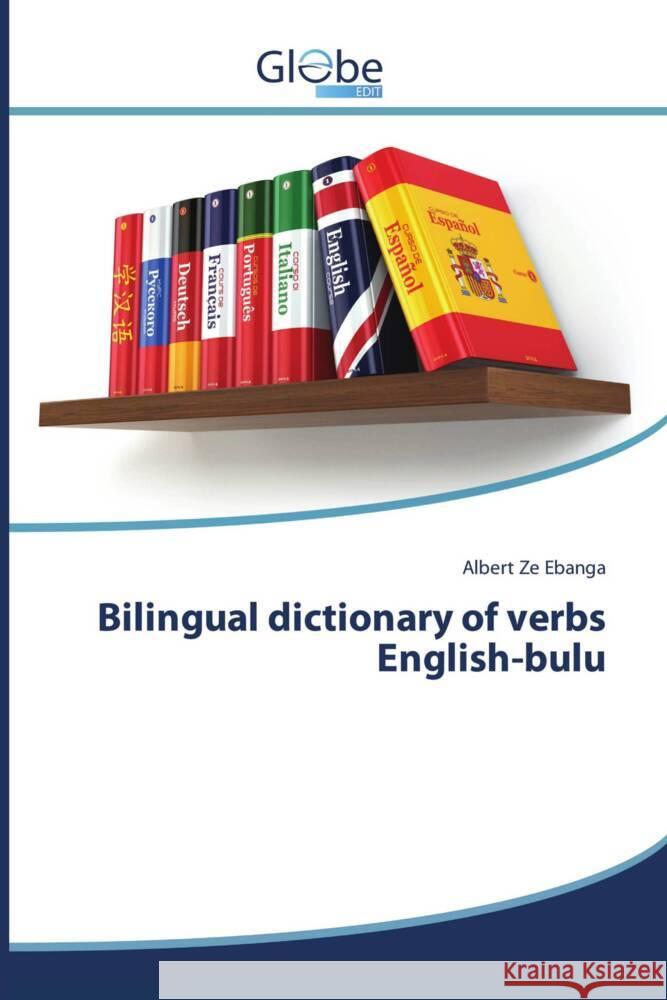
This dictionary is a tool for students and teachers who want to translate English sentences into Bulu or the reverse. A verb is one of the main categories of a language. In Bulu the verb can carry the following range of inflections 'a-' présent tense, 'nga-' remote past tense, 'ate' past tense of today, 'é-' future tense etc. In this dictionary the reader will find many examples of VV constructions, where the first verb is an auxiliary verb. For Andrew Radford the word auxiliary is a term used to categorise items such as "must", "may" and their counterparts in Bulu.
This dictionary is a tool for students and teachers who want to translate English sentences into Bulu or the reverse. A verb is one of the main catego...
In this paper I explore the syntax of the exclusive focus particle "ve"-'only in Bulu a bantu language of Cameroon. The structure of a simple sentence is often T-vP in Bulu, but the exclusive focus particle never surfaces between T and vP a position which can host other particles. The paper is mainly a comparative study of Bulu and English syntax. I try to apply the work of Richard Kayne concerning the the overt movement of 'only ' in English syntax to the data of Bulu, I also pay tribute to Vicki Carstens for her works on bantu languages.
In this paper I explore the syntax of the exclusive focus particle "ve"-'only in Bulu a bantu language of Cameroon. The structure of a simple sentence...
This book is made up of three main sections with numerous chapitres. The first section is about the syntax of negation and the particle "ki" (not). The next section deals with the exclusive focus particle "ve " or "he" (only) and the Reduplication of categories like verb for the aim of Focalisation. These two particles sometimes occur in ambiguous sentences. And The last section is a dictionary of Ewondo verbs and their meaning in English. This book will be useful for the comparative study of Bulu, Fang and Ewondo. These languages share many features in common. They have the same verbal...
This book is made up of three main sections with numerous chapitres. The first section is about the syntax of negation and the particle "ki" (not). Th...
The comparative syntax of A70 languages Fang Ewondo and Bulu is a study of three languages spoken in Cameroon, Gabon and Equatorial Guinea. This study explores some aspects of the minimalist syntax such as External Merge and Internal Merge, the deletion of copies in multiple agreement constructions. It shows lists of verbs that can take an infinitival complement. These languages have a special type of coordination that can help to understand the theory of binding and partial control. There are two other comparative studies of these three languages : their negative strategies and their...
The comparative syntax of A70 languages Fang Ewondo and Bulu is a study of three languages spoken in Cameroon, Gabon and Equatorial Guinea. This study...