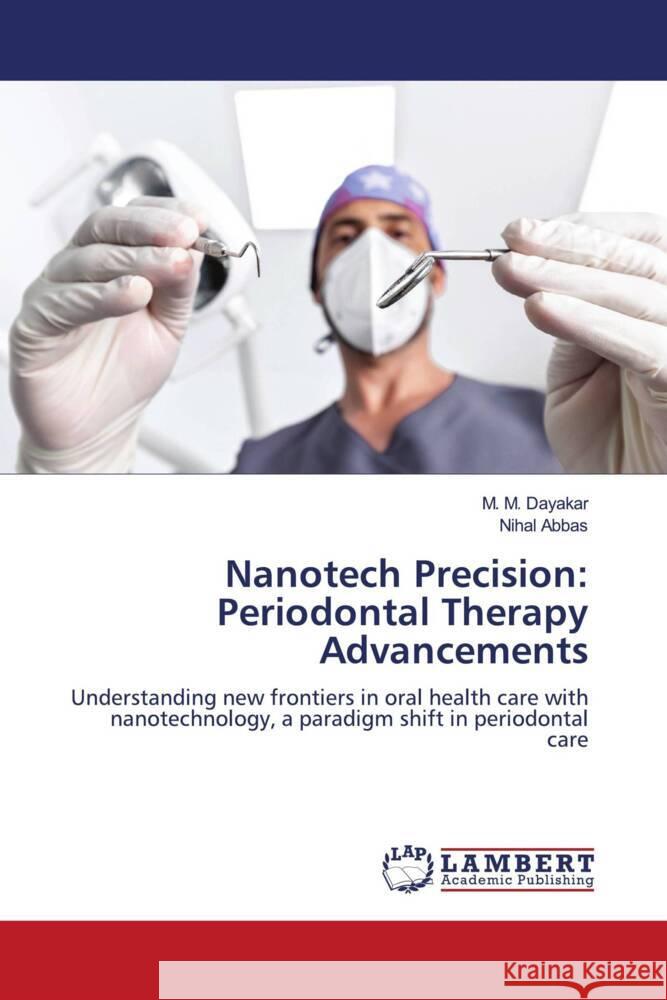
Nanotechnology has emerged as a groundbreaking frontier in the field of periodontics, at the nanoscale level, materials exhibit unique properties that can be leveraged for targeted therapeutic interventions. In periodontal care, this translates to precision and effectiveness previously unseen. Nanotechnology represents a paradigm shift in periodontics and learning about nanotechnology in periodontics is crucial for its potential to revolutionize diagnosis and treatment. Nanomaterials enable precise diagnostics, targeted drug delivery, and antimicrobial solutions, improving therapeutic...
Nanotechnology has emerged as a groundbreaking frontier in the field of periodontics, at the nanoscale level, materials exhibit unique properties that...
Gurupur, Prakash Pai, H. A., Impana, Dayakar, M. M.
Künstliche Intelligenz (KI) verändert die moderne zahnärztliche Praxis, indem sie ein intelligenteres, effizienteres und individuelleres Patientenmanagement ermöglicht. In dieser Dissertation werden die neuesten technologischen Fortschritte und praktischen Anwendungen von KI in verschiedenen Bereichen der Zahnmedizin untersucht, wobei ein besonderer Schwerpunkt auf ihrer wachsenden Rolle in der Parodontologie liegt. Die Anwendung von maschinellem Lernen und Deep-Learning-Techniken - insbesondere bei der Interpretation von Röntgendaten und der Vorhersage des Verlaufs parodontaler...
Künstliche Intelligenz (KI) verändert die moderne zahnärztliche Praxis, indem sie ein intelligenteres, effizienteres und individuelleres Patientenm...
Gurupur, Prakash Pai, H. A., Impana, Dayakar, M. M.
L'intelligence artificielle (IA) est en train de remodeler la pratique dentaire contemporaine en permettant une gestion plus intelligente, plus efficace et plus individualisée des patients. Cette thèse étudie les dernières avancées technologiques et les utilisations concrètes de l'IA dans diverses branches de la dentisterie, en mettant particulièrement l'accent sur son rôle croissant en parodontologie. L'application de techniques d'apprentissage automatique et d'apprentissage profond - en particulier dans l'interprétation des données radiographiques et la prédiction de la...
L'intelligence artificielle (IA) est en train de remodeler la pratique dentaire contemporaine en permettant une gestion plus intelligente, plus effica...
H., Shivananda, Kulkarni, Souparnika M., Dayakar, M. M.
"Nanotechnologie" wird definiert als die Untersuchung, Entwicklung und Anwendung von extrem kleinen (etwa 1-100 nm) Materialien, Geräten und Systemen, die physikalische, chemische und biologische Eigenschaften aufweisen, die sich von denen in größerem Maßstab unterscheiden (Dunn et al., 2002). Der Begriff "Nanotechnologie" wurde 1977 von Prof. Kerie E. Drexler geprägt und populär gemacht.1 Die Nanoskala wird manchmal auch für Materialien verwendet, die kleiner als 1 µm sind. Die Nanotechnologie in der Zahnmedizin umfasst mehrere Bereiche, darunter diagnostische Nanogeräte,...
"Nanotechnologie" wird definiert als die Untersuchung, Entwicklung und Anwendung von extrem kleinen (etwa 1-100 nm) Materialien, Geräten und Systemen...
H., Shivananda, Kulkarni, Souparnika M., Dayakar, M. M.
La "nanotechnologie" est définie comme l'étude, le développement et l'application de matériaux, de dispositifs et de systèmes extrêmement petits (de l'ordre de 1 à 100 nm) présentant des propriétés physiques, chimiques et biologiques différentes de celles que l'on trouve à plus grande échelle (Dunn et al., 2002). L'autre nom de cette technologie est la nanotechnologie moléculaire ou ingénierie moléculaire (Drexler, 1992). Le terme "nanotechnologie" a été inventé et popularisé par le professeur Kerie E Drexler en 1977. La nanotechnologie en dentisterie englobe plusieurs...
La "nanotechnologie" est définie comme l'étude, le développement et l'application de matériaux, de dispositifs et de systèmes extrêmement petits...