In Knowing How to Live, Sangharakshita delves into Nagarjuna s Precious Garland text and extracts the gems of wisdom relevant to the Buddhist practitioner of today, from the beginner to one who is more experienced. The text, originally written for King Satavahana, a spiritual disciple of Nagarjuna s, is a layman s guide to Enlightenment. Though originally intended to be studied by a leader of men, in this democratic era Buddhists of all walks of life can learn from the insights of this enlightened teacher of the past.
Principally, readers will learn that the path to...
In Knowing How to Live, Sangharakshita delves into Nagarjuna s Precious Garland text and extracts the gems of wisdom relevant to the ...
In this approachable handbook, Sangharakshita guides the reader through the complex tradition of Buddhism. In part one he tackles the theory of the religion in sections devoted to the Buddha, his teachings, and the spiritual community, while in part two he discusses the practicalities of trying to lead a Buddhist life. For those wishing to deepen their knowledge and experience of Buddhism, this is a complete map of the Buddhist path.
Sangharakshita is the founder of the Triratna Buddhist Community. He has a lifetime of teaching experience and is the author of over forty...
In this approachable handbook, Sangharakshita guides the reader through the complex tradition of Buddhism. In part one he tackles the theory of the...
A vivid picture of the people, the places, and the experiences that shaped Sangharakshita's life.
Sangharakshita read the Diamond Sutra for the first time the summer he turned seventeen. It seemed to awaken him to something whose existence he had forgotten, and he joyfully embraced those profound teachings -with an unqualified acceptance.- This experience decided the whole future direction of his life.
In this first volume of memoirs he describes how, from a working-class childhood in the London suburb of Tooting, he came, a twenty-four-year-old Buddhist novice monk, to...
A vivid picture of the people, the places, and the experiences that shaped Sangharakshita's life.
The pieces collected here were written over a ten year period crucial to the development of Sangharakshita's thought and expression. From visionary early writings to the later articles leavened by deep reflection, there emerges the unmistakeable voice of the writer of A Survey of Buddhism.
The pieces collected here were written over a ten year period crucial to the development of Sangharakshita's thought and expression. From visionary ea...
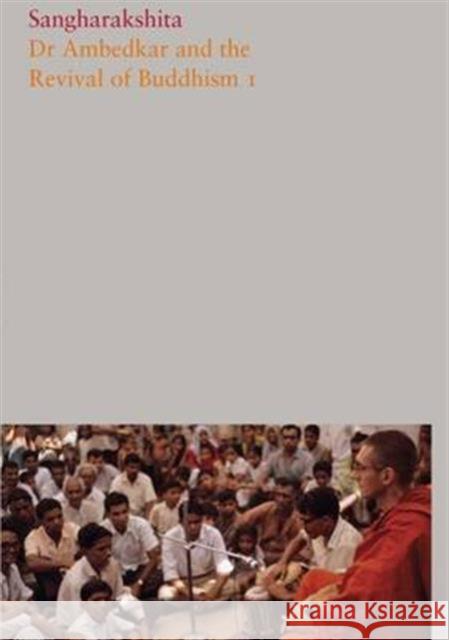
One of the most far-reaching of Sangharakshita's contributions to modern Buddhism was giving shape to the Buddhist conversion movement begun by the great Indian statesman and reformer, Dr. B.R. Ambedkar. In 1956, along with hundreds of thousands of his followers, Ambedkar renounced the Hindu caste system--according to which they were condemned to be -untouchable---and converted to Buddhism, thus beginning a new life.
The first part of this volume tells the story of how Ambedkar overcame the suffering and struggle of his early years to become the shaper of the Indian constitution and...
One of the most far-reaching of Sangharakshita's contributions to modern Buddhism was giving shape to the Buddhist conversion movement begun by the...
'The Bodhisattva ideal is a vast subject. It is the major distinctive emphasis of the phase of the development of Buddhism known as the Mahāyāna, which had its flowering for a period of around 500 years (0–500CE), but is still practised today in many different forms, from Tibetan Buddhism to Zen. To consider this topic is to place one’s hand on the very heart of Buddhism, and feel the beating of that heart.' Thus Sangharakshita introduces his theme. The first part of this volume describes the arising of the bodhicitta and the bodhisattva's path to Enlightenment in a weaving together...
'The Bodhisattva ideal is a vast subject. It is the major distinctive emphasis of the phase of the development of Buddhism known as the Mahāyāna, wh...
Sangharakshita approaches communicating Buddhism in the West from two very different, but equally illuminating, angles. In the first part, he introduces the apparently exotic worlds of Tibetan Buddhism and its creative symbols, and Zen Buddhism. In the second part he examines the practice of Buddhism in the context of Western culture.
Sangharakshita approaches communicating Buddhism in the West from two very different, but equally illuminating, angles. In the first part, he introduc...
This volume includes two memoirs. In the Sign of the Golden Wheel tells the story of the `middle period’ of the fourteen years Sangharakshita was based in the Indian hill station, Kalimpong. It is a crucial time for Buddhism as the whole Asian world is preparing to celebrate 2,500 years of Buddhism, and Sangharakshita’s abundant energies are brought into play in diverse ways. His commitment to spreading the Dharma as widely as he can and to serving the (few) existing Buddhists in India takes him far afield: from tea estates in Assam to a film studio in Bombay, from the Maha Bodhi Society...
This volume includes two memoirs. In the Sign of the Golden Wheel tells the story of the `middle period’ of the fourteen years Sangharakshita was b...