This book, by one of the most innovative and challenging contemporary thinkers, consists of an extensive essay from which the book takes its title and five shorter essays that are internally related to "Being Singular Plural." One of the strongest strands in Nancy's philosophy is his attempt to rethink community and the very idea of the social in a way that does not ground these ideas in some individual subject or subjectivity. The fundamental argument of the book is that being is always "being with," that "I" is not prior to "we," that existence is essentially co-existence. Nancy thinks of...
This book, by one of the most innovative and challenging contemporary thinkers, consists of an extensive essay from which the book takes its title and...
This work examines community as an idea that has dominated modern thought and traces its relation to concepts of experience, discourse and the individual.
This work examines community as an idea that has dominated modern thought and traces its relation to concepts of experience, discourse and the individ...
How have we thought the body? How can we think it anew? The body of mortal creatures, the body politic, the body of letters and of laws, the mystical body of Christ-all these (and others) are incorporated in the word Corpus, the title and topic of Jean-Luc Nancy's masterwork.Corpus is a work of literary force at once phenomenological, sociological, theological, and philosophical in its multiple orientations and approaches. In thirty-six brief sections, Nancy offers us at once an encyclopedia and a polemical program-reviewing classical takes on the corpusfrom Plato, Aristotle, and Saint Paul...
How have we thought the body? How can we think it anew? The body of mortal creatures, the body politic, the body of letters and of laws, the mystical ...
Originally written for an exhibition Jean-Luc Nancy curated at the Museum of Fine Arts in Lyon in 2007, this book addresses the medium of drawing in light of the question of form--of form in its formation, as a formative force, as a birth to form. In this sense, drawing opens less toward its achievement, intention, and accomplishment than toward a finality without end and the infinite renewal of ends, toward lines of sense marked by tracings, suspensions, and permanent interruptions. Recalling that drawing and design were once used interchangeably, Nancy notes that "drawing" designates a...
Originally written for an exhibition Jean-Luc Nancy curated at the Museum of Fine Arts in Lyon in 2007, this book addresses the medium of drawing in l...
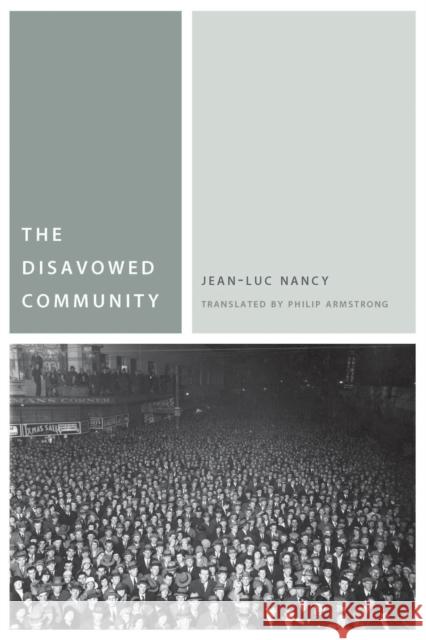
Over thirty years after Maurice Blanchot writes The Unavowable Community (1983)--a book that offered a critical response to an early essay by Jean-Luc Nancy on "the inoperative community"--Nancy responds in turn with The Disavowed Community. Stemming from Jean-Christophe Bailly's initial proposal to think community in terms of "number" or the "numerous," and unfolding as a close reading of Blanchot's text, Nancy's new book addresses a range of themes and motifs that mark both his proximity to and distance from Blanchot's thinking, from Bataille's "community of lovers" to the relation between...
Over thirty years after Maurice Blanchot writes The Unavowable Community (1983)--a book that offered a critical response to an early essay by Jean-Luc...
This book examines the practice of portraits as a way in to grasping the paradoxes of subjectivity. To Nancy, the portrait is suspended between likeness and strangeness, identity and distance, representation and presentation, exactitude and forcefulness. It can identify an individual, but it can also express the dynamics by means of which its subject advances and withdraws.
The book consists of two extended essays written a decade apart but in close conversation, in which Nancy considers the range of aspirations articulated by the portrait. Heavily illustrated, it includes a newly...
This book examines the practice of portraits as a way in to grasping the paradoxes of subjectivity. To Nancy, the portrait is suspended between lik...
Jean-Luc Nancy (*1940) patří mezi nejvýznamnější současné francouzské filosofy. Jeho stěžejní titul, vydaný poprvé v 80. letech, se snaží pojmenovat a obhájit původní význam pojmu, z něhož se v moderní společnosti stal jen svazek mezi na sobě nezávislými jedinci. V titulním eseji rozvíjí své úvahy v polemice s Georgem Bataillem a Martinem Heideggerem, v dalších textech se věnuje například konstitutivnímu významu mýtu nebo tomu, co je historie. Společnost pro Nancyho není sociální, ekonomický ani politický koncept, uvažuje o společné povaze...
Jean-Luc Nancy (*1940) patří mezi nejvýznamnější současné francouzské filosofy. Jeho stěžejní titul, vydaný poprvé v 80. letech, se snaÅ...