..". an astonishing work of speculative non-fiction." - from the Foreword by John Robert Colombo ..". a Grail tale to beat them all." - Mike Strobel, The Toronto Sun Swords at Sunset is Michael Bradley's bestselling non-fiction exploration of Holy Grail adventurers in North America from 1398 to 1571 (the author's research skills were also put to good use in the movie The Da Vinci Code). Bradley draws on evidence in The Book of Mormon and recently discovered artefacts from Lake Memphremagog and Niagara region to offer a convincing argument that communities of Grail refugees - who had fled the...
..". an astonishing work of speculative non-fiction." - from the Foreword by John Robert Colombo ..". a Grail tale to beat them all." - Mike Strobel, ...
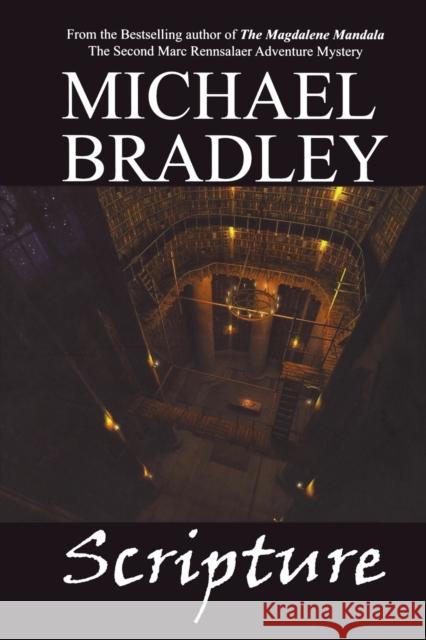
Draws on Michael Bradley's enviable reputation as a Holy Grail expert to lend authenticity to a plot that twists and turns at a rapid pace, bringing together murder and intrigue, political cover-ups, the Grail...and Mary Magdalene. Added to this intoxicating literary mix are detailed descriptions of ingenious low-tech survivalist devices.
Draws on Michael Bradley's enviable reputation as a Holy Grail expert to lend authenticity to a plot that twists and turns at a rapid pace, bringing t...
Michael Bradley is the bestselling author of more than 20 critically acclaimed books and a Holy Grail expert who served as a researcher for Da Vinci Code and National Treasure movies. His first 2 novels sold half-a-million copies. Then came the 2006 release of The Magdalene Mandala, paired by amazon with Swords at Sunset, the author's non-fiction book employing archeological evidence to trace the Grail to North America. The Magdalene Mandala marked the first of the author's Marc Rennsalaer Adventure Mystery series of Holy Grail novels that are captivating a growing audience. Now, there's...
Michael Bradley is the bestselling author of more than 20 critically acclaimed books and a Holy Grail expert who served as a researcher for Da Vinci C...
Although mathematical innovation stagnated in Europe after the fall of the Roman Empire, scholars in southern Asia and the Middle East continued to preserve the mathematical writings of the Greeks and contributed new ideas to arithmetic, algebra, geometry, and trigonometry, as well as astronomy and physics. The five centuries from 1300 to 1800 marked the end of a rich period of cultural, mathematical, and scientific advancements in China, India, and Arabic countries, while witnessing new intellectual life in Europe and the Western Hemisphere. The Age of Genius, Updated...
Although mathematical innovation stagnated in Europe after the fall of the Roman Empire, scholars in southern Asia and the Middle East continued to pr...
From 700 BCE to 1300 CE, thousands of scholars from many civilizations introduced mathematical ideas that established the foundations of arithmetic, number theory, algebra, geometry, and trigonometry, as well as the related sciences of astronomy and physics. Although we know very little about specific individuals who made important mathematical discoveries in Babylonia, Egypt, and China, historians in Arabia, ancient Greece, India, and medieval Italy preserved a more complete record, including the identities of some of the innovators.
The Birth of Mathematics, Updated...
From 700 BCE to 1300 CE, thousands of scholars from many civilizations introduced mathematical ideas that established the foundations of arithmetic, ...
During the 16th and 17th centuries, mathematicians developed a wealth of new ideas but had not carefully employed accurate definitions, proofs, or procedures to document and implement them. However, in the early 19th century, mathematicians began to recognize the need to precisely define their terms, to logically prove even obvious principles, and to use rigorous methods of manipulation.
The Foundations of Mathematics, Updated Edition presents the lives and accomplishments of 10 mathematicians who contributed to one or more of the four major initiatives that characterized the...
During the 16th and 17th centuries, mathematicians developed a wealth of new ideas but had not carefully employed accurate definitions, proofs, or pro...
During the first half of the 20th century, mathematics became an international discipline that led to major advances in science and technology. Modern Mathematics, Updated Edition provides an eye-opening introduction to those five historic decades by analyzing the advancement of the field through the accomplishments of 10 significant mathematicians. From David Hilbert and Emmy Noether, who introduced the infinite dimensional vector spaces and algebraic rings that bear their names, to Norbert Wiener, the founder of cybernetics, this in-depth title covers the early 20th-century...
During the first half of the 20th century, mathematics became an international discipline that led to major advances in science and technology. Mo...