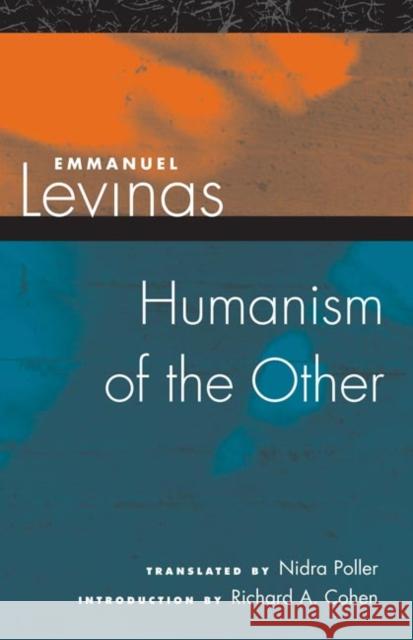
This book consists of transcripts from two lecture courses Levinas delivered in 1975-76, his last year at the Sorbonne. They cover some of the most pervasive themes of his thought and were written at a time when he had just published his most important--and difficult--book, Otherwise than Being, or Beyond Essence. Both courses pursue issues related to the question at the heart of Levinas's thought: ethical relation. The Foreword and Afterword place the lectures in the context of his work as a whole, rounding out this unique picture of Levinas the thinker and the teacher.
The...
This book consists of transcripts from two lecture courses Levinas delivered in 1975-76, his last year at the Sorbonne. They cover some of the most...
First published in 1935, On Escape represents Emmanuel Levinas's first attempt to break with the ontological obsession of the Western tradition. In it, Levinas not only affirms the necessity of an escape from being, but also gives a meaning and a direction to it. Beginning with an analysis of need not as lack or some external limit to a self-sufficient being, but as a positive relation to our being, Levinas moves through a series of brilliant phenomenological analyses of such phenomena as pleasure, shame, and nausea in order to show a fundamental insufficiency in the human condition....
First published in 1935, On Escape represents Emmanuel Levinas's first attempt to break with the ontological obsession of the Western tradition...
The "Nations" are the "seventy nations" a metaphor which, in the Talmudic idiom, designates the whole of humanity surrounding Israel. In this major collection of essays, Levinas considers Judaism's uncertain relationship to European culture since the Enlightenment, problems of distance and integration. It also includes essays on Franz Rosenzweig and Moses Mendelssohn, and a discussion of central importance to Jewish philosophy in the context of general philosophy. This work brings to the fore the vital encounter between philosophy and Judaism, a hallmark of Levinas's thought.
The "Nations" are the "seventy nations" a metaphor which, in the Talmudic idiom, designates the whole of humanity surrounding Israel. In this major co...
Argues that it is not only possible but of the highest exigency to understand one's humanity through the humanity of others. This book also argues that the humanity of the human is found in the recognition that the other person comes first, that the suffering and mortality of others are the obligations and morality of the self.
Argues that it is not only possible but of the highest exigency to understand one's humanity through the humanity of others. This book also argues tha...
Východiskem Lévinasova myšlení je Husserlova fenomenologie a Heideggerova ontologie, s nimiž vede polemnický dialog. Kriticky se staví proti chápání dějin, společnosti a člověka jako celku či totality, které hledisko nekonečnosti dává do pozadí.
Východiskem Lévinasova myšlení je Husserlova fenomenologie a Heideggerova ontologie, s nimiž vede polemnický dialog. Kriticky se staví proti ch...