This book presents the 1946 National Book League lecture, delivered by Bertrand Russell on the relationship between philosophies and the development of political systems.
This book presents the 1946 National Book League lecture, delivered by Bertrand Russell on the relationship between philosophies and the development o...
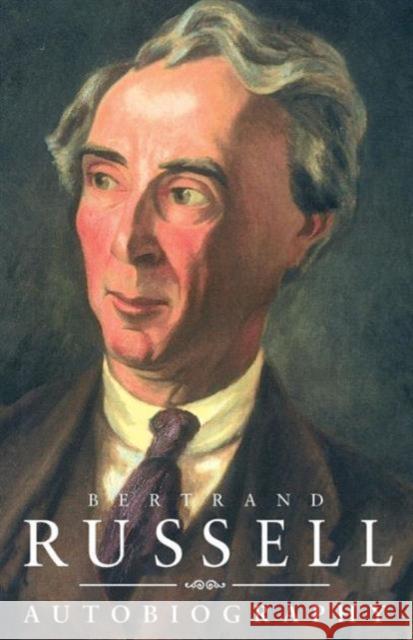
Bertrand Russell was born in 1872 and died in 1970. One of the most influential figures of the twentieth century, he transformed philosophy and can lay claim to being one of the greatest philosophers of all time. He was a Nobel Prize winner for Literature and was imprisoned several times as a result of his pacifism. His views on religion, education, sex, politics and many other topics, made him one of the most read and revered writers of the age. This, his autobiography, is one of the most compelling and vivid ever written. This one-volume, compact paperback edition contains an...
Bertrand Russell was born in 1872 and died in 1970. One of the most influential figures of the twentieth century, he transformed philosophy and can la...
Intolerance and bigotry lie at the heart of all human suffering. So claims Bertrand Russell at the outset of In Praise of Idleness, a collection of essays in which he espouses the virtues of cool reflection and free enquiry; a voice of calm in a world of maddening unreason. From a devastating critique of the ancestry of fascism to a vehement defence of 'useless' knowledge, with consideration given to everything from insect pests to the human soul, this is a tour de force that only Bertrand Russell could perform.
Intolerance and bigotry lie at the heart of all human suffering. So claims Bertrand Russell at the outset of In Praise of Idleness, a collect...
The key to human nature that Marx found in wealth and Freud in sex, Bertrand Russell finds in power. Power, he argues, is man's ultimate goal, and is, in its many guises, the single most important element in the development of any society. Writting in the late 1930s when Europe was being torn apart by extremist ideologies and the world was on the brink of war, Russell set out to found a 'new science' to make sense of the traumatic events of the day and explain those that would follow. The result was Power, a remarkable book that Russell regarded as one of the most important of...
The key to human nature that Marx found in wealth and Freud in sex, Bertrand Russell finds in power. Power, he argues, is man's ultimate goal, and is,...
'These propositions may seem mild, yet, if accepted, they would absolutely revolutionize human life.'
With these words Bertrand Russell introduces what is indeed a revolutionary book. Taking as his starting-point the irrationality of the world, he offers by contrast something 'wildly paradoxical and subversive' - a belief that reason should determine human actions. Today, besieged as we are by the numbing onslaught of twenty-first-century capitalism, Russell's defence of scepticism and independence of mind is as timely as ever. In clear, engaging prose, he guides us...
'These propositions may seem mild, yet, if accepted, they would absolutely revolutionize human life.'
Along with Why I Am Not a Christian, this essay must rank as the most articulate example of Russell's famed atheism. It is also one of the most notorious. Used as evidence in a 1940 court case in which Russell was declared unfit to teach college-level philosophy, What I Believe was to become one of his most defining works. The ideas contained within were and are controversial, contentious and - to the religious - downright blasphemous. A remarkable work, it remains the best concise introduction to Russell's thought.
Along with Why I Am Not a Christian, this essay must rank as the most articulate example of Russell's famed atheism. It is also one of the mo...
While its tone is playful and frivolous, this book poses tough questions over the nature of religion and belief.
Religion provides comfortable responses to the questions that have always beset humankind - why are we here, what is the point of being alive, how ought we to behave? Russell snatches that comfort away, leaving us instead with other, more troublesome alternatives: responsibility, autonomy, self-awareness. He tells us that the time to live is now, the place to live is here, and the way to be happy is to ensure others are happy.
While its tone is playful and frivolous, this book poses tough questions over the nature of religion and belief.
In his controversial book An Outline of Philosophy, first published in 1927, Bertrand Russell argues that humanity demands consideration solely as the instrument by which we acquire knowledge of the universe. From our inner-world to the outer-world, from our physical world to the universe, his argument separates modern scientific knowledge and our 'seeming' consciousness. These innovative perspectives on philosophy made a significant contribution to the discourse on the meaning, relevance and function of philosophy which continues to this day.
In his controversial book An Outline of Philosophy, first published in 1927, Bertrand Russell argues that humanity demands consideration s...
Between 1931 and 1935, Bertrand Russell contributed some 156 essays to the literary pages of the American newspaper New York American. These were often fun, humorous observations on the very real issues of the day, such as the Depression, the rise of Nazism and Prohibition, to more perennial themes such as love, parenthood, education and friendship. Available for the first time in the Routledge Classics series in a single volume, this pithy, provocative and often-personal collection of essays brings together the very best of Russell's many contributions to the New York...
Between 1931 and 1935, Bertrand Russell contributed some 156 essays to the literary pages of the American newspaper New York American. The...
Bertrand Russell was regarded as one of the twentieth century's greatest minds. Well known for his profound knowledge and controversial approach to a myriad of different issues and subjects, his prolific works also exhibited great intellectual wit and humour. Bertrand Russell's Best is a collection of Russell's wittiest and most pungent writings. First published in 1958, this delightfully funny and entertaining book is a striking testament to the remarkable life, work and wit of Bertrand Russell.
Bertrand Russell was regarded as one of the twentieth century's greatest minds. Well known for his profound knowledge and controversial approach to...