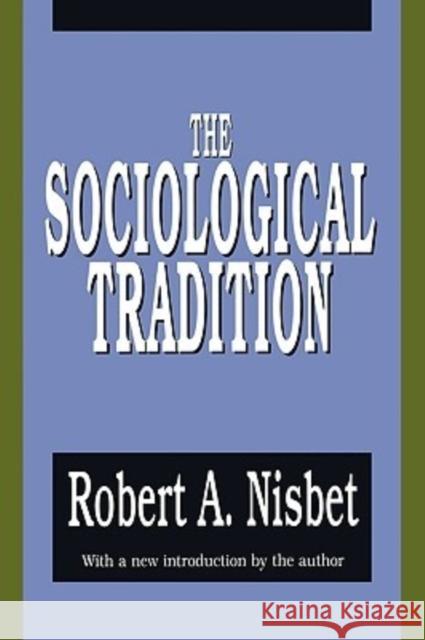
When first published, The Sociological Tradition had a profound and positive impact on sociology, providing a rich sense of intellectual background to a relatively new discipline in America. Robert Nisbet describes what he considers the golden age of sociology, 1830-1900, outlining five major themes of nineteenth-century sociologists: community, authority, status, the sacred, and alienation. Nisbet focuses on sociology's European heritage, delineating the arguments of Tocqueville, Marx, Durkheim, and Weber in new and revealing ways.
When the book initially appeared, the...
When first published, The Sociological Tradition had a profound and positive impact on sociology, providing a rich sense of intellectual b...
This text was first published in 1975, shortly after the resignation of President Richard Nixon, which revealed, according to Robert Nisbet, the extreme and corrupt manifestation of a democratic royalism that has its roots in several preceding administrations. Nisbet argues that the political community in the West had broken down after two centuries of ascendancy. He believes that the West has entered a twilight age that will be characterized by political and cultural crises similar to those that preceded the fall of Rome. He foresees the displacement of traditional, liberal society by...
This text was first published in 1975, shortly after the resignation of President Richard Nixon, which revealed, according to Robert Nisbet, the extre...
The idea of progress from the Enlightenment to postmodernism is still very much with us. In intellectual discourse, journals, popular magazines, and radio and talk shows, the debate between those who are "progressivists" and those who are "declinists" is as spirited as it was in the late seventeenth century. In History of the Idea of Progress, Robert Nisbet traces the idea of progress from its origins in Greek, Roman, and medieval civilizations to modern times. It is a masterful frame of reference for understanding the present world. Nisbet asserts there are two fundamental building blocks...
The idea of progress from the Enlightenment to postmodernism is still very much with us. In intellectual discourse, journals, popular magazines, and r...
"One of our most original social thinkers," according to the New York Times, Robert Nisbet offers a new approach to sociology. He shows that sociology is indeed an art form, one that has a strong kinship with literature, painting, Romantic history, and philosophy in the nineteenth century, the age in which sociology came into full stature. Sociology as an Art Form is an introduction for the initiated and the uninitiated in so-ciology.
Nisbet explains the degree to which sociology draws from the same creative impulses, themes and styles (rooted in history), and actual modes...
"One of our most original social thinkers," according to the New York Times, Robert Nisbet offers a new approach to sociology. He shows that sociol...
This is one of the most important books ever published about the American university. Robert Nisbet accuses universities of having betrayed themselves. Over the centuries they earned the respect of society by attempting to remain faithful to what he terms "the academic dogma," the pursuit of knowledge for its own sake. The measure of a university's greatness and of the stature of an individual scholar was determined not by the immediate usefulness of the work done, but by how much it contributed to scholarship, learning, and teaching.
American universities abandoned this ideal,...
This is one of the most important books ever published about the American university. Robert Nisbet accuses universities of having betrayed themsel...