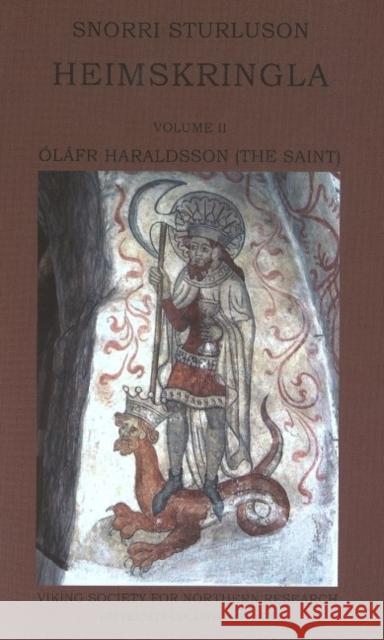
This compelling Icelandic history describes the life of King Harald Hardradi, from his battles across Europe and Russia to his final assault on England in 1066, less than three weeks before the invasion of William the Conqueror. It was a battle that led to his death and marked the end of an era in which Europe had been dominated by the threat of Scandinavian forces. Despite England's triumph, it also played a crucial part in fatally weakening the English army immediately prior to the Norman Conquest, changing the course of history. Taken from the Heimskringla Snorri Sturluson's complete...
This compelling Icelandic history describes the life of King Harald Hardradi, from his battles across Europe and Russia to his final assault on Englan...
Beginning with the dim prehistory of the mythical gods and their descendants, Heimskringla recounts the history of the kings of Norway through the reign of Olaf Haraldsson, who became Norway's patron saint. Once found in most homes and schools and still regarded as a national treasure, Heimskringla influenced the thinking and literary style of Scandinavia over several centuries.
Beginning with the dim prehistory of the mythical gods and their descendants, Heimskringla recounts the history of the kings of Norway...
But the king's heart swells, bulging with courage in battle, where heroes sink down... Over a period of twenty years Snorri Sturluson, scholar, courtier and poet, compiled the prose Edda as a textbook for young poets who wished to praise kings. His work surveys the content, style and metres of traditional Viking poetry and includes a lengthy poem of Snorrie's own, praising the king of Norway. Ironically, Snorri was killed in his own cellar in Iceland in 1241 on the instigation of the king of Norway, as a result of political intrigue. The Edda contains the most...
But the king's heart swells, bulging with courage in battle, where heroes sink down... Over a period of twenty years Snorri Sturluson, sch...
Written in Iceland a century after the close of the Viking Age, The Prose Edda is the source of most of what we know of Norse mythology. Its tales are peopled by giants, dwarves, and elves, superhuman heroes and indomitable warrior queens. Its gods live with the tragic knowledge of their own impending destruction in the cataclysmic battle of Ragnarok. Its time scale spans the eons from the world's creation to its violent end. This robust new translation captures the magisterial sweep and startling psychological complexity of the Old Icelandic original. For more than seventy years,...
Written in Iceland a century after the close of the Viking Age, The Prose Edda is the source of most of what we know of Norse mythology. Its ta...
Gods and giants bestride these ancient tales, in which warrior queens and noble heroes battle with elves, dwarves, and fearsome monsters. Spanning the dawn of the world's creation to its fiery destruction, these gripping Norse legends chronicle the triumphs and tragedies of a lost era. Resounding with a poetic instinct for the picturesque, the dramatic, and the human, they form vivid portraits of the characters' personalities. They also depict the comic and disastrous results of ambition, passion, and destiny. The wellspring of modern knowledge of Norse mythology, these sagas preserved the...
Gods and giants bestride these ancient tales, in which warrior queens and noble heroes battle with elves, dwarves, and fearsome monsters. Spanning the...
Prose Edda is a work without predecessor or parallel. It was designed as a handbook for poets to compose in the style of the skalds of the Viking ages. It is an exposition of the rule of poetic diction with many examples, applications, and retellings of myths and legends. Snorri Sturluson feared that the traditional techniques of Norse poetics, the pagan kennings, and the allusions to mythology would be forgotten with the introduction of new verse forms from Europe. The present selection includes the whole of Gylfaginning (The deluding of Gylfi)--a guide to mythology...
Prose Edda is a work without predecessor or parallel. It was designed as a handbook for poets to compose in the style of the skalds of the Viki...