"The Exploit is that rare thing: a book with a clear grasp of how networks operate that also understands the political implications of this emerging form of power. It cuts through the nonsense about how 'free' and 'democratic' networks supposedly are, and it offers a rich analysis of how network protocols create a new kind of control. Essential reading for all theorists, artists, activists, techheads, and hackers of the Net." --McKenzie Wark, author of A Hacker Manifesto
The network has become the core organizational structure for postmodern politics, culture, and...
"The Exploit is that rare thing: a book with a clear grasp of how networks operate that also understands the political implications of this eme...
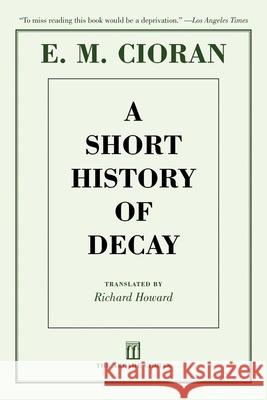
E. M. Cioran confronts the place of today's world in the context of human history focusing on such major issues of the twentieth century as human progress, fanaticism, and science in this nihilistic and witty collection of aphoristic essays concerning the nature of civilization in mid-twentieth-century Europe. Touching upon Man's need to worship, the feebleness of God, the downfall of the Ancient Greeks and the melancholy baseness of all existence, Cioran's pieces are pessimistic in the extreme, but also display a beautiful certainty that renders them delicate, vivid, and memorable....
E. M. Cioran confronts the place of today's world in the context of human history focusing on such major issues of the twentieth century as human prog...
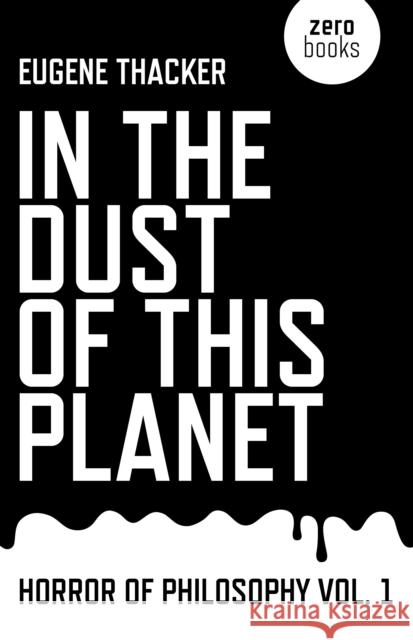
"Thacker's discourse on the intersection of horror and philosophy is utterly original and utterly captivating..." Thomas Ligotti, author of The Conspiracy Against the Human Race The world is increasingly unthinkable, a world of planetary disasters, emerging pandemics, and the looming threat of extinction. In this book Eugene Thacker suggests that we look to the genre of horror as offering a way of thinking about the unthinkable world. To confront this idea is to confront the limit of our ability to understand the world in which we live - a central motif of the horror genre. In the Dust of...
"Thacker's discourse on the intersection of horror and philosophy is utterly original and utterly captivating..." Thomas Ligotti, author of The Conspi...
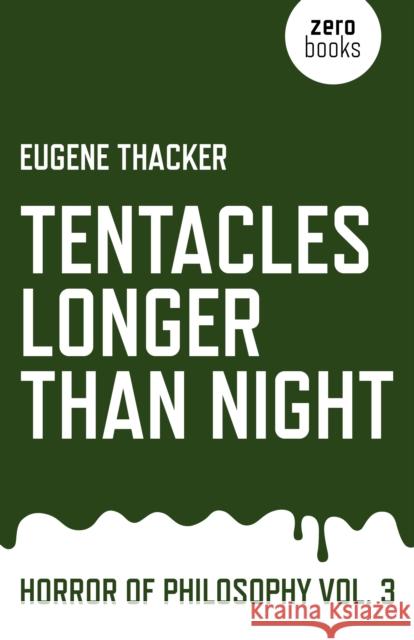
Our contemporary horror stories are written in a world where there seems little faith, lost hope, and no salvation. All that remains is the fragmentary and occasionally lyrical testimony of the human being struggling to confront its lack of reason for being in the vast cosmos. This is the terrain of the horror genre. Eugene Thacker explores this situation in Tentacles Longer Than Night. Extending the ideas presented in his book In The Dust of This Planet, Thacker considers the relationship between philosophy and the horror genre. But instead of taking fiction as the mere illustration of...
Our contemporary horror stories are written in a world where there seems little faith, lost hope, and no salvation. All that remains is the fragmentar...
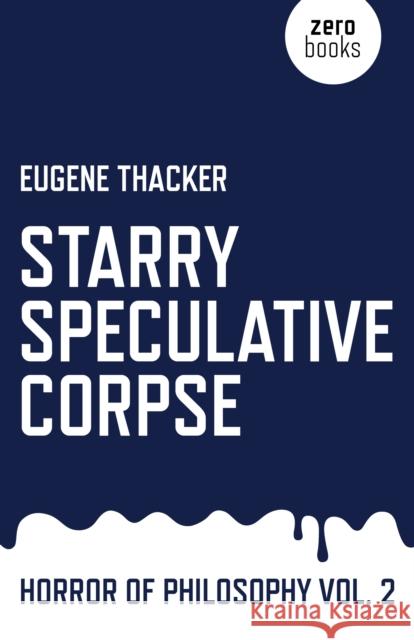
Could it be that the more we know about the world, the less we understand it? Could it be that, while everything has been explained, nothing has meaning? Extending the ideas presented in his book In The Dust of This Planet, Eugene Thacker explores these and other issues in Starry Speculative Corpse. But instead of using philosophy to define or to explain the horror genre, Thacker reads works of philosophy as if they were horror stories themselves, revealing a rift between human beings and the unhuman world of which they are part. Along the way we see philosophers grappling with demons,...
Could it be that the more we know about the world, the less we understand it? Could it be that, while everything has been explained, nothing has meani...
"We're doomed." So begins the work of the philosopher whose unabashed and aphoristic indictments of the human condition have been cropping up recently in popular culture. Today we find ourselves in an increasingly inhospitable world that is, at the same time, starkly indifferent to our species-specific hopes, desires, and disappointments. In the Anthropocene, pessimism is felt everywhere but rarely given its proper place. Though pessimism may be, as Eugene Thacker says, the lowest form of philosophy, it may also contain an enigma central to understanding the horizon of the human. Written...
"We're doomed." So begins the work of the philosopher whose unabashed and aphoristic indictments of the human condition have been cropping up recen...