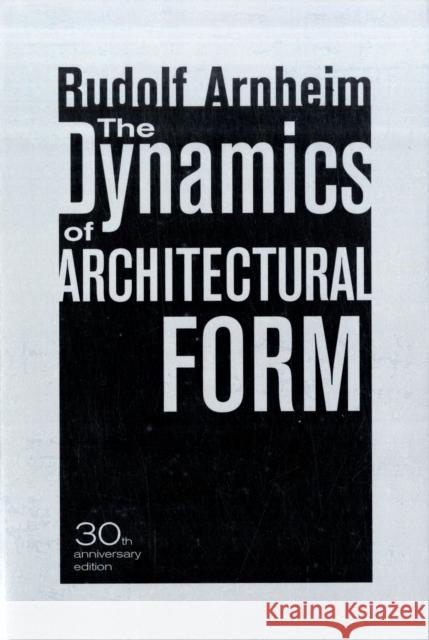
Rudolf Arnheim has been known, since the publication of his groundbreaking Art and Visual Perception in 1974, as an authority on the psychologicalinterpretation of the visual arts. Two anniversary volumes celebrate the landmark anniversaries of his works in 2009. In The Power of the Center, Arnheim uses a wealth of examples to consider the actors that determine the overall organization of visual form in works of painting, sculpture, and architecture. The Dynamics of Architectural Form explores the unexpected perceptual consequences of architecture with Arnheim's customary...
Rudolf Arnheim has been known, since the publication of his groundbreaking Art and Visual Perception in 1974, as an authority on the psychologi...
For thirty-five years Visual Thinking has been the gold standard for art educators, psychologists, and general readers alike. In this seminal work, Arnheim, author of The Dynamics of Architectural Form, Film as Art, Toward a Psychology of Art, and Art and Visual Perception, asserts that all thinking (not just thinking related to art) is basically perceptual in nature, and that the ancient dichotomy between seeing and thinking, between perceiving and reasoning, is false and misleading. An indis-pensable tool for students and for those interested in the arts.
For thirty-five years Visual Thinking has been the gold standard for art educators, psychologists, and general readers alike. In this seminal w...
Since its publication fifty years ago, this work has established itself as a classic. It casts the visual process in psychological terms and describes the creative way one's eye organizes visual material according to specific psychological premises. In 1974 this book was revised and expanded, and since then it has continued to burnish Rudolf Arnheim's reputation as a groundbreaking theoretician in the fields of art and psychology.
Since its publication fifty years ago, this work has established itself as a classic. It casts the visual process in psychological terms and describes...