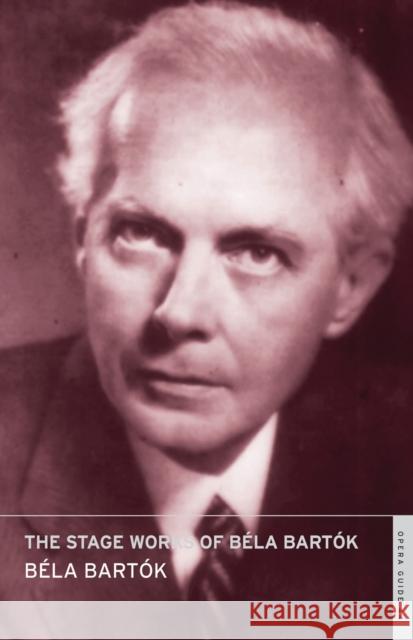
English National Opera Guides are ideal companions to the opera. They provide stimulating introductory articles together with the complete text of each opera in English and the original. A product of Hungary s political ferment at the start of the 20th century, Bela Bartok s works couple his determination to participate in Western art movements with an enthusiasm for the folk traditions of a disappearing world. In this introduction to Bartok s stage works, Julian Grant describes the score for "Duke Bluebeard s Castle," a symbolist version of the Bluebeard myth. Included in this volume are...
English National Opera Guides are ideal companions to the opera. They provide stimulating introductory articles together with the complete text of eac...
Bartok originally set this series of folk tunes for piano in 1915. Two years later, he scored them for small orchestra. This is a newly engraved and corrected edition of the deservedly popular orchestral showpiece, available for the first time at a reasonable price for musicians, students and fans of Bartoks highly individual style.
Bartok originally set this series of folk tunes for piano in 1915. Two years later, he scored them for small orchestra. This is a newly engraved and c...
Leo Weiner (1885-1960) was recognized both as a composer and a teacher of chamber music. World-famous Hungarian musicians and string quartets pointed to him as their legendary maestro. His transcriptions for string orchestra of ten pieces from Bartok's cycle For Children are a masterpiece from a genuine musician: in it, besides simply providing study pieces for young orchestras, he also, and far more importantly, introduces learners of string instruments to the unique, incomparable musical world that Bartok's pieces for children inhabit.This volume, previously available in the Leggiero...
Leo Weiner (1885-1960) was recognized both as a composer and a teacher of chamber music. World-famous Hungarian musicians and string quartets pointed ...
Bela Bartok composed the series of forty-four violin duos in 1931, prompted by the German violin teacher Erich Doflein. With the exception of numbers 35 and 36, all the pieces are based on original folk melodies, and the majority were collected by the composer himself during his numerous field trips in the Carpathian Basin. The melody for no. 42 was collected by Bartok in Algeria. Universal Edition (Vienna) published the violin duos in 1933 in four volumes, arranged in order of difficulty.The present transcription faithfully follows the original; fingerings are by the editor.CONTENTS:...
Bela Bartok composed the series of forty-four violin duos in 1931, prompted by the German violin teacher Erich Doflein. With the exception of numbers ...
Bela Bartok composed Dance Suite in 1923 for the 50th anniversary of the foundation of Hungary's capital through the unification of Buda, Obuda, and Pest. It soon became one of his most popular orchestral works, and in 1925 he arranged it for piano solo. Adam Tabajdi completed the organ version of Dance Suite in 2019/20, and recorded it on the Kern organ of Sapporo's Kitara Concert Hall later that year. His transcription was inspired by the composer's own version for piano, exploiting the alternative solutions offered by the ''orchestral'' timbres of the organ, with its manuals and pedals....
Bela Bartok composed Dance Suite in 1923 for the 50th anniversary of the foundation of Hungary's capital through the unification of Buda, Obuda, and P...