For this definitive collection of Pound's Literary Essays, his friend (and English editor) T. S. Eliot chose material from five earlier volumes: Pavannes and Divisions (1918), Instigations (1920), How to Read (1931), Make It New (1934), and Polite Essays (1937). 33 pieces are arranged in three groups: "The Art of Poetry," "The Tradition," and "Contemporaries." Eliot wrote in his introduction: "I hope that this volume will demonstrate that Pound's literary criticism is the most important contemporary criticism of its kind . . perhaps the kind we can least afford to do without . . . the...
For this definitive collection of Pound's Literary Essays, his friend (and English editor) T. S. Eliot chose material from five earlier volumes: Pavan...
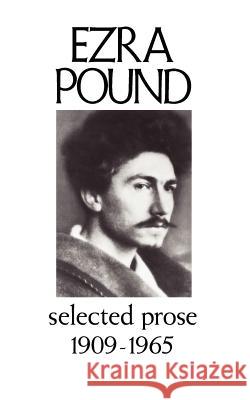
In making this selection, the author writes in his introduction to this paperback edition of early and out-of-print writings, 'my aim has been to show the unity of Ezra Pound's concerns.' The sixty-six pieces in Pound's Selected Prose 1909-1965 are arranged thematically, and while they are organized chronologically within several groupings, there are natural cross-currents of thoughts among them.
In making this selection, the author writes in his introduction to this paperback edition of early and out-of-print writings, 'my aim has been to show...
If the invention of literary modernism is usually attributed to Joyce, Eliot and Pound, it was Pound's personality and position in the artistic world that enabled the experiment to transform itself into an international movement.
If the invention of literary modernism is usually attributed to Joyce, Eliot and Pound, it was Pound's personality and position in the artistic world ...
Ezra Pound was born in 1885 in Hailey, Idaho. He came to Europe in 1908 and settled in London, where he became a central figure in the literary and artistic world, befriended by Yeats and a supporter of Eliot and Joyce, among others. In 1920 he moved to Paris, and later to Rapallo in Italy. During the Second World War he made a series of propagandist broadcasts over Radio Rome, for which he was later tried in the United States and subsequently committed to a hospital for the insane. After thirteen years, he was released and returned to Italy; dying in Venice in 1972.
Ezra Pound was born in 1885 in Hailey, Idaho. He came to Europe in 1908 and settled in London, where he became a central figure in the literary and ar...
Ezra Pound, Zhaoming Qian (Hangzhou Normal University)
First published in 1915, Cathay, Ezra Pound's early monumental work, originally contained fourteen translations from the Chinese and a translation of the Anglo-Saxon poem "The Seafarer." Over time, these poems have been widely read and loved as both translations and original poetry. In 1916, Cathay was reprinted in the book Lustra without "The Seafarer" and with four more Chinese poems. Cathay is greatly indebted to the notes of a Harvard-trained scholar Ernest Fenollosa. "In Fenollosa's Chinese poetry materials," Pound scholar Zhaoming Qian writes, "Pound discovered a new model that at once...
First published in 1915, Cathay, Ezra Pound's early monumental work, originally contained fourteen translations from the Chinese and a translation of ...
Ezra Pound s" Posthumous Cantos "collects unpublished pages of his great poem, drawn from manuscripts held in the archive at Yale s Beinecke Library and elsewhere. They are assembled by Pound s Italian translator, the critic and scholar Massimo Bacigalupo, into a companion book to the Cantos, running from 1917 to 1972 and including the Cantos he wrote in Italian in 1944-5. This is the first English edition of a crucial part of the Pound canon. "Posthumous Cantos" is arranged to reflect the eight phases of the Cantos composition."
Ezra Pound s" Posthumous Cantos "collects unpublished pages of his great poem, drawn from manuscripts held in the archive at Yale s Beinecke Library a...