The Platonic Theology is a visionary work and the philosophical masterpiece of Marsilio Ficino (1433-1499), the Florentine scholar-philosopher-magus who was largely responsible for the Renaissance revival of Plato.
A student of the Neoplatonic schools of Plotinus and Proclus, he was committed to reconciling Platonism with Christianity, in the hope that such a reconciliation would initiate a spiritual revival and return of the golden age. His Platonic evangelizing was eminently successful and widely influential, and his Platonic Theology, translated into English for the...
The Platonic Theology is a visionary work and the philosophical masterpiece of Marsilio Ficino (1433-1499), the Florentine scholar-philosoph...
The Platonic Theology is a visionary work and the philosophical masterpiece of Marsilio Ficino (1433-1499), the Florentine scholar-philosopher-magus who was largely responsible for the Renaissance revival of Plato.
A student of the Neoplatonic schools of Plotinus and Proclus, he was committed to reconciling Platonism with Christianity, in the hope that such a reconciliation would initiate a spiritual revival and return of the golden age. His Platonic evangelizing was eminently successful and widely influential, and his Platonic Theology, translated into English for...
The Platonic Theology is a visionary work and the philosophical masterpiece of Marsilio Ficino (1433-1499), the Florentine scholar-philosoph...
Marsilio Ficino (1433-99) directed the Platonic Academy in Florence, and it was the work of this Academy that gave the Renaissance in the 15th century its impulse and direction.
Marsilio Ficino (1433-99) directed the Platonic Academy in Florence, and it was the work of this Academy that gave the Renaissance in the 15th century...
Marsilio Ficino (1433-1499), the Florentine scholar-philosopher-magus, was largely responsible for the Renaissance revival of Plato. The publication of his Latin translations of the dialogues in 1484 was an intellectual event of the first magnitude, making the Platonic canon accessible to western Europe after the passing of a millennium and establishing Plato as an authority for Renaissance thought. This volume contains Ficino's extended analysis and commentary on the Phaedrus, which he explicates as a meditation on "beauty in all its forms" and a sublime work of theology. In the...
Marsilio Ficino (1433-1499), the Florentine scholar-philosopher-magus, was largely responsible for the Renaissance revival of Plato. The publication o...
Marsilio Ficino (1433-1499), the Florentine scholar-philosopher-magus, was largely responsible for the Renaissance revival of Plato. Ficino's commentaries on Plato remained the standard guide to the Greek philosopher's works for centuries. Vanhaelen's new translation of Ficino's vast commentary on the Parmenides makes this monument of Renaissance metaphysics accessible to the modern student of philosophy. The volume contains the first critical edition of the Latin text, an ample introduction, and extensive notes.
Marsilio Ficino (1433-1499), the Florentine scholar-philosopher-magus, was largely responsible for the Renaissance revival of Plato. Ficino's commenta...
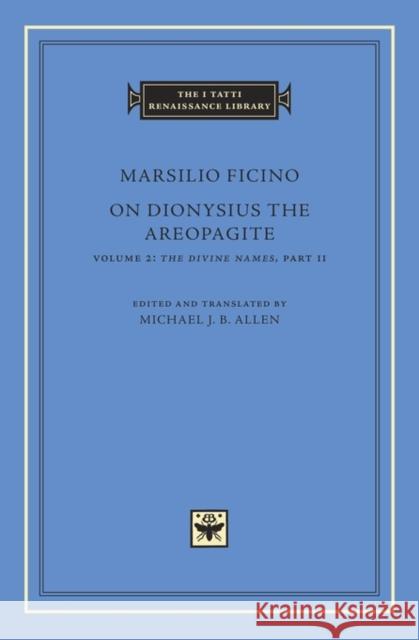
In 1490/92 Marsilio Ficino, the Florentine scholar-philosopher-magus who was largely responsible for the Renaissance revival of Plato, made new translations of, with running commentaries on, two treatises he believed were the work of Dionysius the Areopagite, the disciple of St. Paul mentioned in the Acts of the Apostles. His aim was to show how these two treatises (in fact the achievement of a sixth-century Christian follower of the Neoplatonist Proclus) had inspired pagan thinkers in the later Platonic tradition like Plotinus and Iamblichus. These major products of fifteenth-century...
In 1490/92 Marsilio Ficino, the Florentine scholar-philosopher-magus who was largely responsible for the Renaissance revival of Plato, made new transl...
Listy florentského platonika Marsilia Ficina De officiis a Veritas de institutione principis patří mezi nejvlivnější z celé Ficinovy korespondence jakožto stručná pojednání o v renesanci oblíbených tématech morální filosofie. Unikátní recepce se dočkaly i v českém prostředí počátku šestnáctého století, kdy byly přeloženy do humanistické češtiny, list Veritas dokonce dvakrát. Publikace přináší kritickou edici obou listů, jejich nový překlad do češtiny, jakož i transkripci obou staročeských překladů, jejichž autory byli Řehoř z Hrubý z...
Listy florentského platonika Marsilia Ficina De officiis a Veritas de institutione principis patří mezi nejvlivnější z celé Ficinovy koresponde...
Nejzdařilejším a nejvlivnějším z Ficinových spisů se stal jeho Komentář k Platónově Hostině, O lásce. Formou nápodoby Platónova Symposia, přeneseného do prostředí medicejské Florencie, tu Ficino předkládá svou syntézu platonismu, inspirovanou pohanskými i křesťanskými autory pozdní antiky, zejména Plótínem, Augustinem a Dionysiem Areopagitou. Stěžejním tématem této filosofie je láska. Ficino ji spolu s Dantem chápe jako božskou sílu, která prostřednictvím krásy milovaného člověka přivádí zbloudilou lidskou duši k poznání Boha....
Nejzdařilejším a nejvlivnějším z Ficinových spisů se stal jeho Komentář k Platónově Hostině, O lásce. Formou nápodoby Platónova Sympos...