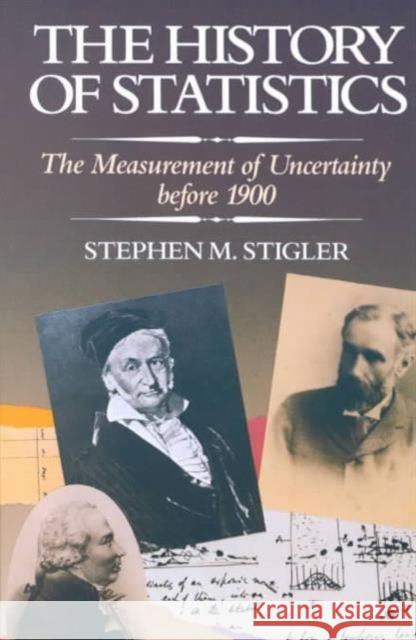
This magnificent book is the first comprehensive history of statistics from its beginnings around 1700 to its emergence as a distinct and mature discipline around 1900. Stephen M. Stigler shows how statistics arose from the interplay of mathematical concepts and the needs of several applied sciences including astronomy, geodesy, experimental psychology, genetics, and sociology. He addresses many intriguing questions: How did scientists learn to combine measurements made under different conditions? And how were they led to use probability theory to measure the accuracy of the result? Why...
This magnificent book is the first comprehensive history of statistics from its beginnings around 1700 to its emergence as a distinct and mature di...
What gives statistics its unity as a science? Stephen Stigler sets forth the seven foundational ideas of statistics--a scientific discipline related to but distinct from mathematics and computer science.
Even the most basic idea--aggregation, exemplified by averaging--is counterintuitive. It allows one to gain information by discarding information, namely, the individuality of the observations. Stigler's second pillar, information measurement, challenges the importance of "big data" by noting that observations are not all equally important: the amount of information in...
What gives statistics its unity as a science? Stephen Stigler sets forth the seven foundational ideas of statistics--a scientific discipline relate...