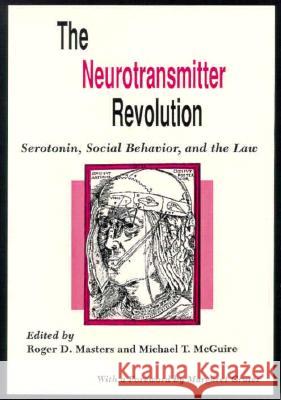
Roger D. Masters, Michael T. McGuire, Margaret Gruter, Roger D. Masters, Michael T. McGuire
Extraordinary advances in neurochemistry are both transforming our understanding of human nature and creating an urgent problem. Much is now known about the ways that neurotransmitters influence normal social behavior, mental illness, and deviance. What are these discoveries about the workings of the human brain? How can they best be integrated into our legal system?
These explosive issues are best understood by focusing on a single neurotransmitter like serotonin, which is associated with such diverse behaviors as dominance and leadership, seasonal depression, suicide, alcoholism,...
Extraordinary advances in neurochemistry are both transforming our understanding of human nature and creating an urgent problem. Much is now known ...
Jean-Jacques Rousseau, Christopher Kelly, Roger D. Masters, Judith R. Bush
Rousseau attacks the social and political effects of the dominant forms of scientific knowledge. Contains the entire First Discourse, contemporary attacks on it, Rousseau's replies to his critics, and his summary of the debate in his preface to Narcissus. A number of these texts have never before been available in English. The First Discourse and Polemics demonstrate the continued relevance of Rousseau's thought. Whereas his critics argue for correction of the excesses and corruptions of knowledge and the sciences as sufficient, Rousseau attacks the social and political effects of the...
Rousseau attacks the social and political effects of the dominant forms of scientific knowledge. Contains the entire First Discourse, contemporary att...
Jean-Jacques Rousseau, Christopher Kelly, Roger D. Masters, Terence Marshall, Judith R. Bush
Includes the Second Discourse (complete with the author's extensive notes), contemporary critiques by Voltaire, Diderot, Bonnet, and LeRoy, Rousseau's replies (some never before translated), and Political Economy, which first outlined principles that were to become famous in the Social Contract. This is the first time that the works of 1755 and 1756 have been combined with careful commentary to show the coherence of Rousseau's "political system." The Second Discourse examines man in the true "state of nature," prior to the formation of the first human societies, tracing the "hypothetical...
Includes the Second Discourse (complete with the author's extensive notes), contemporary critiques by Voltaire, Diderot, Bonnet, and LeRoy, Rousseau's...
Jean-Jacques Rousseau, Christopher Kelly, Roger D. Masters, Peter G. Stillman, Christopher Kelly
When Rousseau first read his Confessions to a 1770 gathering in Paris, reactions varied from admiration of his candor to doubts about his sanity to outrage. Indeed, Rousseau's intent and approach were revolutionary. As one of the first attempts at autobiography, the Confessions' novelty lay not in just its retelling the facts of Rousseau's life, but in its revelation of his innermost feelings and its frank description of the strengths and failings of his character. Based on his doctrine of natural goodness, Rousseau intended the Confessions as a testing ground to explore his belief that,...
When Rousseau first read his Confessions to a 1770 gathering in Paris, reactions varied from admiration of his candor to doubts about his sanity to ou...