"Its publication should be a major event for cognitive linguistics and should pose a major challenge for cognitive science. In addition, it should have repercussions in a variety of disciplines, ranging from anthropology and psychology to epistemology and the philosophy of science. . . . Lakoff asks: What do categories of language and thought reveal about the human mind? Offering both general theory and minute details, Lakoff shows that categories reveal a great deal."--David E. Leary, American Scientist
"Its publication should be a major event for cognitive linguistics and should pose a major challenge for cognitive science. In addition, it should hav...
What are human beings like? How is knowledge possible? What is truth? Where do moral values come from? Questions like these have stood at the center of Western philosophy for centuries. In addressing them, philosophers have made certain fundamental assumptions-that we can know our own minds by introspection, that most of our thinking about the world is literal, and that reason is disembodied and universal-that are now called into question by well-established results of cognitive science. It has been shown empirically that: Most thought is unconscious. We have no direct conscious access to the...
What are human beings like? How is knowledge possible? What is truth? Where do moral values come from? Questions like these have stood at the center o...
Ten years after writing the definitive, international bestselling book on political debate and messaging, George Lakoff returns with new strategies about how to frame today's essential issues.
Called the -father of framing- by The New York Times, Lakoff explains how framing is about ideas--ideas that come before policy, ideas that make sense of facts, ideas that are proactive not reactive, positive not negative, ideas that need to be communicated out loud every day in public.
The ALL NEWDon't Think of an Elephant...
Ten years after writing the definitive, international bestselling book on political debate and messaging, George Lakoff returns with new s...
When Moral Politics was first published two decades ago, it redefined how Americans think and talk about politics through the lens of cognitive political psychology. Today, George Lakoff's classic text has become all the more relevant, as liberals and conservatives have come to hold even more vigorously opposed views of the world, with the underlying assumptions of their respective worldviews at the level of basic morality. Even more so than when Lakoff wrote, liberals and conservatives simply have very different, deeply held beliefs about what is right and wrong. Lakoff reveals...
When Moral Politics was first published two decades ago, it redefined how Americans think and talk about politics through the lens of cognitive...
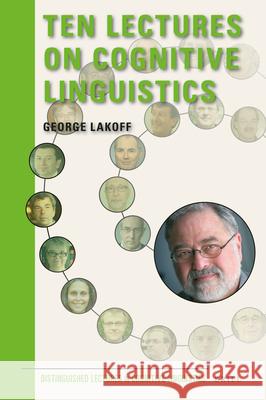
Ten Lectures on Cognitive Linguistics presents ten lectures, in both audio and transcribed text, given by George Lakoff in Beijing in April 2004. Lakoff gives an account of the background of cognitive linguistics, and basic mechanisms of thought, grammar, neural theory of language, metaphor, implications for Philosophy, and political linguistics. He does so in a manner that is accessible for anyone, including undergraduate level students and a general audience. With the massive experience of being a linguist for over 50 years, and being one of the founding fathers of the field, George Lakoff...
Ten Lectures on Cognitive Linguistics presents ten lectures, in both audio and transcribed text, given by George Lakoff in Beijing in April 2004. Lako...