With engaging wit and subtle irony, Albert Hirschman maps the diffuse and treacherous world of reactionary rhetoric in which conservative public figures, thinkers, and polemicists have been arguing against progressive agendas and reforms for the past two hundred years.
Hirschman draws his examples from three successive waves of reactive thought that arose in response to the liberal ideas of the French Revolution and the Declaration of the Rights of Man, to democratization and the drive toward universal suffrage in the nineteenth century, and to the welfare state in our own century....
With engaging wit and subtle irony, Albert Hirschman maps the diffuse and treacherous world of reactionary rhetoric in which conservative public fi...
Since the mid-twentieth century Albert O. Hirschman has been known for his innovative, lucid, and brilliantly argued contributions to economics, the history of ideas, and the social sciences. Two central and already widely admired essays in this collection explore new territory. The title essay distinguishes among four very different conceptions of the characteristics and dynamics of capitalist societies. A related plea for embracing complexity is made in "Against Parsimony," a wide-ranging critique of traditional economic models. In other writings Hirschman revisits his own views on economic...
Since the mid-twentieth century Albert O. Hirschman has been known for his innovative, lucid, and brilliantly argued contributions to economics, the h...
An innovator in contemporary thought on economic and political development looks here at decline rather than growth. Albert O. Hirschman makes a basic distinction between alternative ways of reacting to deterioration in business firms and, in general, to dissatisfaction with organizations: one, "exit," is for the member to quit the organization or for the customer to switch to the competing product, and the other, "voice," is for members or customers to agitate and exert influence for change "from within." The efficiency of the competitive mechanism, with its total reliance on exit, is...
An innovator in contemporary thought on economic and political development looks here at decline rather than growth. Albert O. Hirschman makes ...
In this volume, Albert Hirschman reconstructs the intellectual climate of the seventeenth and eighteenth centuries to illuminate the intricate ideological transformation that occurred, wherein the pursuit of material interests--so long condemned as the deadly sin of avarice--was assigned the role of containing the unruly and destructive passions of man. Hirschman here offers a new interpretation for the rise of capitalism, one that emphasizes the continuities between old and new, in contrast to the assumption of a sharp break that is a common feature of both Marxian and Weberian thinking....
In this volume, Albert Hirschman reconstructs the intellectual climate of the seventeenth and eighteenth centuries to illuminate the intricate ideo...
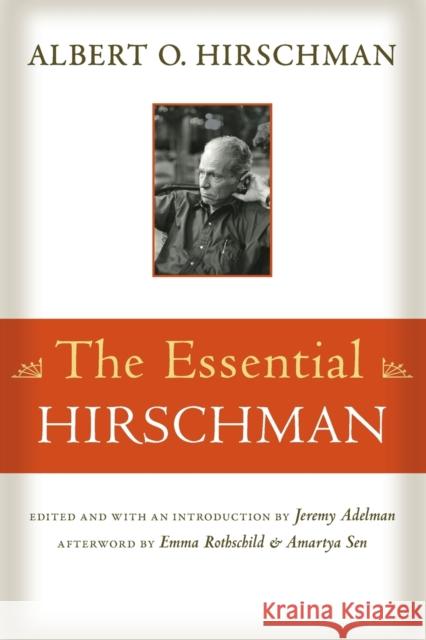
The Essential Hirschman brings together some of the finest essays in the social sciences, written by one of the twentieth century's most influential and provocative thinkers. Albert O. Hirschman was a master essayist, one who possessed the rare ability to blend the precision of economics with the elegance of literary imagination. In an age in which our academic disciplines require ever-greater specialization and narrowness, it is rare to encounter an intellectual who can transform how we think about inequality by writing about traffic, or who can slip in a quote from Flaubert...
The Essential Hirschman brings together some of the finest essays in the social sciences, written by one of the twentieth century's mos...