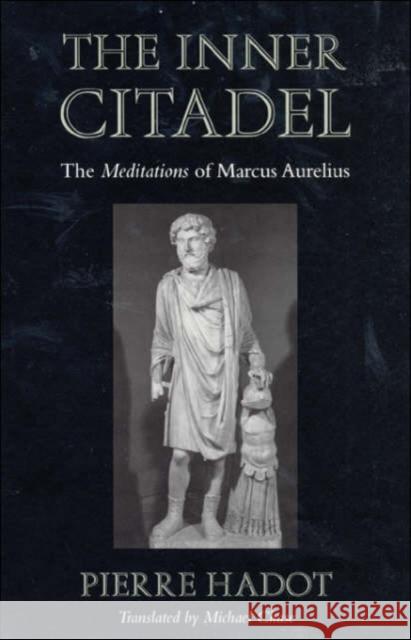
The Meditations of Marcus Aurelius are treasured today--as they have been over the centuries--as an inexhaustible source of wisdom. And as one of the three most important expressions of Stoicism, this is an essential text for everyone interested in ancient religion and philosophy. Yet the clarity and ease of the work's style are deceptive. Pierre Hadot, eminent historian of ancient thought, uncovers new levels of meaning and expands our understanding of its underlying philosophy.
Written by the Roman emperor for his own private guidance and self-admonition, the...
The Meditations of Marcus Aurelius are treasured today--as they have been over the centuries--as an inexhaustible source of wisdom. And as o...
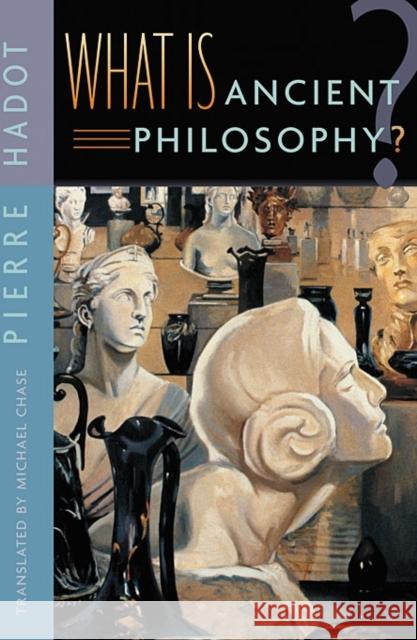
A magisterial mappa mundi of the terrain that Pierre Hadot has so productively worked for decades, this ambitious work revises our view of ancient philosophy--and in doing so, proposes that we change the way we see philosophy itself. Hadot takes ancient philosophy out of its customary realm of names, dates, and arid abstractions and plants it squarely in the thick of life. Through a meticulous historical reading, he shows how the various schools, trends, and ideas of ancient Greek and Roman philosophy all tended toward one goal: to provide a means for achieving happiness in this...
A magisterial mappa mundi of the terrain that Pierre Hadot has so productively worked for decades, this ambitious work revises our view ...
Nearly twenty-five hundred years ago the Greek thinker Heraclitus supposedly uttered the cryptic words "Phusis kruptesthai philei." How the aphorism, usually translated as "Nature loves to hide," has haunted Western culture ever since is the subject of this engaging study by Pierre Hadot. Taking the allegorical figure of the veiled goddess Isis as a guide, and drawing on the work of both the ancients and later thinkers such as Goethe, Rilke, Wittgenstein, and Heidegger, Hadot traces successive interpretations of Heraclitus' words. Over time, Hadot finds, "Nature loves to hide" has meant...
Nearly twenty-five hundred years ago the Greek thinker Heraclitus supposedly uttered the cryptic words "Phusis kruptesthai philei." How the aphoris...
One of the most influential historians of ancient philosophy of the past half-century, Pierre Hadot was adept at using ancient philosophers to illuminate the relevance of their ideas to contemporary life. This new edition of The Present Alone is Our Happiness, which has been significantly revised and expanded to include two previously untranslated essays, is an ideal introduction to some of Hadot's more scholarly work. In it, we discover that to be an Epicurean is not merely to think like one; it is to adopt a way of living where limiting desires is the condition for happiness. Being...
One of the most influential historians of ancient philosophy of the past half-century, Pierre Hadot was adept at using ancient philosophers to illumin...
Hadotův úvod (Vnitřní tvrz) do Hovorů Marka Aurelia lze číst v jistém smyslu jako úvod do antického stoicismu. Neexistuje nakonec věčný stoicismus, který je napříč časem a prostorem jedním z možných postojů lidského vědomí? Jeho neustálá ozvěna ve filozofických koncepcích dvou tisíciletí tomu napovídá.
Hadotův úvod (Vnitřní tvrz) do Hovorů Marka Aurelia lze číst v jistém smyslu jako úvod do antického stoicismu. Neexistuje nakonec věčný s...