Over a period of 25 years as author of the Mathematical Games column for Scientific American, Martin Gardner devoted a column every six months or so to short math problems or puzzles. He was especially careful to present new and unfamiliar puzzles that had not been included in such classic collections as those by Sam Loyd and Henry Dudeney. Later, these puzzles were published in book collections, incorporating reader feedback on alternate solutions or interesting generalizations. The present volume contains a rich selection of 70 of the best of these brain teasers, in some cases...
Over a period of 25 years as author of the Mathematical Games column for Scientific American, Martin Gardner devoted a column every six mont...
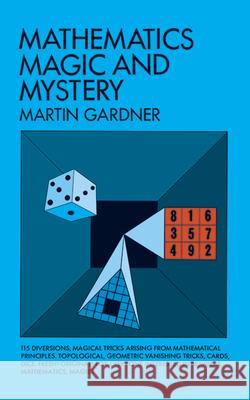
Why do card tricks work? How can magicians do astonishing feats of mathematics mentally? Why do stage "mind-reading" tricks work? As a rule, we simply accept these tricks and "magic" without recognizing that they are really demonstrations of strict laws based on probability, sets, number theory, topology, and other branches of mathematics. This is the first book-length study of this fascinating branch of recreational mathematics. Written by one of the foremost experts on mathematical magic, it employs considerable historical data to summarize all previous work in this field. It is also a...
Why do card tricks work? How can magicians do astonishing feats of mathematics mentally? Why do stage "mind-reading" tricks work? As a rule, we simply...
Matematika je jistě základem moderní vědy, ale kvůli tomu nemusí jít o disciplínu přehnaně vážnou. V rozporu s názorem mnoha studentů mohou být matematické úlohy současně chytré, inspirativní i velice zábavné. Autor této knihy Martin Gardner byl jedním z nejlepších popularizátorů rekreační matematiky, po řadu desetiletí bavil čtenáře časopisu Scientific American a dokázal shromáždit tisíce matematických hádanek. Sbírka představuje úlohy spadající do různých oborů matematiky – hrátky s celými s čísly, geometrii v rovině i v prostoru....
Matematika je jistě základem moderní vědy, ale kvůli tomu nemusí jít o disciplínu přehnaně vážnou. V rozporu s názorem mnoha studentů mo...
Well-known skeptic and acclaimed popular science writer Martin Gardner presents a complete history of the Urantia movement, from its beginnings in the early 20th century to the present day. In addition to providing an outline of the Urantia cult's worldview, Gardner presents strong evidence to establish the identity of the man whose trancelike orations formed the basis of the book. Gardner also analyzes the flaws in Urantian science and points out many instances of plagiarism in various sections of the book. In a new postscript to this paperback edition, Gardner details recent...
Well-known skeptic and acclaimed popular science writer Martin Gardner presents a complete history of the Urantia movement, from its beginnings in the...
Martin Gardner, the "Mathematical Games" columnist for Scientific American from 1956 to 1981, was also a philosopher, polymath, magician, religious thinker, and the author of more than 70 books, including The Annotated Alice, The Ambidextrous Universe, and Visitors from Oz. Here his life and works are celebrated in a bouquet of essays about him or in his honor. Introduced by his son Jim, the book includes reminiscences by Douglas Hofstadter, Morton N. Cohen, Scott Kim, David Singmaster, Michael Patrick Hearn, and many others; a festschrift contains essays by such writers as Raymond Smullyan...
Martin Gardner, the "Mathematical Games" columnist for Scientific American from 1956 to 1981, was also a philosopher, polymath, magician, religious th...
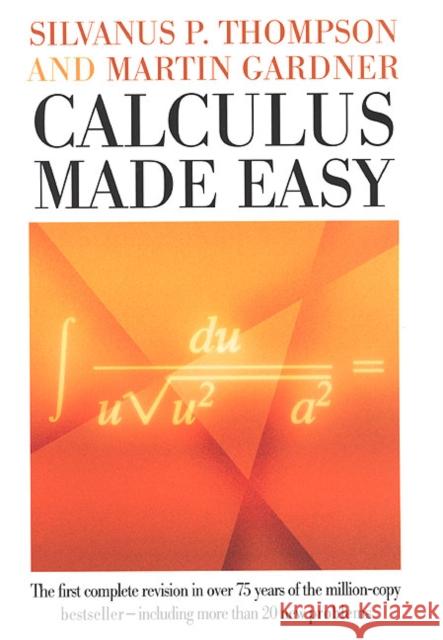
Calculus Made Easy has long been the most popular calculus primer, and this major revision of the classic math text makes the subject at hand still more comprehensible to readers of all levels. With a new introduction, three new chapters, modernized language and methods throughout, and an appendix of challenging and enjoyable practice problems, Calculus Made Easy has been thoroughly updated for the modern reader.
Calculus Made Easy has long been the most popular calculus primer, and this major revision of the classic math text makes the subject at han...
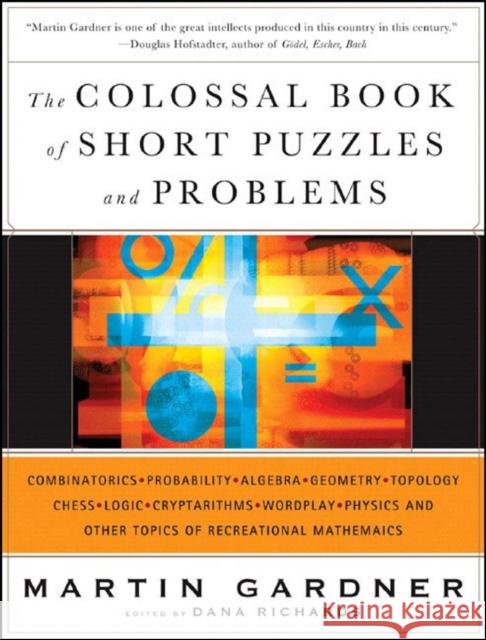
For more than twenty-five years, Martin Gardner was "Scientific American's" renowned provocateur of popular math. His yearly gatherings of short and inventive problems were easily his most anticipated math columns. Loyal readers would savor the wit and elegance of his explorations in physics, probability, topology, and chess, among others. Grouped by subject and arrayed from easiest to hardest, the puzzles gathered here, which complement the lengthier, more involved problems in "The Colossal Book of Mathematics," have been selected by Gardner for their illuminating; and often bewildering;...
For more than twenty-five years, Martin Gardner was "Scientific American's" renowned provocateur of popular math. His yearly gatherings of short and i...
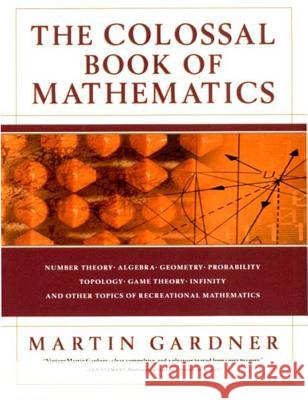
In its twelve sections, The Colossal Book of Math explores a wide range of areas, each startlingly illuminated by Gardner's incisive expertise. Beginning with seemingly simple topics, Gardner expertly guides us through complicated and wondrous worlds: by way of basic algebra we contemplate the mesmerizing, often hilarious, linguistic and numerical possibilities of palindromes; using simple geometry, he dissects the principles of symmetry upon which the renowned mathematical artist M. C. Escher constructs his unique, dizzying universe. Gardner, like few thinkers today, melds a...
In its twelve sections, The Colossal Book of Math explores a wide range of areas, each startlingly illuminated by Gardner's incisive expertis...
Hexaflexagons, Probability Paradoxes, and the Tower of Hanoi is the inaugural volume in The New Martin Gardner Mathematical Library series. Based off of Gardener's enormously popular Scientific American columns, his puzzles and challenges can now fascinate a whole new generation Paradoxes and paper-folding, Moebius variations and mnemonics, fallacies, magic square, topological curiosities, parlor tricks, and games ancient and modern, from Polyminoes, Nim, Hex, and the Tower of Hanoi to four-dimensional ticktacktoe. These mathematical recreations, clearly and cleverly presented by Martin...
Hexaflexagons, Probability Paradoxes, and the Tower of Hanoi is the inaugural volume in The New Martin Gardner Mathematical Library series. Based off ...