In just four weeks in the summer of 1941 the German Wehrmacht wrought unprecedented destruction on four Soviet armies, conquering central Ukraine and killing or capturing three quarters of a million men. This was the Battle of Kiev one of the largest and most decisive battles of World War II and, for Hitler and Stalin, a battle of crucial importance. For the first time, David Stahel charts the battle's dramatic course and aftermath, uncovering the irreplaceable losses suffered by Germany's 'panzer groups' despite their battlefield gains, and the implications of these losses for the German war...
In just four weeks in the summer of 1941 the German Wehrmacht wrought unprecedented destruction on four Soviet armies, conquering central Ukraine and ...
In November 1941 Hitler ordered German forces to complete the final drive on the Soviet capital, now less than 100 kilometres away. Army Group Centre was pressed into the attack for one last attempt to break Soviet resistance before the onset of winter. From the German perspective the final drive on Moscow had all the ingredients of a dramatic final battle in the east, which, according to previous accounts, only failed at the gates of Moscow. David Stahel challenges this well-established narrative by demonstrating that the last German offensive of 1941 was a forlorn effort, undermined by...
In November 1941 Hitler ordered German forces to complete the final drive on the Soviet capital, now less than 100 kilometres away. Army Group Centre ...
Operation Barbarossa, the German invasion of the Soviet Union, began the largest and most costly campaign in military history. Its failure was a key turning point of the Second World War. The operation was planned as a Blitzkrieg to win Germany its Lebensraum in the East, and the summer of 1941 is well-known for the German army's unprecedented victories and advances. Yet the German Blitzkrieg depended almost entirely upon the motorised Panzer groups, particularly those of Army Group Centre. Using previously unpublished archival records, David Stahel presents a new history of Germany's summer...
Operation Barbarossa, the German invasion of the Soviet Union, began the largest and most costly campaign in military history. Its failure was a key t...
In just four weeks in the summer of 1941 the German Wehrmacht wrought unprecedented destruction on four Soviet armies, conquering central Ukraine and killing or capturing three quarters of a million men. This was the Battle of Kiev one of the largest and most decisive battles of World War II and, for Hitler and Stalin, a battle of crucial importance. For the first time, David Stahel charts the battle's dramatic course and aftermath, uncovering the irreplaceable losses suffered by Germany's 'panzer groups' despite their battlefield gains, and the implications of these losses for the German war...
In just four weeks in the summer of 1941 the German Wehrmacht wrought unprecedented destruction on four Soviet armies, conquering central Ukraine and ...
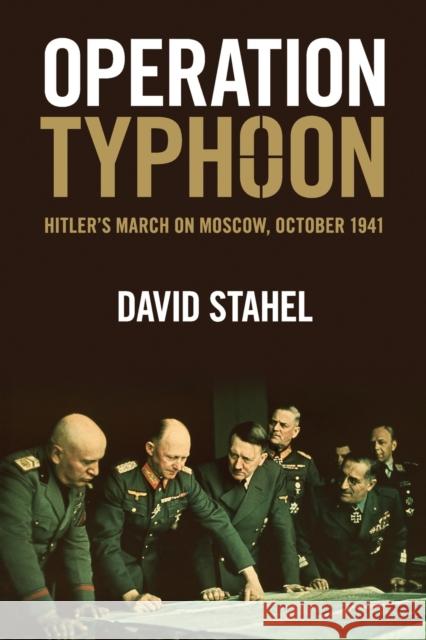
In October 1941 Hitler launched Operation Typhoon the German drive to capture Moscow and knock the Soviet Union out of the war. As the last chance to escape the dire implications of a winter campaign, Hitler directed seventy-five German divisions, almost two million men and three of Germany's four panzer groups into the offensive, resulting in huge victories at Viaz'ma and Briansk - among the biggest battles of the Second World War. David Stahel's groundbreaking new account of Operation Typhoon captures the perspectives of both the German high command and individual soldiers, revealing that...
In October 1941 Hitler launched Operation Typhoon the German drive to capture Moscow and knock the Soviet Union out of the war. As the last chance to ...