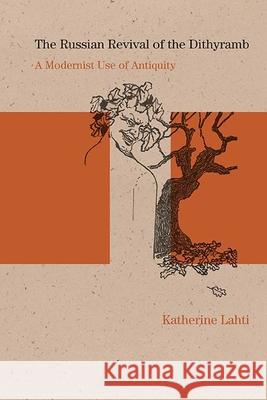
Late nineteenth-century Russia witnessed a revival of the dithyramb, a poetic form of verse and dance that ancient Greeks performed to summon Dionysus. The Russian Revival of the Dithyramb offers a fascinating recounting of this resurrection and traces the form's surprising influence on Russian identity and art in the work of artists, writers, and musicians as varied as Aleksandr Blok, Andrei Bely, Aleksei Remizov, Vladimir Mayakovsky, and Igor Stravinksy. Nietzsche's The Birth of Tragedy and Viacheslav Ivanov's treatise in response, "The Hellenic Religion of the Suffering...
Late nineteenth-century Russia witnessed a revival of the dithyramb, a poetic form of verse and dance that ancient Greeks performed to summon Dionysus...
Late nineteenth-century Russia witnessed a revival of the dithyramb, a poetic form of verse and dance that ancient Greeks performed to summon Dionysus. The Russian Revival of the Dithyramb offers a fascinating recounting of this resurrection and traces the form's surprising influence on Russian identity and art in the work of artists, writers, and musicians as varied as Aleksandr Blok, Andrei Bely, Aleksei Remizov, Vladimir Mayakovsky, and Igor Stravinksy. Nietzsche's The Birth of Tragedy and Viacheslav Ivanov's treatise in response, "The Hellenic Religion of the Suffering...
Late nineteenth-century Russia witnessed a revival of the dithyramb, a poetic form of verse and dance that ancient Greeks performed to summon Dionysus...