Thomas H. Huxley Charles O. Marsh History and Civilization Collection
What is life? This question gives a new interest to every department of science that relates to life in any form, and the history of life offers a most suggestive field for research. The paleontology took its origin in the mind of the first person who, finding something like a shell or a bone naturally imbedded in gravel or in rock, indulged in speculations upon the nature of this thing which he had dug out-this "fossil"-and upon the causes which had brought it into such a position. In this rudimentary form, a high antiquity may safely be ascribed to paleontology, inasmuch as we know that,...
What is life? This question gives a new interest to every department of science that relates to life in any form, and the history of life offers a mos...
It is the purpose of this paper to treat of the movements of american arborigenes and their migrations, and to show how it affected Minnesota. Before its explorations by white men, the Minnesota was inhabited by people of two great divisions of the American race. From the southern boundary of the state the land was inhabited by the Dakotas, while the shores of Lake Superior and the northern portion of the state were occupied by the Ojibways. Many places in Minnesota bear Indian names, and those derived from the respective languages of these two aboriginal nations show very clearly at the...
It is the purpose of this paper to treat of the movements of american arborigenes and their migrations, and to show how it affected Minnesota. Before ...
Charles Martel is generally considered as the Frankish Military Leader who defeated the Moslem army and stopped the great movement of Arab conquest in Europe. His victory during the battle of Tours (also called the battle of Poitiers) is described by the historians as the decisive event which preserved the European Civilization. According to E. Gibbon the victory of Charles Martel rescued the ancestors of Europeans, from the Islamic civilization. And the historian L. Von Ranke said: "the battle of Poitiers was the turning point of one of the most important epochs in the history of the world."...
Charles Martel is generally considered as the Frankish Military Leader who defeated the Moslem army and stopped the great movement of Arab conquest in...
This book deals with the prehistoric and historic arts in America, with several illustrations. In America, eminent archaeologists and enthusiastic collectors have eagerly studied all that relates to the past of the human race. With the aid of their publications and the photographs they have distributed with rare liberality, we are able to follow the ancient populations in their migrations from the shores of the Atlantic and the Pacific, to study their habits and their progress, and to show that among them also art was born at a very early epoch, and that it grew up with the generations.
This book deals with the prehistoric and historic arts in America, with several illustrations. In America, eminent archaeologists and enthusiastic col...
Who were the Franks? Anyone who wants to know the history of European nations, must read the history of the Franks. Beyond the Roman Empire, the foundation of medieval Europe also depends on the Franks whose empire evolved into the modern France and other European countries. This book, based on historical works, deals with the rise and development of the Franks, and their influence in the history of Europe.
Who were the Franks? Anyone who wants to know the history of European nations, must read the history of the Franks. Beyond the Roman Empire, the found...
Abner E. Woodruff History and Civilization Collection
This book deals with the evolution of American agriculture, the effect of machinery both upon production and rural population; and the last chapter attempt to show the development of a distinctly proletarian class upon the farms. "Five periods mark the agricultural history of the United States since the advent of the white man. The first or Colonial period extends to the end of the Revolutionary War and records but slight technical advances in the art of agriculture... The second period, from 1783 to 1830, saw a rapid spread of the agricultural population across the mountains into the Ohio,...
This book deals with the evolution of American agriculture, the effect of machinery both upon production and rural population; and the last chapter at...
Edward B. Tylor Louis Bourdeau History and Civilization Collection
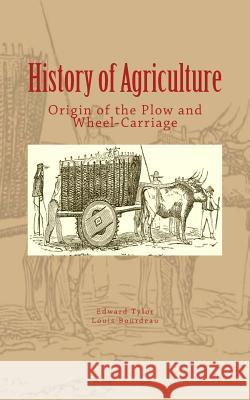
This book published in "History and Civilization Collection" deals with the History of Agriculture and the Origin of the Plow and Wheel-Carriage. (With illustrations) "Not only the beginning of agriculture, but the invention of the plow itself, is prehistoric. The plow was known to the ancient Egyptians and Babylonians, and the very existence of these nations points to previous thousands of years of agricultural life, which alone could have produced such dense, settled, and civilized populations..."
This book published in "History and Civilization Collection" deals with the History of Agriculture and the Origin of the Plow and Wheel-Carriage. (Wit...
David A. Wells History and Civilization Collection
This book deals with the History of Taxation and the struggle against arbitrary system of taxation. What is the place of taxation in ancient civilizations and how has it evolved in our present countries (United States of America, England, France, Switzerland, Germany, Japan, China, India...)?
This book deals with the History of Taxation and the struggle against arbitrary system of taxation. What is the place of taxation in ancient civilizat...