In this final paper on quantum gravity, we amend our previous conclusion (see "Observations on the Quantum Mechanical Nature of Gravity") that the motion of mass alone gives rise to the magnetic force. Instead, we conclude that magnetic fields are generated by the motion of both the electric and gravitational charges. In addition, we determine that the photon and the graviton are the same particle; i.e. there is one (massless) gauge boson that couples to the 'total' charge of a particle; be it mass, or mass plus electric charge
In this final paper on quantum gravity, we amend our previous conclusion (see "Observations on the Quantum Mechanical Nature of Gravity") that the mot...
This paper explores and develops the ideas presented in -A quantum mechanical theory of gravitational interactions-. A satisfactory unification of the four forces can be achieved if we assume the electron neutrino is a point magnetic charge corresponding to the point electric charge of the electron. This is not to be confused with the idea of the classical magnetic monopole. The neutrino is assumed, however, to have a magnetic moment. This leads to the conclusion that magnetic fields are caused by the moton of mass rather than charge. The predicted value of the magnetic moment of the electron...
This paper explores and develops the ideas presented in -A quantum mechanical theory of gravitational interactions-. A satisfactory unification of the...
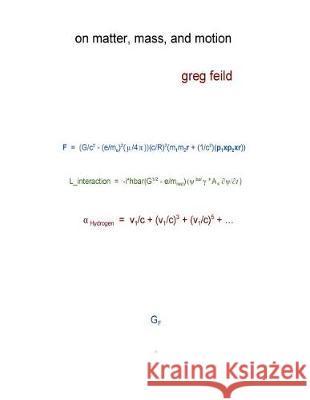
This book is an overview of the 'universal model' of physics, which we have recently derived or induced over the course of five previous books; warts and all The universal model aspires to be a fully relativistic, quantum mechanical field description of all particle interactions. It should work on all scales; from the microscopic, to the macroscopic, to the cosmic. It also seems it should be gauge invariant and re-normalizable. This 'new' model is essentially the current standard model with a lot of pruning and a few new assumptions; mainly concerning the mass and magnetic moment of the...
This book is an overview of the 'universal model' of physics, which we have recently derived or induced over the course of five previous books; warts ...
In this paper, we continue our interpretation of the investigations of physics as the science of mass in motion. The universe is sinister, but it is no longer spooky.
In this paper, we continue our interpretation of the investigations of physics as the science of mass in motion. The universe is sinister, but it is n...