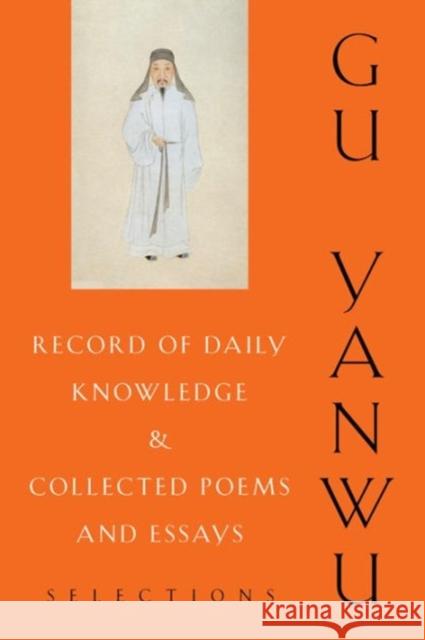
Gu Yanwu pioneered the late-Ming and early Qing-era practice of Han Learning, or Evidential Learning, favoring practical over theoretical approaches to knowledge. He strongly encouraged scholars to return to the simple, ethical precepts of early Confucianism, and in his best-known work, Rizhi lu (Record of Daily Knowledge), he applied this paradigm to literature, government, economics, history, education, and philology. This volume includes translations of selected essays from Rizhi lu and Gu Yanwu's Shiwen Ji (Collected Poems and Essays), along with an...
Gu Yanwu pioneered the late-Ming and early Qing-era practice of Han Learning, or Evidential Learning, favoring practical over theoretical approaches t...
The story is set in an unnamed penal colony. Internal clues and the setting on an island suggest Octave Mirbeau's The Torture Garden as an influence. As in some of Kafka's other writings, the narrator in this story seems detached from, or perhaps numbed by, events that one would normally expect to be registered with horror. In the Penal Colony describes the last use of an elaborate torture and execution device that carves the sentence of the condemned prisoner on his skin in a script before letting him die, all in the course of twelve hours.
The story is set in an unnamed penal colony. Internal clues and the setting on an island suggest Octave Mirbeau's The Torture Garden as an influence. ...