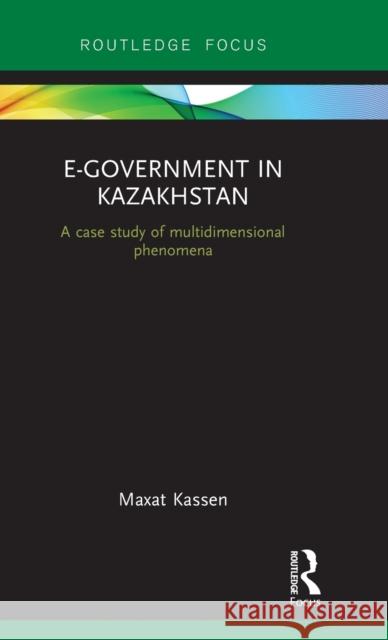
The main purpose of the book was to analyze heterogeneous political and institutional aspects in the development of such an arguably universal tool of modern democracy as e-government from the perspectives of two nations with completely different systems of governance and traditions of public administration and provide generalizations on objective institutional limitations that indirectly affect the implementation of political and administrative decision-making in this area by governments of the United States and Kazakhstan, representing respectively the typical federal and unitary state....
The main purpose of the book was to analyze heterogeneous political and institutional aspects in the development of such an arguably universal tool of...
When it comes to analyzing the phenomenon of digital government, the overwhelming focus is on the most developed nations in the world, and Western countries in particular. However, Kazakhstan, a post-totalitarian country, has also proved to be successful in the development of e-government.
This book analyzes e-government development in Kazakhstan from a multitude of dimensions, including, but not limited to, political, social, economic and technological platforms. It examines the adoption of a wide range of technology-driven public sector projects and identifies the key...
When it comes to analyzing the phenomenon of digital government, the overwhelming focus is on the most developed nations in the world, and Western ...