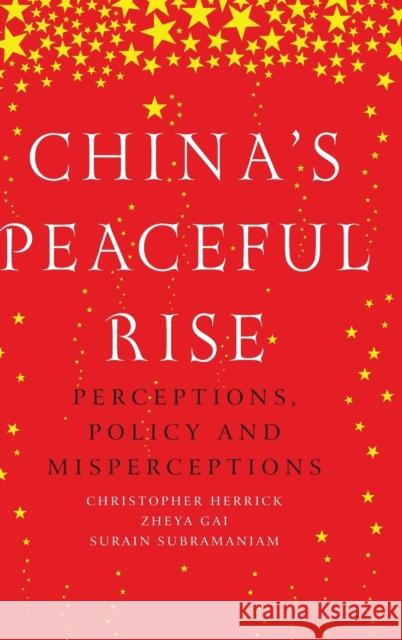
China's rise to great-power status is one of the most significant issues of the twenty-first century. Will the People's Republic be able to complete this process peacefully? And what are the security, economic and governance implications for the rest of the world?
The majority of scholars approach these questions from one of two perspectives: competitive security and power (realism) or complementary economic self-interest (liberalism). In this book, Christopher Herrick, Zheya Gai and Surain Subramaniam offer a constructivist alternative, arguing that China's prospects for...
China's rise to great-power status is one of the most significant issues of the twenty-first century. Will the People's Republic be able to complet...
Can China peacefully attain great power status in the twenty-first century? Adopting a constructivist approach, the book argues that China's prospects for achieving great power status peacefully depend more on Chinese and international perceptions of China's rise/development than on concrete measures of power or economic benefits, because power considerations and economic self-interest reflect shifting perceptions that have their roots in factors, such as historical experience and national image. Incorporating historical perceptions, survey data and general analysis, the book explores Chinese...
Can China peacefully attain great power status in the twenty-first century? Adopting a constructivist approach, the book argues that China's prospects...