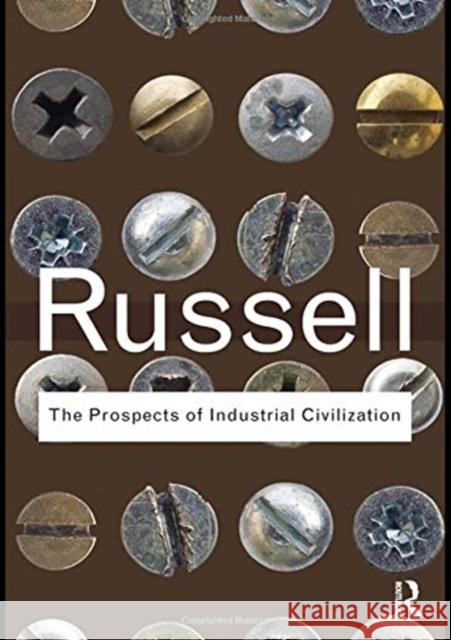
First published in 1923, The Prospects of Industrial Civilization is considered the most ambitious of Bertrand Russell's works on modern society. It offers a rare glimpse into often-ignored subtleties of his political thought and in it he argues that industrialism is a threat to human freedom, since it is fundamentally linked with nationalism. His proposal for one government for the whole world as the ultimate solution, along with his argument that the global village and prevailing political democracy should be its eventual results, is both provocative and thoroughly...
First published in 1923, The Prospects of Industrial Civilization is considered the most ambitious of Bertrand Russell's works on modern s...
Bertrand Arthur William Russell, 3rd Earl Russell, was born May 18, 1872 and died February 2, 1970. He was a British philosopher, as well as a logician, mathematician, historian, writer, and social critic. He was a political activist and Nobel laureate. His work contributed significantly to the advancement of logic, mathematics, set theory, linguistics, artificial intelligence, cognitive science, and computer science.
Bertrand Arthur William Russell, 3rd Earl Russell, was born May 18, 1872 and died February 2, 1970. He was a British philosopher, as well as a logicia...
In the following pages I have confined myself in the main to those problems of philosophy in regard to which I thought it possible to say something positive and constructive, since merely negative criticism seemed out of place. For this reason, theory of knowledge occupies a larger space than metaphysics in the present volume, and some topics much discussed by philosophers are treated very briefly, if at all.
In the following pages I have confined myself in the main to those problems of philosophy in regard to which I thought it possible to say something po...
In the following pages I have confined myself in the main to those problems of philosophy in regard to which I thought it possible to say something positive and constructive, since merely negative criticism seemed out of place. For this reason, theory of knowledge occupies a larger space than metaphysics in the present volume, and some topics much discussed by philosophers are treated very briefly, if at all.
In the following pages I have confined myself in the main to those problems of philosophy in regard to which I thought it possible to say something po...