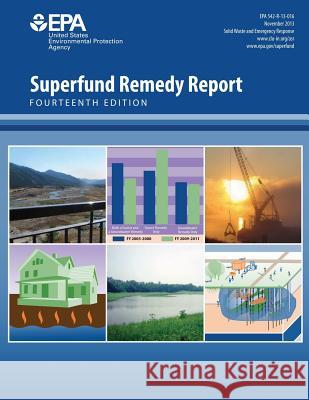
The U.S. Environmental Protection Agency (EPA) prepared the Superfund Remedy Report (SRR) 14th Edition to provide information and analyses on remedies selected to address contamination at Superfund sites. The EPA is particularly interested in documenting and disseminating information on innovative treatment technologies that advance its mission of protecting human health and the environment at contaminated sites. This report is the latest in a series, prepared since 1991, on Superfund remedy selection. The SRR 14th Edition focuses on the analysis of Superfund remedial actions from fiscal...
The U.S. Environmental Protection Agency (EPA) prepared the Superfund Remedy Report (SRR) 14th Edition to provide information and analyses on remedies...
This National Water Program Guidance (Guidance) for fiscal year (FY) 2014 describes how the Environmental Protection Agency (EPA), states, territories, and tribal governments will work together to protect and improve the quality of the Nation's waters, including wetlands, and ensure safe drinking water. Within EPA, the Office of Water (OW) oversees the delivery of the national water programs, while the regional offices work with states, tribes, territories, and others to implement these programs and other supporting efforts. In drafting this Guidance, OW recognizes that the federal budget is...
This National Water Program Guidance (Guidance) for fiscal year (FY) 2014 describes how the Environmental Protection Agency (EPA), states, territories...
Cities employ a variety of measures to manage stormwater runoff. However, most do not take advantage of the stormwater utility benefits trees provide. Grey stormwater systems use curbs, gutters, drains, pipes, ponds, vaults, and outfalls to move water quickly to containment and/or treatment areas or to receiving waters. Alternatively, green stormwater systems manage stormwater on site with overflow ability, creating areas that mimic nature. Vegetation, swales, wetlands, buffer zones, and pervious surfaces capture, filter, and slow stormwater runoff. Volume is managed through...
Cities employ a variety of measures to manage stormwater runoff. However, most do not take advantage of the stormwater utility benefits trees provide....
This National Program Manager Guidance applies to the Office of Enforcement and Compliance Assurance (OECA), all U.S. Environmental Protection Agency (EPA) regional enforcement programs, and states and federally-recognized Indian tribes (tribes) implementing EPA-approved inspection and enforcement programs. 1 OECA coordinates with the regions, states and local agencies and consults with tribal governments as it designs, develops, implements and oversees national compliance and enforcement programs. Regional offices also work with states and local agencies and consult with tribes to implement...
This National Program Manager Guidance applies to the Office of Enforcement and Compliance Assurance (OECA), all U.S. Environmental Protection Agency ...
The mitigation of combined sewer overflows (CSOs) is a significant environmental and financial challenge, particularly for older urban communities where these overflows are most prevalent. Communities are increasingly examining more environmentally sustainable "green" alternatives for addressing these problems. These green solutions are often endorsed because of the additional environmental, social, and economic benefits they produce. A growing body of reports and case studies - briefly reviewed here - describes and attempts to quantify these benefits as economic impacts. Most estimates of...
The mitigation of combined sewer overflows (CSOs) is a significant environmental and financial challenge, particularly for older urban communities whe...
This document, the "Data Entry and Troubleshooting Guide" for the Shipper Tool, is the second of two guides available to help your company participate fully in the SmartWay Transport Partnership as a Shipper Partner. The Shipper Tool "Quick Start Guide" is a basic walk-through of the process of identifying, gathering, preparing, and submitting your data by using the SmartWay Shipper Partner Tool, and includes several worksheets referenced in this guide. (From this point on, this guide will refer to the SmartWay Shipper Partner Tool as the "Shipper Tool" or simply, the "Tool," for brevity.)...
This document, the "Data Entry and Troubleshooting Guide" for the Shipper Tool, is the second of two guides available to help your company participate...
In this guide you will learn about: 1) Basic SmartWay information, 2) Joining SmartWay Transport Partnership as a shipper company, 3) Understanding the details of the SmartWay partnership agreement, 4) Meeting software/hardware requirements for participating in the program, and 5) Gathering the necessary data to become a SmartWay Shipper Partner.
In this guide you will learn about: 1) Basic SmartWay information, 2) Joining SmartWay Transport Partnership as a shipper company, 3) Understanding th...
The SmartWay Shipper Tool is intended to help shippers estimate and assess their carbon, PM, and NOx emissions associated with goods movement in the U.S. freight rail and trucking sectors1 with a greater degree of sophistication than was possible with previous SmartWay tools. Shippers can track their freight-related emissions performance from year-to-year using the Tool and assess a range of strategies to improve the emissions performance of their freight operations, including selection of low-emissions carriers and implementation of operational strategies such as (but not limited to)...
The SmartWay Shipper Tool is intended to help shippers estimate and assess their carbon, PM, and NOx emissions associated with goods movement in the U...
This document is the User Guide for the OTAQ Fuels Program Registration (OTAQReg) online application. It describes the processes a user must follow to register; update their user profile; associate to companies as well as create, view, and edit companies. If you have any questions about the content, format, or policies for the Office of Transportation and Air Quality (OTAQ) please reference the Fuels Program website at http: //www.epa.gov/otaq/fuels/index.htm. If you have any general or technical questions related to the Central Data Exchange (CDX) you may contact any of the following:...
This document is the User Guide for the OTAQ Fuels Program Registration (OTAQReg) online application. It describes the processes a user must follow to...
This document is the User Guide for the OTAQ DC FUEL online application. It describes the process a user must follow to submit reports using DC FUEL. This document will cover registration, how to upload a file and submit a report, and how to view your copy of record. If you have any questions about the content, format, or policies for the Office of Transportation and Air Quality (OTAQ) please reference the Fuels Program website at http: //www.epa.gov/otaq/fuels/index.htm. If you have any general or technical questions related to the Central Data Exchange (CDX) you may contact any of the...
This document is the User Guide for the OTAQ DC FUEL online application. It describes the process a user must follow to submit reports using DC FUEL. ...